
If you’re deciding between hiring an SEO freelancer or an agency, the choice depends on your budget, goals, and project needs. Here’s the key takeaway:
- Freelancers are ideal for smaller budgets, short-term tasks, or personalized attention. They charge less, typically $50–$150/hour or $500–$2,500/month, and offer direct communication. However, they may struggle with large-scale projects and lack the resources of a team.
- Agencies are better for complex, large-scale campaigns or businesses aiming for growth. They provide a team of specialists, advanced tools, and scalability but come with higher costs – $3,000–$15,000+/month – and more formal processes.
Quick Comparison:
| Factor | Freelancer | Agency |
|---|---|---|
| Cost | $50–$150/hour, $500–$2,500/month | $100–$300/hour, $3,000–$15,000+/month |
| Scalability | Limited to solo capacity | Handles large projects with teams |
| Expertise | Specialized in specific areas | Broad expertise across SEO fields |
| Communication | Direct, informal | Structured, often through account managers |
| Speed | Faster onboarding, quicker task execution | Slower onboarding but simultaneous task handling |
Freelancers work well for startups or targeted projects, while agencies are better suited for long-term growth and multi-faceted campaigns. Start small with a trial project to find the best fit for your business.
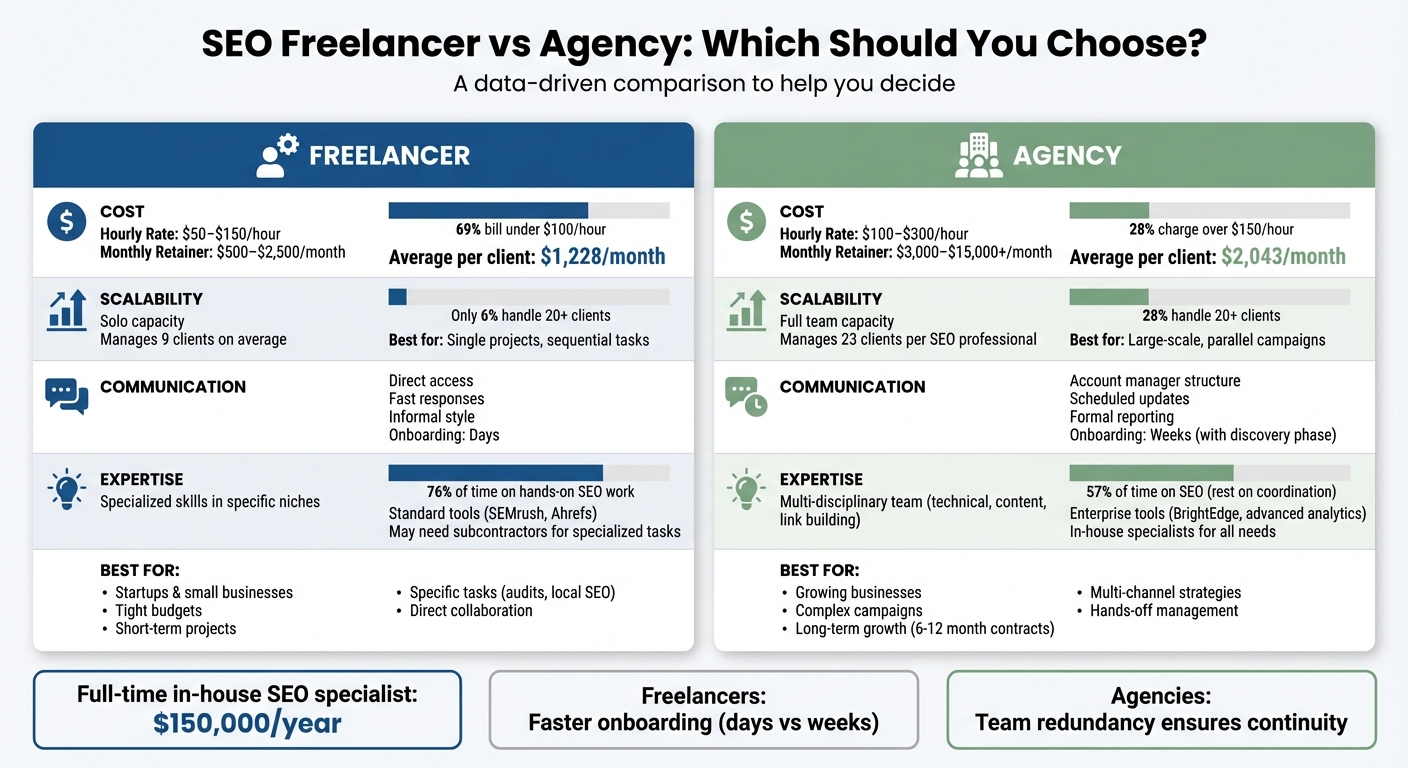
SEO Freelancer vs Agency: Cost, Scalability, and Expertise Comparison
SEO Freelancers: Pros and Cons
SEO freelancers are independent professionals who offer specialized services without the overhead of a large team. They’re often a great option for businesses with tight budgets or those needing help with specific, short-term projects. However, working with a solo professional does come with its challenges. Let’s break down the benefits and drawbacks of hiring SEO freelancers.
Benefits of Hiring Freelancers
One of the biggest perks of hiring freelancers is affordability. Their rates typically range from $50 to $150 per hour, with monthly retainers starting at $500 and going up to $2,500 or more. Compared to hiring a full-time SEO specialist, which can cost around $150,000 annually, freelancers are a much more budget-friendly option.
"Hiring SEO freelancers is cost-effective compared to having a full-time in-house specialist on board." – Neil Patel, Co-Founder of NP Digital
Freelancers also offer direct communication, which makes it easier to provide feedback and speed up project timelines. Many of them excel in specific areas like technical audits or local SEO, bringing expertise that generalists often lack. Their flexibility is another plus – they can often start working on your project within days, whereas agencies may need more time for discovery and planning phases.
Drawbacks of Hiring Freelancers
The main downside is scalability. Freelancers work alone, meaning their capacity is limited. If your business grows quickly or requires a large volume of work, a solo freelancer may struggle to keep up.
"Freelancers have very little oversight – they have nobody reviewing their work, communicating details, and providing feedback. In order for the partnership to run smoothly, an internal team member has to manage them." – Hannah Hicklen, Content Marketing Manager at Clutch
Availability can also be a challenge. Freelancers often juggle multiple clients, which might lead to inconsistent quality or limited availability during busy times. If they’re unavailable or need to take time off, there’s no backup team to step in, creating potential disruptions to your SEO strategy. Additionally, freelancers usually have a narrower skill set compared to agencies. For example, they might be great at optimizing content but lack the technical expertise for complex coding fixes. Plus, managing the project often becomes your responsibility.
Freelancer Comparison Table
Here’s a quick summary of the pros and cons:
| Pros | Cons |
|---|---|
| Lower service fees due to minimal overhead | Limited capacity to scale for large projects |
| Direct access to the person performing the work | Availability issues if serving multiple clients |
| Specialized skills in specific SEO niches | Narrower skill set compared to a multi-disciplinary team |
| Flexible schedules and project terms | Lack of internal oversight or quality assurance layers |
| Faster onboarding and project initiation | Responsibility for project management falls on the client |
SEO Agencies: Pros and Cons
SEO agencies bring specialized teams to the table, making them well-suited for managing complex campaigns. However, this expertise often comes with higher costs and added layers of communication. Here’s a closer look at what working with an agency entails.
Benefits of Hiring Agencies
Unlike freelancers who provide a more individualized service, agencies offer a team-based approach. One of the standout advantages is the access to a diverse range of expertise. Instead of depending on a single person’s skills, you gain a team of specialists covering every aspect of SEO. Bruce Clay, Founder and President of Bruce Clay Inc., highlights this benefit:
"An SEO agency should be a think tank of experienced, savvy analysts. Their experience and talent, coupled with access to talented peers, tools and data, is an invaluable resource for any business."
Agencies also invest in high-end tools like Semrush, Ahrefs, and Jira – subscriptions that can cost thousands each year. These tools provide deeper insights and more accurate data to shape strategies. Additionally, agencies can scale their efforts to manage multiple campaigns simultaneously, making them ideal for businesses aiming for rapid growth or tackling large-scale projects.
Another advantage is redundancy. If a team member becomes unavailable, others can step in to maintain continuity. Established processes and quality control measures also ensure deliverables align with your goals, helping campaigns stay on track without sacrificing quality.
Finally, agencies bring a wealth of experience from working across various industries. This broader perspective allows them to apply proven strategies from one sector to another. Jackie Chu, SEO Intelligence Lead at Uber, explains:
"The exposure to sites of different sizes and the SEO savviness one can get inside an agency are unparalleled. Experience is a superpower in SEO."
Despite these strengths, agencies aren’t without their challenges.
Drawbacks of Hiring Agencies
Cost is one of the biggest hurdles when working with an agency. Monthly retainers typically range from $3,000 to $15,000 or more, with hourly rates between $100 and $300. These prices reflect not only the expertise of the team but also the overhead costs for salaries, office space, and management infrastructure.
Communication can also be a point of frustration. Instead of speaking directly with the person handling your project, you’ll often work through an account manager. This added layer can sometimes lead to delays or miscommunication. As SEO Specialist Gordon Ibarra puts it:
"It’s like ordering a pizza from a big chain – everyone has a role, but you might go through three people just to swap the toppings."
Another drawback is divided attention. Agencies manage multiple clients, so you may not receive the same level of one-on-one focus as you would with a freelancer. Some agencies also lean on standardized strategies that might not fully address your unique business needs.
Employee turnover is another challenge. With team members often staying for only two years on average, frequent changes can disrupt continuity, forcing you to reintroduce your goals to new staff. Finally, the structured onboarding and approval processes typical of larger agencies can slow down project timelines compared to working with a solo consultant.
Agency Comparison Table
| Pros | Cons |
|---|---|
| Access to a full team of specialists (technical, content, link building) | Higher monthly costs due to overhead and infrastructure |
| Enterprise-grade tools and advanced analytics | Shared attention across multiple client accounts |
| High scalability for large campaigns and rapid growth | Potential for standardized, one-size-fits-all strategies |
| Redundancy ensuring continuity | Higher employee turnover can disrupt account continuity |
| Quality assurance measures and established workflows | Longer approval processes and bureaucratic structures |
| Broader industry perspective from cross-sector experience |
How Freelancers and Agencies Compare
Deciding between hiring a freelancer or an agency comes down to four key factors: your budget, how quickly you need to scale, your preferred communication style, and the expertise your business requires. These differences help determine the best fit for your needs.
Cost and Budget
Freelancers generally charge less than agencies. Their hourly rates typically range from $50 to $150, while agencies charge between $100 and $300 per hour. Monthly retainers show an even larger gap: freelancers usually charge $500 to $2,500+, compared to agencies at $3,000 to $15,000+.
Industry data shows that 69% of freelancers bill under $100 per hour, compared to only 34% of agencies. At the higher end, 10% of freelancers charge more than $150 per hour, while 28% of agencies operate at this rate. On average, freelancers earn $1,228 per client each month, while agencies bring in $2,043.
Freelancers tend to have lower overhead costs – they don’t deal with office spaces, management layers, or large team salaries. Agencies, however, bundle the costs of their entire team (strategists, writers, and technical experts) and enterprise-level tools into their pricing. As Gordon Ibarra, an SEO Specialist, puts it:
"Hiring an agency is like booking a resort. Hiring a freelancer is like renting a cabin – you pay for what’s included, and what’s not."
Freelancers also offer flexibility with short-term or per-project contracts. Agencies, on the other hand, often require 6 to 12-month commitments. If you need to scale down, freelancers are easier to adjust to, while agencies may require renegotiation.
For startups or small businesses on tight budgets, freelancers are a great option for specific tasks like audits or basic optimizations, especially if you have internal resources to implement recommendations.
Scalability and Resources
Cost aside, scalability plays a big role in long-term success. Agencies excel at managing large-scale projects by deploying full teams at once. They can handle multiple SEO tasks – technical fixes, content creation, and link outreach – all at the same time. Their teams include technical SEOs, writers, link builders, and data analysts, supported by enterprise-grade tools and project management platforms like Jira and Basecamp.
Agencies manage more clients overall, with their SEO professionals averaging 23 clients each, compared to freelancers, who manage just 9 clients. Additionally, 28% of agency SEOs handle over 20 clients, whereas only 6% of freelancers reach that level.
Freelancers, working solo, are better suited for focused, sequential tasks rather than juggling multiple complex initiatives. They often rely on standard tools like SEMrush or Ahrefs and may need to hire subcontractors for specialized tasks like web development or large-scale content creation.
Agencies also provide redundancy. If one team member is unavailable, another steps in to keep the project on track. With freelancers, a single illness or overbooked schedule can bring progress to a halt. Gordon Ibarra explains this difference well:
"Scaling with a freelancer is like adjusting a playlist; scaling with an agency, a planned concert."
If you’re managing a large-scale website, need international SEO, or require high volumes of content quickly, an agency is the better choice. For smaller, specific goals – like a one-time technical audit or local SEO for a single location – a freelancer might be the perfect fit.
Communication and Speed
How you communicate and the speed of execution are critical in SEO. Freelancers offer direct, personal communication. You’ll typically interact with them via email or messaging apps, allowing for quicker responses and a more informal style. Onboarding is fast – often just a few days after receiving website and analytics access. Freelancers can also pivot quickly based on your feedback.
Agencies follow a more structured approach. Communication often happens through an account manager, not directly with the specialists working on your project. This creates a more formal process, with scheduled updates and detailed reporting. Onboarding takes longer because agencies conduct discovery calls and technical audits before beginning optimization.
Hannah Hicklen, Content Marketing Manager at Clutch, sums it up:
"Freelancers are best if you want speed and personalized updates without heavy formalities. Agency processes tend to be slower but ensure consistency, detailed performance tracking, and alignment with long-term strategy."
While freelancers can start projects faster, agencies can handle high volumes of work simultaneously thanks to their team structure. As Gordon Ibarra notes:
"An agency might schedule a kickoff call two weeks out. A freelancer might already be halfway through the audit by then."
Agencies also reduce your management burden by having senior strategists review deliverables before they reach you, while freelancers may require more oversight.
Expertise and Strategy
Agencies bring a wealth of experience from working across various industries. They apply strategies proven in one sector to another and take a comprehensive, long-term approach to SEO. Their teams cover all aspects of SEO, including technical optimization, content strategy, link building, and analytics. They also use advanced tools like BrightEdge, which provide deeper insights but come at a high cost – tools typically included in agency fees.
Freelancers, on the other hand, offer more specialized expertise and personalized attention. However, their skill sets may be narrower, and they often lack in-house capabilities for tasks like web development or design.
Freelancers spend about 76% of their working hours on SEO tasks, while agency workers spend 57%, as they often delegate or handle administrative coordination. This means freelancers are more hands-on with the actual work, but agencies distribute tasks across team members for efficiency. Freelancers typically use standard SEO tools and may charge extra for access to specialized software.
If you need a multi-channel strategy with ongoing optimization across technical, content, and link-building fronts, go with an agency. If you prefer a hands-on approach or need focused expertise for a specific challenge, a freelancer is the better option.
Factor Comparison Table
| Factor | Freelancer Advantage | Agency Advantage | Best For |
|---|---|---|---|
| Cost | Lower rates ($50–$150/hour, $500–$2,500/month); minimal overhead; flexible terms | Bundled team expertise and enterprise tools; predictable pricing structure | Startups, small businesses, and specific tasks |
| Scalability | Focused execution on single projects; quick to adjust scope | Multiple specialists working in parallel; high-volume capacity | Niche projects or small sites vs. large, rapidly growing sites |
| Communication | Direct access, fast responses, and an informal style | Structured reporting through account managers with scheduled updates | Agile, direct collaboration vs. formal, scheduled processes |
| Speed | Rapid onboarding (days), instant pivots, and quick project starts | Slower onboarding but faster execution at scale with built-in quality assurance |
sbb-itb-7a53647
When to Hire an SEO Freelancer
Freelancers are a great option when you’re working with a tight budget, need help with specific tasks, or require quick results. While agencies often charge retainers ranging from $3,000 to $15,000 per month, freelancers typically charge between $500 and $2,500 per month, making them a more affordable choice for many businesses. Neil Patel, Co-Founder of NP Digital, sums it up well:
"Hiring SEO freelancers is cost-effective compared to having a full-time in-house specialist on board… you save money by working with them on a project-by-project base."
Freelancers are especially useful for short-term or clearly defined projects. If you need a one-time technical audit, a site migration, or a targeted link-building campaign, hiring a freelancer for $500 to $5,000 is often more practical than committing to a long-term agency contract. They also make excellent additions to your existing team – whether your in-house staff is overloaded or you need someone to tackle time-intensive tasks like cold-emailing for backlinks.
For time-sensitive projects, freelancers can often deliver faster results with more direct communication. Ryan Tronier, SEO Editor, explains:
"A solo SEO freelancer can lift your rankings faster than a bloated agency process."
Freelancers are also a smart choice if you’re planning to eventually bring SEO in-house. They can help establish your foundation – setting up tools like Google Analytics and Search Console, addressing technical aspects, and laying the groundwork for your team to take over later. Many freelancers also act as mentors, guiding you through the basics while handling the initial heavy lifting. Starting with a smaller project, like a technical audit, can help you evaluate their skills and communication style before committing to a longer-term arrangement. Just ensure they use white hat SEO practices to avoid penalties that could harm your rankings.
When to Hire an SEO Agency like Organic Media Group

Hiring an SEO agency makes sense when your business faces complex SEO challenges that involve technical optimization, content creation, and link building all at once. If you’re planning for long-term growth and need to scale quickly – whether that means producing a higher volume of content or increasing backlinks – an agency’s resources and expertise can meet those demands. This comprehensive approach often shifts the focus from cost to value. As Bruce Clay, Founder and President of Bruce Clay Inc., explains:
"An SEO agency should be a think tank of experienced, savvy analysts… Their experience and talent, coupled with access to talented peers, tools and data, is an invaluable resource for any business."
While agencies typically charge between $3,000 and $15,000+ per month, they save businesses from the expense of hiring, training, and managing an in-house SEO team. For example, employing a single experienced SEO professional in-house can cost over $150,000 annually. Yaseen Sadan from SaaSpirin highlights this benefit:
"The biggest benefit of hiring an SEO agency is gaining access to professionals specializing in every part of SEO, such as technical SEO, content writing, and backlink building."
If managing multiple freelancers or overseeing daily SEO tasks feels overwhelming, an agency simplifies the process by offering a single point of contact. With structured project management, they only require 30–60 minutes of your time each week for updates, freeing you from the need for constant oversight. For businesses aiming to build domain authority, Organic Media Group specializes in targeted link building and guest posting services, backed by a proven track record.
Agencies are particularly valuable when your focus is on ROI and conversions, not just driving more traffic. The best agencies target high-buying-intent keywords and prioritize bottom-of-the-funnel strategies that directly impact revenue. They also bring an unbiased, outside perspective, which can help avoid the tunnel vision that sometimes affects internal teams. If your business is entering a growth phase, starting with a comprehensive audit is a smart move. Agencies can identify technical and content gaps, setting the stage for successful large-scale campaigns.
How to Make Your Decision
When deciding between hiring a freelancer or an agency for your SEO needs, it’s essential to weigh key factors like your budget, in-house expertise, project scope, and timeline. If your budget is tight and you’re confident managing your SEO strategy, a freelancer charging between $50–$150 per hour could be a practical choice. On the other hand, if you prefer a more hands-off approach, an agency’s monthly retainer offers a comprehensive solution.
Take a close look at your internal SEO knowledge. As Bruce Clay, Founder of Bruce Clay Inc., advises:
"The bottom line is that you do not want to know more than the agency you’re hiring".
If your team lacks the expertise to shape an effective strategy, an agency can serve as your external brain trust. However, freelancers are ideal if you already have a solid grasp of SEO and need help with specific tasks, such as technical audits or content optimization. Once you’ve assessed your capabilities, the next logical step is to test your chosen option before fully committing.
Start small with a pilot project – hire a freelancer for a one-time audit or engage an agency for a three-month trial. Request reports focused on tangible results like leads and revenue, rather than vanity metrics. Also, ensure your contract grants you ownership of all content, backlinks, and account access after the partnership ends.
Scalability is another crucial factor. For businesses with large, complex websites or ambitious growth plans, agencies bring the resources to scale quickly across multiple channels. Freelancers, while excellent for specific tasks like optimizing a WordPress site for local search, may struggle with managing expansive, multi-specialist campaigns. If your website is smaller and your goals are more targeted, a freelancer’s flexibility and direct communication can often yield quicker results.
FAQs
Should I hire an SEO freelancer or an agency?
Choosing between an SEO freelancer and an agency comes down to your budget, project needs, and long-term plans. Freelancers are often the go-to choice for smaller, more specific tasks like site audits, keyword research, or short-term link-building campaigns. They typically offer a more personalized, hands-on approach, making them a solid option for small businesses or startups working with limited funds and clear, short-term objectives.
On the other hand, agencies bring a team of experts who can tackle broad, long-term strategies. They’re a better fit for larger businesses or those looking for a full-service solution that includes technical SEO, content creation, and ongoing campaign management. While agencies usually charge higher fees, they offer the advantage of scalability, professional-grade tools, and the ability to manage multiple campaigns simultaneously.
If your goal is sustained growth, partnering with an agency like Organic Media Group can provide customized strategies to drive organic traffic, generate leads, and increase sales. Weigh your budget, timeline, and available resources to decide which option best suits your business goals.
What are the cost differences between hiring an SEO freelancer and an agency?
Freelancers often charge more affordable rates, typically around $75 per hour or roughly $500 per month. On the other hand, agencies tend to come with a heftier price tag, with fees ranging from $100 per hour to anywhere between $500 and $10,000 per month, depending on the project’s size and complexity.
The cost difference reflects the services provided. Freelancers can be a budget-friendly option, but agencies justify their higher fees by offering a wider array of services, access to advanced tools, and the advantage of a collaborative team. Deciding between the two comes down to your specific business needs, budget, and the level of expertise you’re looking for.
Are freelancers capable of managing large-scale SEO projects?
Freelancers are capable of handling large-scale SEO projects, but their success often hinges on the complexity of the project and their individual skill set. Many freelancers shine in specialized areas like content creation or technical SEO. However, they usually don’t have access to the broad resources or the collaborative team dynamics that agencies bring to the table.
When it comes to extensive campaigns that demand a mix of strategies – like link building, on-page optimization, and content marketing – agencies tend to be better suited. Their team-based structure and access to diverse expertise allow them to manage these multi-faceted efforts more efficiently.