
Content gap analysis is the process of identifying what your website is missing – topics, keywords, or formats that your competitors are ranking for and your audience is actively searching. By addressing these gaps, you can attract more traffic, improve rankings, and meet your audience’s needs at every stage of their journey.
Here’s what you need to know:
- Purpose: Discover missing keywords, underperforming topics, and overlooked formats to boost visibility and authority.
- Benefits: Better rankings, increased traffic, and optimized content for search engines and AI tools like ChatGPT.
- Key Areas to Analyze:
- Keyword Gaps: Competitors rank for terms you don’t.
- Topic Gaps: Missing coverage of broader subject clusters.
- Quality Gaps: Outdated or shallow content compared to competitors.
- Format Gaps: Lack of diverse formats like videos, infographics, or tools.
- Steps to Perform: Identify competitors, gather keyword data, analyze gaps, evaluate search intent, prioritize opportunities, and create a content plan.
Regular content gap analysis ensures your site stays relevant, aligns with user intent, and maintains visibility across search engines and AI platforms. This guide breaks down actionable steps to help you close gaps, improve rankings, and engage your audience effectively.
Why Content Gap Analysis Matters for SEO
Content gap analysis takes the guesswork out of SEO and turns it into a strategy driven by data. By identifying the keywords and topics your competitors rank for – but your site doesn’t – you can create content that fills those gaps and attracts that untapped audience. This approach ensures every piece of content you produce is aimed at an audience that’s already searching for it.
Filling these gaps consistently helps establish your site as an authority in your niche. When you cover a topic thoroughly, search engines like Google recognize your site as a reliable resource, rewarding you with better rankings across related search terms. The more comprehensive your coverage, the more likely you are to dominate your topic.
"Content isn’t king, it’s the kingdom. And finding the uncharted territories in that kingdom is where true SEO success begins." – Kyle Roof, Co-Founder, PageOptimizer Pro
Content gap analysis isn’t just about traditional search anymore. It’s also key for Generative Engine Optimization (GEO) – ensuring your brand appears in AI-generated results from tools like ChatGPT. This dual-layer visibility, across both search engines and AI platforms, keeps your strategy relevant as user behavior evolves. Plus, the analysis helps you uncover long-tail keywords – those less competitive but high-converting phrases – that can deliver quick wins while you work toward larger traffic goals.
Most importantly, content gap analysis ensures your content aligns with every stage of the buyer’s journey, from initial awareness to the final decision-making process. When your site provides answers at every step, visitors are more likely to stay, engage, and convert, rather than heading to a competitor. This thorough coverage not only improves rankings but also enhances user experience by reducing bounce rates and driving more conversions.
Types of Content Gaps
Content gaps come in various forms, and identifying the right type is key to improving your SEO strategy. Below are the four primary categories that can affect your site’s performance.
Keyword Gaps
Keyword gaps occur when your competitors rank for search terms that you either don’t rank for at all or rank poorly for. These gaps fall into two categories: "missing keywords", where you have no presence, and "weak keywords", where your rankings lag behind competitors. For example, a comparison between CarMax and Cars.com revealed that CarMax was missing over 500,000 keywords, translating to a potential loss of 114,834,902 visits. That’s a massive amount of traffic left on the table.
"Identifying competitor keyword gaps uncovers high-impact opportunities to expand visibility across the search landscape." – Mitul Gandhi, Co-Founder and Chief Architect, seoClarity
To address this, start by targeting keywords with difficulty scores below 65, as these are easier to rank for. Focus on terms with commercial intent first, as they tend to deliver quicker returns by attracting users who are ready to make a purchase. Instead of creating thin pages for individual keywords, group related terms into well-rounded content pieces that thoroughly cover the topic.
Topic Gaps
Topic gaps go beyond keywords – they represent entire areas of content missing from your site. While keyword gaps are about specific queries, topic gaps reflect incomplete coverage of broader subject clusters. If your content doesn’t fully address a topic, Google may view it as insufficient, which can hurt your rankings across the entire cluster.
"Search engines like Google reward web pages that offer comprehensive, relevant content by ranking them higher, leading to increased visibility." – Bernard Huang, Co-founder, Clearscope
To close topic gaps, evaluate your content clusters to ensure they address informational, commercial, and transactional intent. Collaborate with your sales and support teams to uncover "question gaps" – common customer concerns or queries that aren’t addressed on your site. These insights often reveal opportunities that keyword tools might miss.
It’s not just about covering more ground; the depth and quality of your content also matter.
Quality Gaps
Quality gaps arise when your content falls short compared to competitors in terms of depth, accuracy, or user experience. These gaps can weaken your E-E-A-T (Experience, Expertise, Authoritativeness, and Trustworthiness) signals. For instance, content that hasn’t been updated in over two years is often seen as outdated by both search engines and AI models, which prioritize recent information.
"Common content gaps include: Content freshness, Thoroughness, Usability, and Wow factor." – Backlinko
To bridge quality gaps, include proprietary data, unique case studies, or expert insights that make your content stand out. First-hand experiences and expert opinions are especially valuable under Google’s E-E-A-T framework. Manually review top-ranking competitor pages to identify specific elements – like media, references, or sub-topics – they include that your content lacks.
The way you present your content also plays a critical role in its effectiveness.
Format Gaps
Format gaps happen when competitors leverage content types that you don’t, such as videos, infographics, podcasts, or interactive tools. Even if your written content performs well, missing out on these formats can reduce click-through rates.
The data is clear: 91% of businesses use video as a marketing tool, and 82% of consumers say a video has influenced their decision to make a purchase. To address format gaps, use structured data and incorporate formats like FAQs, short definitions, or step-by-step guides to increase your chances of capturing Featured Snippets. Tailor your formats to the buyer’s journey – blog posts might work best for awareness, while comparison guides or video demos are ideal for decision-making stages.
How to Perform a Content Gap Analysis
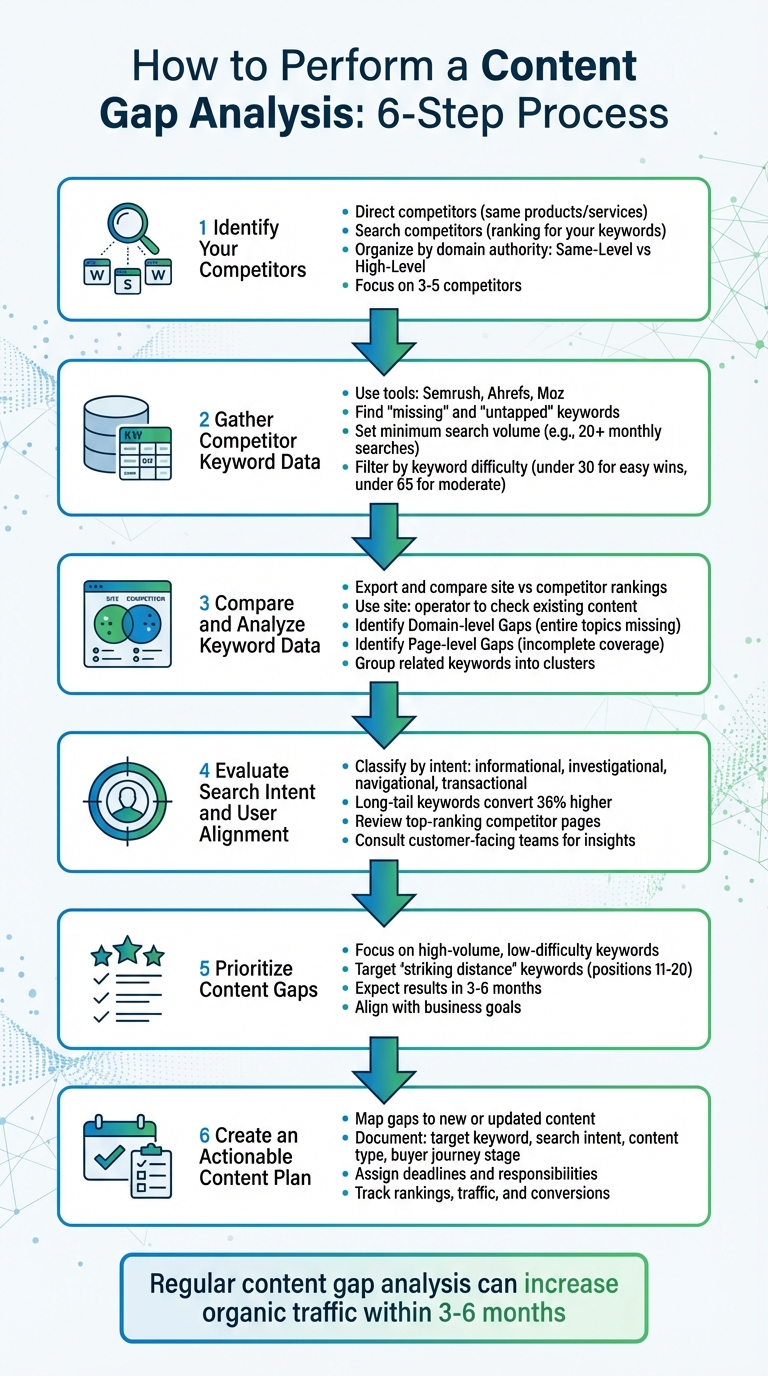
6-Step Content Gap Analysis Process for SEO
A content gap analysis helps you spot opportunities your competitors are leveraging and identify areas where you’re missing out on traffic. Here’s a step-by-step guide to get started.
Step 1: Identify Your Competitors
Start by distinguishing between two types of competitors: direct competitors (those offering the same products or services) and search competitors (websites ranking for your target keywords, such as blogs or review sites). This is important because direct competitors can highlight transactional gaps, while search competitors often reveal gaps in informational or top-of-funnel content.
Organize competitors based on domain authority into two groups: Same-Level (realistic ranking opportunities) and High-Level (long-term goals for building authority).
To find search competitors, search for your industry’s core terms (e.g., "project management software") and note the top 5–10 organic results. Tools like Semrush or Ahrefs can also help identify domains that share ranking keywords with your site. Focus your analysis on 3–5 competitors and manually verify their relevance before moving to the next step.
Step 2: Gather Competitor Keyword Data
Leverage tools like Semrush, Ahrefs, or Moz to uncover "missing" keywords – terms your competitors rank for but you don’t – and "untapped" keywords where at least one competitor ranks but you don’t.
Free tools like Google Search Console can help identify "striking distance" keywords – terms where you rank just outside the top positions – and Google Analytics 4 can reveal pages with declining organic traffic, pointing to areas that need improvement.
When exporting data, filter out irrelevant terms like competitor brand names or misspellings. Set a minimum search volume threshold (e.g., 20 monthly searches) and apply keyword difficulty filters to focus on attainable opportunities (e.g., under 30 for easier wins or under 65 for moderately challenging terms).
With this data in hand, proceed to Step 3 to identify precise gaps.
Step 3: Compare and Analyze Keyword Data
Export your site’s rankings alongside competitor data and compare them to pinpoint gaps. Use the "site:" operator (e.g., site:yourdomain.com "keyword") to confirm whether content already exists on your site. This helps avoid keyword cannibalization and determines whether you need to create new content or update existing pages.
Break gaps into two categories:
- Domain-level Gaps: Entire topics your site hasn’t addressed.
- Page-level Gaps: Topics you’ve covered but not as thoroughly as competitors.
Here’s a quick breakdown:
| Gap Type | What It Means |
|---|---|
| Missing Keywords | Keywords all competitors rank for, but you don’t. |
| Untapped Keywords | Keywords at least one competitor ranks for, but you don’t. |
| Striking Distance | Keywords where you rank in positions 11–20. |
| Page-Level Gaps | Keywords you rank for, but competitors offer more comprehensive content. |
Consider grouping related keywords into clusters. For instance, instead of creating separate pages for "improve cash flow" and "cash flow management", you could combine them into one in-depth resource, which often performs better.
This groundwork prepares you to evaluate search intent in Step 4.
Step 4: Evaluate Search Intent and User Alignment
Not every gap is worth pursuing. Assess whether competitor content better meets user intent and aligns with the buyer’s journey. Classify gaps by search intent – informational, investigational, navigational, or transactional.
Long-tail keywords often convert better, with a 36% higher average conversion rate than short-tail terms. Review top-ranking competitor pages to understand why they perform well. Look for elements like exclusive data, expert quotes, first-hand insights, or thorough subtopic coverage. Additionally, consult customer-facing teams to uncover questions or objections that traditional keyword tools might miss.
Once you’ve analyzed intent, prioritize gaps based on volume, difficulty, and relevance.
Step 5: Prioritize Content Gaps
Focus on high-volume, low-difficulty keywords that align with your business goals. Pay special attention to terms where you already rank (e.g., positions 11–20) but competitors outrank you – these "traffic lift" opportunities often require less effort to improve rankings. Regularly performing content gap analyses can lead to noticeable organic traffic growth within 3 to 6 months.
Step 6: Create an Actionable Content Plan
Turn your findings into a clear plan. Map gaps to new or updated content opportunities that align with your objectives. Decide whether to create new cornerstone content or improve existing pages – updating content often delivers faster results.
"Don’t be afraid to cannibalize your own content. Sometimes, one amazing comprehensive piece performs better than three mediocre ones covering similar topics."
– Kyle Roof, Co-Founder & Lead SEO, PageOptimizer Pro
For each gap, document the target keyword, search intent, content type, and buyer’s journey stage. Assign deadlines and responsibilities, and track results by monitoring rankings, traffic, and conversions.
sbb-itb-7a53647
Advanced Techniques for Content Gap Analysis
Building on the basics of identifying keyword, topic, quality, and format gaps, advanced strategies take your SEO efforts to the next level by refining how you approach content creation and optimization.
Mapping Content to Buyer Journey and Geographic Markets
A common pitfall in content strategies is overemphasizing the awareness stage while neglecting the mid-funnel (MOFU) and bottom-funnel (BOFU) stages. Missing key details like pricing, implementation, or product comparisons at these stages can lead users to abandon your site. To counter this, conduct a thorough audit of your content across all three stages of the buyer journey: Awareness, Consideration, and Decision.
Geographic targeting adds another dimension to content optimization. 64% of technology buyers prefer content tailored to their specific region or country, but only 26% of marketers focus on localization efforts. Regional preferences also vary in terms of content formats. For example, 60% of respondents in APAC are more likely to engage with infographics, compared to 47% in North America. Instead of treating localization as an afterthought, integrate it during the campaign planning phase to ensure your messaging resonates with regional audiences.
| Buyer Journey Stage | Content Goal | Regional Format Preferences |
|---|---|---|
| Awareness (TOFU) | Define problems and pain points | Blog posts, e-books, podcasts, educational videos |
| Consideration (MOFU) | Compare potential solutions | Case studies, white papers, webinars, comparison pages |
| Decision (BOFU) | Reinforce final decision | Product demos, pricing guides, free trials, testimonials |
Once you’ve aligned your content with the buyer journey and regional needs, AI tools can help uncover deeper insights.
Using AI and LLMs for Content Insights
Interestingly, 90% of ChatGPT’s citations come from search results ranked below position 20. This highlights a shift in focus for content gap analysis: instead of solely aiming for top rankings, pay attention to citation probability – the likelihood that your content is referenced by AI models.
To capitalize on this, create an LLM (Large Language Model) matrix that prioritizes prompts related to your key business features. Then, analyze your visibility gaps for these specific queries. Companies leveraging entity-level mapping and revenue scoring for AI-driven search results have reported an average 15–20% recovery in traffic share and an 11% boost in incremental organic revenue within six months.
"We build an LLM matrix that contains prompts prioritized by features and solutions highly important to our clients. And we then analyze LLM visibility gaps for these prompts." – Ajdin Perco, Director of Content, Automation/AI, and Ops, Organic Growth Marketing
To improve your chances of being cited in AI-generated summaries, develop schema-ready content briefs. These should include specific entities, related questions, and internal link suggestions to help LLMs map relationships effectively. When AI Overviews appear in search results, clicks to traditional organic results drop by 25%, but URLs included in these overviews retain 68% of their prior click volume.
These AI-driven insights pave the way for enhancing the quality of your content using E-E-A-T principles.
Improving Content Quality with E-E-A-T
The E-E-A-T framework (Experience, Expertise, Authoritativeness, Trustworthiness) pushes content gap analysis beyond keywords and into the realm of quality and credibility. Addressing these factors strengthens your competitive edge by filling gaps uncovered during competitor analysis.
One way to achieve this is through original research – such as conducting surveys, product testing, or industry studies – to provide data that competitors can’t easily replicate. Regularly update your content, especially if it’s older than two years or hasn’t been revised in over 90 days.
Incorporate expert quotes to meet Google’s Expertise criteria, and use schema markup (e.g., FAQ, HowTo, Article, or Product) to make it easier for search engines and AI tools to process and cite your content. With 26% of searchers ending their session after reading an AI-generated summary, ensuring your content appears in AI Overviews is crucial for maintaining traffic.
Integrating Content Gap Analysis into Your SEO Strategy
Identifying missing keywords or topics is just the starting point of content gap analysis. The real impact comes from incorporating these insights into your overall SEO strategy to achieve measurable results. It’s about bridging the gap between what your competitors rank for and what your audience needs at every stage of their buying journey. This approach naturally builds on the advanced techniques we’ve discussed earlier.
Aligning with Business Goals
When addressing content gaps, focus on search volume, keyword difficulty, and their relevance to your products or services. For instance, a keyword with 10,000 monthly searches won’t help if it doesn’t align with your offerings or if your audience isn’t ready to take action.
Organize your content to match the buyer’s journey stages: Awareness (identifying problems), Consideration (exploring solutions), Decision (encouraging conversions), and Success (supporting customer retention). This ensures your content not only attracts visitors but also guides them through the funnel. Without robust on-site content, potential customers may turn to competitors to find the answers they’re looking for.
Audit your existing pages and update underperforming content. Often, one strong, well-rounded article can outperform several weaker ones. Strategically addressing these gaps can strengthen your site’s authority, signaling to search engines that your site offers a comprehensive resource on key topics. To stay ahead, consider incorporating Generative Engine Optimization (GEO) by identifying prompts where competitors appear in AI-generated responses but your brand does not. Setting priorities now will prepare you for the adjustments outlined below.
Monitoring and Adjusting Your Strategy
Regular monitoring is crucial to prevent gaps from reappearing and to ensure your content continues to deliver results. By refining your approach over time, you can maintain your competitive edge. Consistent content gap analysis can drive noticeable increases in organic traffic within three to six months.
Track both traditional search rankings and visibility in AI-driven prompts to get a complete picture of your performance. Pay attention to engagement metrics like bounce rate, time on page, and pages per session to ensure your content meets user intent. Focus on improving "weak" keywords – those where your site ranks just outside the top 10 – as these often require minimal effort to yield significant traffic gains.
Refresh older content (especially pieces over two years old) with updated statistics, expert opinions, and fresh visuals. This often delivers quicker SEO results than creating entirely new content. Use a content calendar to schedule updates and track improvements in rankings and traffic.
"The ‘Content Gap’ itself is not a gap between you and your competitors – it’s a gap between you and your customers." – Robert Duckers, BlueGreen Marketing
Engage with customer-facing teams to uncover new questions or objections your content may not currently address. Additionally, leverage social listening to identify emerging pain points that keyword tools might overlook. This feedback loop ensures your content strategy evolves alongside shifting consumer needs and market trends.
Conclusion
Content gap analysis shines a light on missed opportunities that could be costing your business valuable revenue. As Chris Kirksey, CEO of Direction.com, puts it:
"Content gaps represent untapped revenue potential – a missed chance to convert search intent into profit".
By following this guide – from identifying keyword and topic gaps to aligning content with the buyer’s journey – you can replace guesswork with a structured, data-backed approach. Regularly conducting content gap analysis can lead to measurable results, such as increased organic traffic within three to six months, and long-tail keywords boasting an average conversion rate of 36%.
In today’s landscape, where Generative Engine Optimization (GEO) plays a growing role, it’s crucial to also address gaps in AI-generated responses on platforms like ChatGPT, Claude, and Perplexity. The key to staying ahead lies in treating content gap analysis as a recurring, quarterly effort rather than a one-off task. Search algorithms evolve, competitors release new content, and audience needs shift – so ongoing analysis ensures you’re consistently building your site’s authority and adapting to these changes.
FAQs
What is content gap analysis, and how can it improve my website’s SEO?
Content gap analysis involves pinpointing the topics or keywords your website is missing – those that your audience is actively searching for. By addressing these gaps, you can craft content that meets their needs, enhances your site’s relevance, and builds its credibility.
This strategy not only helps improve your search rankings but also brings in more organic traffic. Plus, it gives you the chance to attract users who might otherwise land on competitors’ sites. In short, it’s an effective way to increase your website’s visibility and strengthen its SEO.
What are the best tools for finding keyword gaps during content gap analysis?
To pinpoint keyword gaps, SEO tools can reveal the keywords your competitors rank for that your site doesn’t. Here are a few trusted options:
- SEOClarity Content Gaps: This tool compares your site’s rankings with those of your competitors, highlighting keywords you’re missing.
- Semrush Keyword Gap: It analyzes competitor domains to uncover high-traffic keywords you haven’t targeted yet.
- PageOptimizer Pro (POP): Powered by AI, this tool identifies keyword gaps and provides suggestions for updating your content.
These tools make it easier to identify missed opportunities, helping you refine your content strategy for improved SEO results.
How does content gap analysis support each stage of the buyer’s journey?
Content gap analysis is all about spotting the topics your site is missing or underperforming in and aligning them with your audience’s journey. By filling these gaps, you can serve up the right content at the right time, helping potential customers move from curiosity to commitment – and beyond.
In the awareness stage, your goal is to grab attention. Create content like blog posts or videos that answer common, high-traffic questions (think: "What is X?" or "How does Y work?"). This kind of material pulls in top-of-funnel traffic and gets your brand on their radar.
Next comes the consideration stage, where deeper insights take the spotlight. Here, you’ll want to offer product comparisons, case studies, or detailed guides. This type of content helps potential customers weigh their options while positioning your brand as a go-to resource.
When your audience reaches the decision stage, it’s time to focus on conversions. Address topics like pricing, features, and common concerns. Use landing pages or FAQs to answer objections and nudge them toward making a purchase.
Finally, don’t forget the retention and advocacy stage. Keep your existing customers engaged with resources like how-to guides or troubleshooting tips. These not only solve problems but also build loyalty, turning customers into long-term advocates. A well-planned content strategy ensures your audience feels supported every step of the way.