When it comes to growing your online presence, hiring an SEO agency can save time, reduce costs, and deliver better results. SEO is complex, requiring expertise in technical optimization, content creation, and link building. Here are the key reasons why working with an agency makes sense:
- Expert Teams: Access specialists in SEO, content, and analytics without hiring in-house.
- Faster Results: Agencies use proven methods and tools to achieve rankings quickly.
- Cost Efficiency: Avoid the high costs of building an internal team; agencies typically charge $2,500–$5,000/month.
- Staying Updated: Agencies monitor algorithm changes and adapt strategies accordingly.
- Improved User Experience: They optimize site speed, mobile performance, and navigation.
- Data-Driven Strategies: Agencies analyze performance metrics to refine campaigns.
- Scalable Solutions: Easily adjust services based on your business needs.
- Access to Premium Tools: Get enterprise-level tools without paying for licenses.
- Safe Practices: Agencies follow search engine guidelines to avoid penalties.
1. Expert Knowledge and Skills
SEO agencies bring together diverse teams of specialists – technical SEO experts, content strategists, link builders, web developers, and analytics pros – that most businesses simply can’t replicate in-house. These teams handle every layer of search optimization, from resolving crawlability issues and setting up schema markup to aligning keywords with search intent categories like informational, navigational, commercial, and transactional.
Their expertise shines in tackling complex challenges, such as refining site architecture, implementing structured data, and diagnosing indexability problems. Agencies manage these tasks regularly, all while adapting to the constant stream of algorithm updates from Google and Bing – sometimes numbering in the hundreds each year. This technical know-how creates a strong foundation for strategies tailored to specific industries.
As Steve Morris, CEO and Founder of NEWMEDIA.COM, puts it:
"The real advantage of working with an agency that has proven experience in your specific industry is that they already know the challenges… They don’t have to ‘figure it out as they go’; they’re already building on years of trial and error."
Experienced agencies bring a wealth of tested strategies across sectors like SaaS, B2B, eCommerce, and YMYL. These insights help them avoid the narrow focus that often limits in-house teams, enabling them to navigate the unique buyer journeys, conversion paths, and content demands of each niche.
On top of strategy, agencies rely on advanced tools such as Ahrefs, Semrush, and Screaming Frog. These tools allow them to dig deep into competitive analyses, identify keyword opportunities, and perform detailed technical SEO audits to ensure no optimization opportunity is missed.
2. Better User Experience
Agencies take technical strategies a step further by enhancing usability. They refine site architecture, organize URL hierarchies, and improve internal linking to make navigation simple and intuitive. A well-structured design not only lowers frustration but also smooths the path to conversions.
To ensure fast-loading pages, agencies tackle key performance issues. They compress images, cut down on HTTP requests, and remove unnecessary scripts. Why does this matter? Consider this: the BBC reported losing 10% of users for every extra second their site took to load, while Walmart saw a 2% increase in conversions by shaving just one second off their load time. Faster pages mean happier users – and more business.
Mobile responsiveness is another top priority. Agencies ensure websites perform flawlessly across all devices, addressing back-end issues like broken links and coding errors. This proactive approach helps maintain a consistent experience, no matter how users access the site.
"The true purpose of on-page SEO [is] to educate, inspire and guide your users properly, as they navigate your site".
Neil Patel’s insight highlights the importance of user-focused design. Agencies follow this principle by adding clear calls to action, trust-building elements, and using tools like heat maps to identify and fix problem areas. By removing obstacles and delivering a seamless experience, they turn casual visitors into loyal customers.
3. Staying Current with Algorithm Changes
Search engines release updates constantly – sometimes dozens or even hundreds each year. These changes can shake up rankings overnight. Take the December 2025 Core Update, for example. It lasted 18 days and 2 hours, and during that time, many websites experienced dramatic ranking shifts.
To keep up with these changes, agencies rely on tools like Semrush, Mozcast, and Algoroo to monitor SERP volatility. These tools help spot even unannounced updates. By analyzing data from Google Search Console and server logs, they can tell whether a ranking drop is due to an algorithm update or a technical issue on the site.
"If rankings drop overnight, pages get de-indexed, or you get hit with a negative-SEO attack, [agencies] already have an incident playbook."
– Steve Morris, CEO, NEWMEDIA.COM
Incident playbooks are essential for quick responses. They guide agencies through steps like auditing site changes, verifying indexing issues, reindexing pages, and translating vague search engine updates (often referred to as "Googlespeak") into actionable plans. Because agencies work with multiple clients across various industries, they gain a level of insight and experience that in-house teams often can’t replicate.
This proactive approach doesn’t just protect your rankings – it also lays the groundwork for future, data-driven improvements. At Organic Media Group, our team employs these advanced methods to keep your website ahead of algorithm changes and consistently visible in search results.
4. Data-Driven Insights
SEO agencies turn raw data into actionable strategies by diving deep into performance metrics from tools like Google Analytics and Google Search Console. They monitor critical indicators such as site traffic, impressions, and click-through rates (CTR) to identify which pages are thriving and which ones need attention. These metrics serve as the foundation for understanding user behavior on a deeper level.
As Bruce Clay, Founder and President of Bruce Clay Inc., puts it:
"Data is just numbers without wisdom. SEO agency professionals are adept at looking at the big picture of what the data is actually saying, and distilling that into actionable results for clients."
– Bruce Clay
Agencies also focus on bounce rates, eCommerce performance reports, and search intent to refine content for audiences that matter most. For example, high bounce rates can highlight pages where visitors leave too quickly, signaling a need for better engagement. Meanwhile, eCommerce reports reveal which products or services are drawing the most organic interest, helping businesses align their content with audiences ready to convert. This level of analysis ensures content resonates with users at every stage of the sales funnel.
The numbers back up the value of this approach: 32% of marketers worldwide report that SEO delivers the highest ROI among all marketing strategies. This kind of performance underscores why data-driven optimization consistently outshines more traditional marketing methods.
Take Organic Media Group, for instance. They use this data-centric methodology to refine strategies across multiple channels. By integrating content marketing, link building, and technical optimizations, they ensure every dollar spent delivers maximum impact for your business.
5. Lower Costs
Building an in-house SEO team can quickly become a financial burden. Beyond salaries, there are expenses for recruitment, employee benefits like health insurance and paid leave, office equipment, and ongoing training. Hiring a senior SEO specialist with 10 to 15 years of experience can cost upwards of $100,000 annually. And as Bruce Clay, Founder and President of Bruce Clay Inc., points out, such experts "are in high demand and, thus, are commonly very expensive". When you add the need for multiple roles – like technical SEOs, content creators, and web developers – the costs escalate even further.
SEO agencies, on the other hand, streamline these expenses. They provide expert services at a predictable monthly rate, with most agencies in the U.S. charging between $2,501 and $5,000 per month for comprehensive packages. This single fee gives you access to a full team of specialists and premium tools, with the costs shared among their clients. The savings can then be redirected to other areas of your business to fuel growth.
Another advantage is flexibility. Agency contracts allow you to scale services up or down based on your needs, unlike the fixed overhead of an in-house team. Lauren Walter, Senior Content Director at Online Optimism, explains:
"Agencies can leverage more SEO software and tools that may not be feasible for in-house teams due to cost or complexity".
The financial benefits of outsourcing are clear. SEO delivers an average return of $22.24 for every $1 invested, and SEO-generated leads are over four times cheaper than those from paid ads. Partnering with an SEO agency means you can achieve expert results without the hefty price tag of maintaining an internal team.
6. Faster Results
SEO agencies deliver results much quicker than DIY approaches or in-house efforts. Why? They rely on tested strategies and can tackle multiple tasks at once. While an in-house hire might juggle tasks one by one, agencies bring in specialized teams – technical SEO experts, content creators, and developers – to work on different aspects of your campaign simultaneously.
Steve Morris, CEO and Founder of NEWMEDIA.COM, puts it this way:
"An experienced agency already knows what works, has the right tools, and can deliver immediate results".
Agencies skip the trial-and-error phase, leaning on strategies honed through working with hundreds of clients. This eliminates months of guesswork and allows them to hit the ground running.
Their access to top-tier resources also plays a big role in speeding up results. With tools like Ahrefs, Semrush, and Screaming Frog, agencies can deploy solutions right away. They also leverage established link-building networks to amplify your campaign’s reach.
When technical issues arise – like indexing errors – agencies can quickly identify and fix them using tried-and-true playbooks developed over years of experience. Plus, with in-house developers on hand, they can make necessary site changes immediately, sidestepping the delays that often plague internal teams.
Danny Shepherd from Titan Growth sums it up well:
"Agencies have a tightly knit team that can develop your SEO strategy and implement it simultaneously".
The numbers back this up: SEO leads convert at rates eight times higher than outbound marketing efforts. With such a seasoned approach, you’re likely to see noticeable results in weeks rather than waiting months.
sbb-itb-7a53647
7. Specialized Industry Knowledge
Specialized industry knowledge can give your business a valuable edge by leveraging proven strategies and insights tailored to specific markets. Agencies with experience across sectors like B2B, eCommerce, and local services bring a toolkit of effective tactics. This cross-industry expertise allows them to adapt successful approaches from one field to another, introducing fresh ideas to help your business stand out.
"An industry-experienced agency comes in with tested playbooks and the confidence to adapt them to your brand." – Steve Morris, CEO and Founder, NEWMEDIA.COM
This level of expertise removes much of the guesswork. Agencies familiar with different industries understand the nuances of buyer intent. For example, B2B campaigns often focus on lead generation and navigating longer sales cycles, while eCommerce strategies prioritize product-focused keywords and capitalize on seasonal trends. They also know which link-building methods work best for specific markets – be it digital PR for SaaS companies or local citations for service-based businesses. This tailored approach ensures strategies align with your market’s unique demands.
When evaluating an agency, ask for industry-specific case studies and a detailed 90-day roadmap. This will help you assess whether they truly understand your business model and market. A reputable agency should be able to outline a clear strategy based on their experience with similar businesses.
8. Professional Tools and Technology
SEO agencies rely on high-end software that would cost individual businesses thousands of dollars each month if purchased directly. Tools like Ahrefs, Semrush, and Screaming Frog typically range from $500 to $2,000 monthly per tool. Now imagine agencies using several of these tools at once – for keyword research, technical SEO audits, backlink analysis, and rank tracking. The cost savings alone make partnering with an agency a smart move.
But it’s not just about having access to these tools – it’s about knowing how to use them effectively. SEO experts are skilled at navigating these platforms, turning raw data into actionable strategies that deliver measurable results.
"Experts have access to the latest technology, and important industry platforms – and they know how to use them to their full extent. And they pass that on to your brand." – Danny Shepherd, Titan Growth
With these tools, agencies can tackle issues like indexing errors, sudden traffic drops, or penalties from algorithm updates. They don’t just identify problems – they solve them.
Another advantage? Agencies spread the subscription costs for these premium tools across their entire client base. That means you get access to cutting-edge features without having to shoulder the full price tag. It’s an efficient way to tap into top-tier technology without blowing your budget.
When evaluating an agency, ask about the tools they use and whether they offer real-time reporting. The combination of expert knowledge and premium software can make all the difference in achieving cost-effective, high-performing SEO results.
9. Compliant SEO Methods
Using risky tactics like keyword stuffing or relying on low-quality backlinks can lead to search engine penalties that wipe out your online visibility. That’s why white-hat SEO methods are essential – they strictly follow search engine guidelines to ensure your site provides real value to users. Reliable agencies base their strategies on Search Essentials (previously known as Webmaster Guidelines), which helps keep your site indexed and safe from manual penalties. They focus on creating high-quality content that naturally earns links, performing regular technical audits to fix indexing issues, and implementing security measures like SSL encryption to protect your site from hacking. These practices align perfectly with the advanced technical strategies we discussed earlier.
"SEO can be dangerous if you don’t know what you’re doing, as it opens the door to search penalties, spam, and hacking." – ProEcho Solutions
The challenge lies in keeping up with the constant changes. Search engines release hundreds of algorithm updates every year, making compliance an ongoing effort. Experienced agencies stay ahead by routinely auditing strategies and adapting to new search engine standards. They’re skilled at breaking down complex announcements from search engines and turning them into practical, actionable plans.
In-House vs. Agency: A Comparison
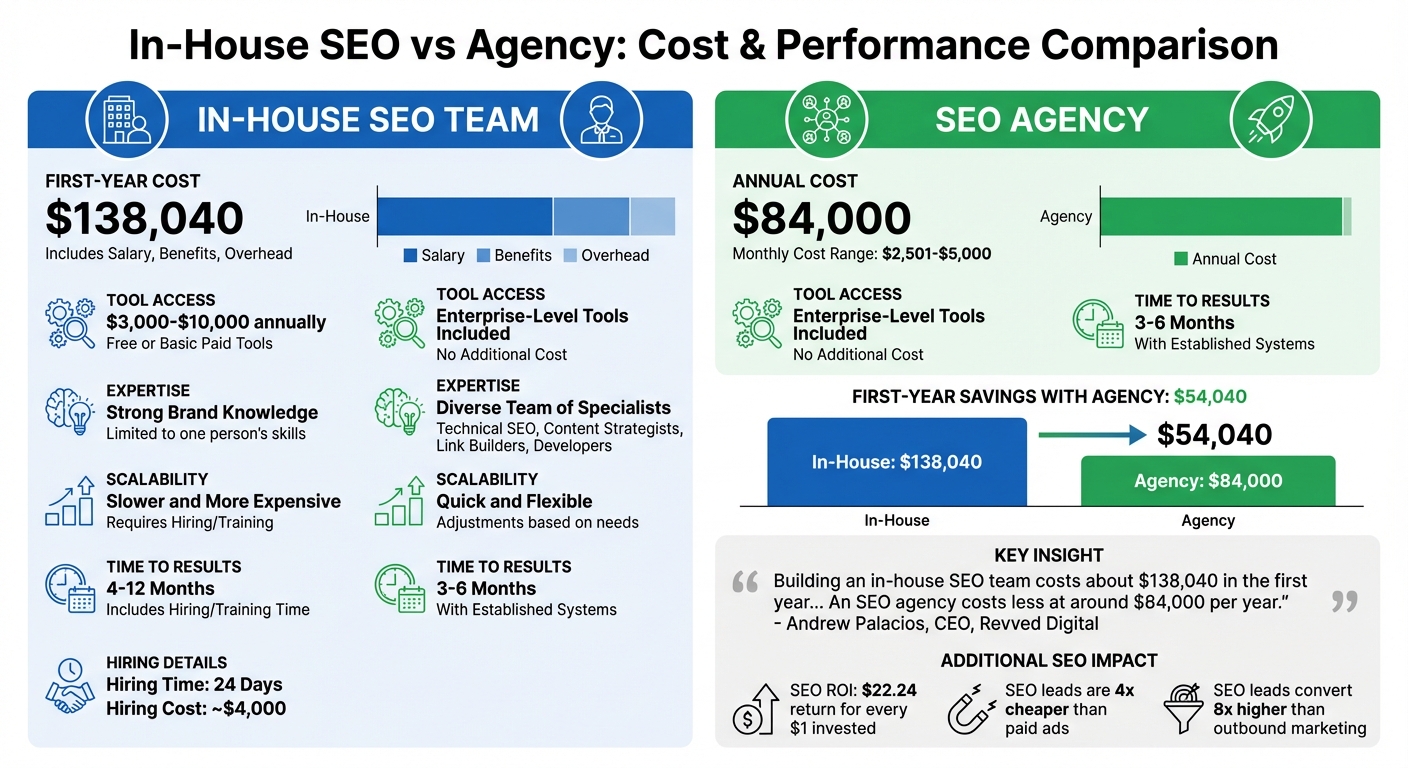
In-House SEO vs Agency: Cost and Performance Comparison
Deciding between an in-house SEO team and hiring an agency often comes down to resources, expertise, and flexibility. The numbers tell an interesting story: building an in-house SEO team can cost around $138,040 in the first year when you factor in salary, benefits, training, and overhead. On the other hand, partnering with an SEO agency typically costs about $84,000 per year. That’s a notable difference, especially for companies that need quick results without the hassle of hiring and onboarding – a process that can take up to 24 days and cost approximately $4,000.
"Building an in-house SEO team costs about $138,040 in the first year… An SEO agency costs less at around $84,000 per year." – Andrew Palacios, CEO, Revved Digital
When it comes to tools, in-house teams often operate on a tighter budget, relying on free or basic paid tools that cost between $3,000 and $10,000 annually. Agencies, however, spread the cost of high-end, enterprise-level software across their client base, giving businesses access to top-tier technology without the steep expense.
Agencies also bring a built-in advantage in expertise. They offer a team of specialists – technical SEOs, content strategists, link builders, and developers – who collaborate to tackle multifaceted challenges. In contrast, in-house teams often consist of generalists who may not have the same depth of knowledge in specific areas.
Here’s a quick breakdown of the key differences:
| Factor | In-House SEO | SEO Agency |
|---|---|---|
| First-Year Cost | ~$138,040 (salary, benefits, overhead) | ~$84,000 |
| Tool Access | Free or basic paid tools ($3,000–$10,000 annually) | Enterprise-level tools included |
| Expertise | Strong brand knowledge but limited to one person’s skills | Diverse team of specialists |
| Scalability | Slower and more expensive due to hiring and training | Quick and flexible adjustments based on needs |
| Time to Results | 4–12 months (includes hiring/training) | 3–6 months with established systems |
Agencies stand out for their ability to scale quickly and adapt to changing business needs or seasonal demand. Expanding an in-house team, by comparison, requires a slower and more expensive hiring process. For larger companies, a hybrid model – where an in-house manager oversees outsourced technical work – can strike a balance between cost-efficiency and control.
Conclusion
Working with an SEO agency brings a wealth of expertise, cost efficiency, and faster growth that’s hard to achieve with in-house teams or DIY approaches. When you partner with an agency, you tap into a team of specialists – technical SEO pros, content strategists, and link-building experts – without taking on the expenses of full-time salaries, benefits, or pricey software tools. This partnership connects the dots between technical SEO efforts and measurable business outcomes.
On top of the financial perks, agencies rely on tried-and-true methods, cutting out the trial-and-error phase that often slows down less experienced teams. These strategies turn your online presence into a steady source of revenue.
"SEO is one of those areas where getting it right from the beginning can set you up for long-term growth, while getting it wrong can cost you months or even years." – Steve Morris, CEO and Founder of NEWMEDIA.COM
For businesses aiming for growth, agencies like Organic Media Group stand out. With over 650 campaigns under their belt, they specialize in blending SEO, content marketing, and editorial link building to grow organic traffic, leads, and sales. Whether you’re a local shop or a global brand, they have the tools and knowledge to deliver results.
Choosing professional SEO services isn’t just about outsourcing a task – it’s a strategic move to secure your place in a competitive digital world. By leveraging the expertise of an agency, your business is better positioned for lasting success in today’s fast-paced online marketplace.
FAQs
How do SEO agencies keep up with changes to Google’s algorithms?
SEO agencies keep pace with Google’s frequent algorithm updates by closely following official announcements and reliable industry sources. They carefully analyze these updates to understand shifts in ranking factors and use specialized tools to monitor website performance metrics like traffic and search rankings.
When an update rolls out, agencies conduct tests – such as adjusting on-page elements or performing backlink audits – to gauge its impact. Based on their findings, they fine-tune strategies to stay in line with Google’s latest guidelines. This might involve improving technical SEO, refining content, or enhancing link-building efforts.
At Organic Media Group, the focus is on staying ahead of the curve. By consistently updating strategies, they ensure their clients’ websites remain optimized and compliant with Google’s ever-changing standards, helping businesses maintain strong search visibility and rankings.
How is hiring an SEO agency more cost-effective than building an in-house team?
Hiring an SEO agency can be a cost-effective alternative to building your own in-house team. Instead of covering annual salaries that range from $54,000 to $102,000 per employee – plus the added costs of training and benefits – you can choose agency packages that typically start at about $2,000 per month.
By going this route, you cut down on overhead expenses and avoid the hassle of recruiting, hiring, and onboarding. This means you can dedicate more energy to growing your business while leaving your SEO strategy in the hands of seasoned professionals.
How do SEO agencies use data to enhance website performance?
SEO agencies dig into data like website traffic, keyword rankings, and user behavior to shape strategies that boost visibility and increase conversions. Using tools like Google Analytics and Search Console, they pinpoint high-performing pages, identify traffic-driving keywords, and uncover where users abandon the conversion process. This insight helps them prioritize impactful updates – whether it’s fine-tuning meta tags, speeding up page load times, or improving internal links – all with the goal of delivering noticeable results.
Beyond the basics, they dive deeper with competitor research, backlink evaluations, and A/B testing to refine their strategies further. Take Organic Media Group, for example – they rely on this data-driven approach to create customized solutions. From focused link-building campaigns to technical SEO enhancements, they help U.S. businesses grow their organic traffic, generate leads, and drive sales, delivering results that are clear and measurable.