Competitor backlink analysis is a powerful way to improve your SEO strategy by studying where your competitors get their backlinks. This process helps you identify websites already linking to similar content, giving you proven link building strategies to build high-quality links. It’s all about finding the "link gap" – websites linking to your competitors but not to you – and turning that into an advantage.
Key takeaways:
- Why it matters: Backlinks are essential for rankings. Pages in the top position on Google have 3.8x more backlinks than those ranked 2–10.
- What you gain: Identify content gaps, refine keyword strategies, and find weak spots in competitors’ backlink profiles.
- How to start: Use tools like Ahrefs, Semrush, or Moz to analyze competitor backlinks, focusing on high-authority, relevant domains.
- Advanced tactics: Spot broken links, analyze anchor text patterns, and track competitors’ new links to stay ahead.
This method turns guesswork into actionable steps, helping you rank higher, drive traffic, and boost your site’s authority. Let’s dive into the details.
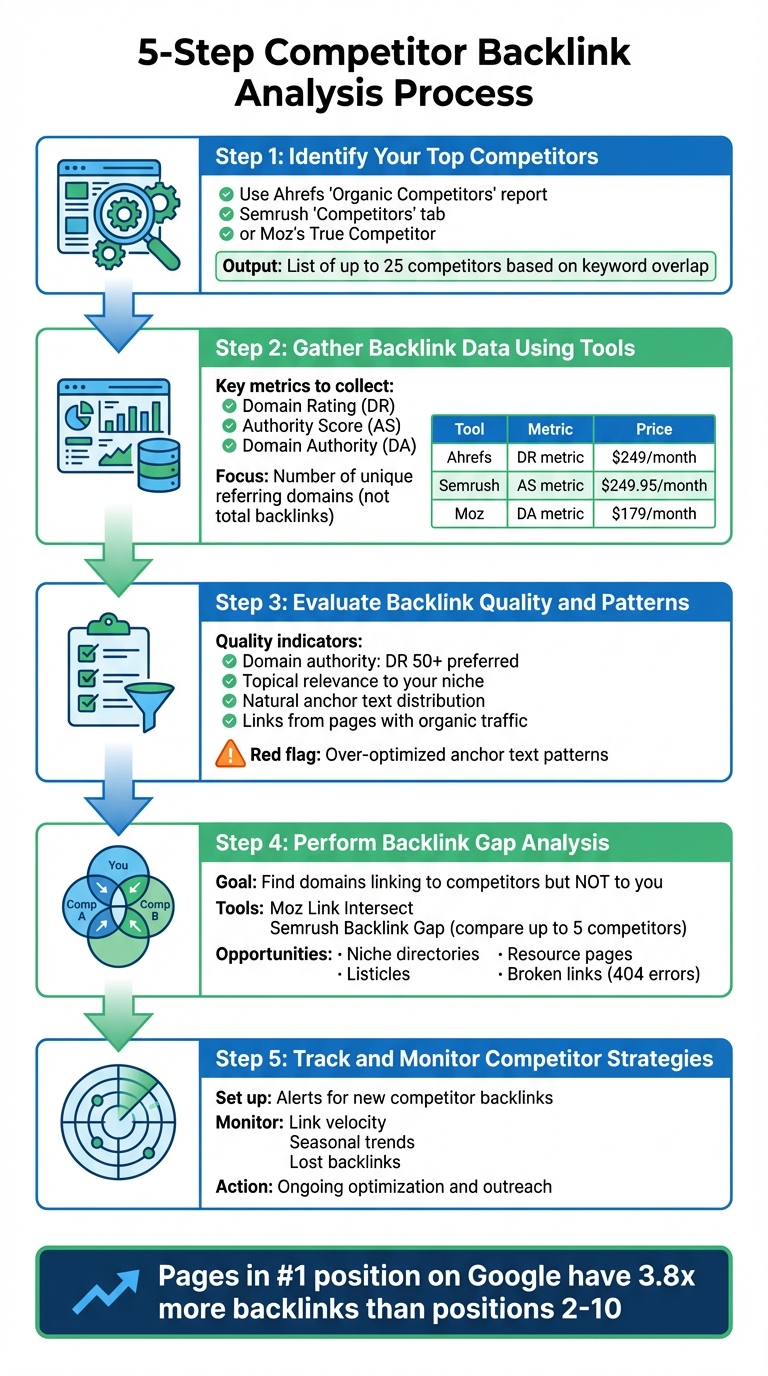
5-Step Competitor Backlink Analysis Process for SEO
Step-by-Step Process for Competitor Backlink Analysis
Step 1: Identify Your Top Competitors
Your biggest search competitors might not be who you think they are. They could include national directories, niche industry blogs, or even high-ranking informational sites. Start by pinpointing domains that rank well for your target keywords or have significant organic visibility. Tools like Ahrefs’ "Organic Competitors" report and Semrush’s "Competitors" tab can help you see which sites are pulling in the most search traffic for your main keywords.
If your website isn’t live yet, try Googling your industry keywords and note the top-ranking results. For local businesses, you can broaden your research by looking at competitors in larger markets to find potential high-quality link sources. Tools like Moz’s True Competitor can also simplify the process by generating a list of up to 25 competitors based on keyword overlap. Once you’ve got a solid list of competitors, you’re ready to dive into backlink data.
Step 2: Gather Backlink Data Using Tools
With your competitors identified, the next step is to collect their backlink data. Tools like Ahrefs Site Explorer, Semrush Backlink Analytics, and Moz Link Explorer are excellent for this. These platforms provide key metrics such as Domain Rating (DR), Authority Score (AS), or Domain Authority (DA), giving you a sense of how strong a site’s backlink profile is.
Instead of focusing solely on the total number of backlinks, prioritize the number of unique referring domains. Features like Ahrefs’ Link Intersect or Semrush’s Backlink Gap can help you spot domains linking to multiple competitors but not to your site – these are prime opportunities for outreach. For a deeper dive, analyze backlinks at the individual URL level rather than just looking at root domains.
| Tool | Key Feature | Primary Metric | Starting Price |
|---|---|---|---|
| Ahrefs | Site Explorer / Link Intersect | Domain Rating (DR) | $249/month |
| Semrush | Backlink Analytics / Backlink Gap | Authority Score (AS) | $249.95/month |
| Moz | Link Explorer / Link Intersect | Domain Authority (DA) | $179/month |
This data lays the groundwork for evaluating backlink quality and identifying patterns.
Step 3: Evaluate Backlink Quality and Patterns
Not all backlinks are created equal. A single link from a high-authority site can outweigh dozens of links from lower-quality domains. Focus on referring domains with strong authority metrics – ideally a DR of 50 or higher. Topical relevance is just as important. As Chima Mmeje, Senior Content Marketing Manager at Moz, puts it:
"Topical links are the key to success – suspecting links that are more topically aligned are given higher priority when assessing their value."
Take a close look at anchor text distribution, ensuring a natural mix of branded terms, generic phrases, and keywords. Avoid over-optimized patterns, as these can signal low-quality or spammy links. Tom Capper, Senior Search Scientist at Moz, cautions:
"Having a lot of links can look suspicious if no one is actually looking for and navigating to your site."
Also, focus on backlinks from pages with organic traffic. These links are more likely to be live and valuable. Once you’ve assessed the quality, you’re ready to find missed opportunities through backlink gap analysis.
Step 4: Perform Backlink Gap Analysis
Backlink gap analysis helps you identify linking opportunities your competitors are already leveraging. Use tools like Moz Link Intersect or Semrush Backlink Gap to compare your domain with up to five competitors. These tools will highlight domains linking to multiple competitors but not to you, giving you a list of prime outreach targets.
Pay attention to patterns – niche directories, resource pages, listicles, or guest post sites often appear as recurring opportunities. Another tactic is to look for broken links. If a competitor’s page has backlinks but is returning a 404 error, you can step in by creating better content and requesting a link update. For local SEO, check whether competitors are earning links from city-specific sources like local newspapers or chambers of commerce.
Step 5: Track and Monitor Competitor Backlink Strategies
Competitor backlink analysis isn’t a one-and-done task – it’s an ongoing process. Use tools to set alerts for new backlinks your competitors acquire. Monitoring how quickly they gain links can help you set realistic benchmarks for your own campaigns.
Keep an eye on seasonal trends and the types of content that consistently attract links. Lost backlinks are also worth tracking – these can be opportunities for you to pitch your updated, high-value content as a replacement. Regular monitoring ensures you stay ahead of the game and adapt your strategy as needed.
sbb-itb-7a53647
Advanced Backlink Analysis Techniques
Filtering Backlinks by Traffic and Relevance
When analyzing competitor backlinks, focus on filtering data at the page level. By setting your tool to "exact page" mode, you can pinpoint URLs that link to specific topics relevant to your content. This ensures you’re targeting backlinks from websites that align with your niche, rather than just chasing high-authority domains that might link to unrelated content on a competitor’s site.
Sort your results by metrics like Authority Score (AS), Domain Authority (DA), or Page Authority (PA) to prioritize links with real SEO value. However, don’t stop there – check if these linking sites have active traffic. Links from websites with little to no visitor engagement won’t move the needle for your rankings. As Tom Capper, Senior Search Scientist at Moz, explains:
Having a lot of links can look suspicious if no one is actually looking for and navigating to your site.
Using anchor text filters can also reveal industry-specific keywords used by competitors. In highly competitive niches, top-ranking sites often have a significant portion of their backlinks with exact match anchor text. For instance, the leading site for "Nashville real estate" has links from 544 unique domains using that exact phrase. Applying filters like "anchor contains" or "exact match" can uncover similar trends in your competitors’ profiles.
Another effective tactic is combining "New" and "Follow" filters to track your competitors’ recent link-building efforts. This lets you observe their strategies in real time. For local SEO, filtering referring domains with a Domain Rating below 50 can help you focus on local businesses, community organizations, and news sites, which often carry more weight for geographic search queries than large national directories.
These refined filtering techniques pave the way for uncovering geographic and niche-specific backlink patterns.
Identifying Geographic or Niche-Specific Patterns
Spotting geographic or niche-specific backlink trends can reveal untapped opportunities. Instead of limiting your focus to local competitors, analyze the top 50 sites in your niche across different cities. This broader approach helps you identify niche-specific domains, such as industry directories, that are valuable across multiple locations. While this analysis may take two to four hours, it often results in high-quality backlink targets.
For local SEO, analyzing backlink profiles of various businesses in the same city – even those outside your industry – can uncover valuable connections. Local entities like news outlets, community groups, and churches often link to other local organizations, regardless of their business type. Filtering out domains with a Domain Rating above 50 can help you avoid generic directories and focus on authentic local connections.
To streamline this process, export competitor referring domains into a spreadsheet. Use a formula like =COUNTIF(range, criteria) to count how many competitors share each link. Sorting by the highest counts can highlight the most "link-worthy" domains in your niche. Additionally, look for natural clusters where related niches frequently link to each other. For example, in the wedding industry, photographers, caterers, and DJs often form interconnected local backlink networks.
These insights can directly inform your content strategies, helping you attract similar high-quality links.
Using Competitor Insights for Content Creation
Competitor backlink data is a goldmine for creating content that attracts links. Start by using the "Indexed Pages" report in your backlink tool to identify your competitors’ most-linked content. Then, create a superior version of it – whether by updating data, improving visuals, or adding deeper insights. This approach, known as the Skyscraper Technique, works because you’re offering improved content to websites already interested in the topic.
Certain content formats, like original research and infographics, consistently attract backlinks. Another effective strategy is broken link building. Look for 404 pages on competitor sites that still have active backlinks, create a better version of that content, and use link building outreach templates to suggest your replacement to the linking sites.
For advanced users, exporting a competitor’s link profile into a Google Custom Search Engine can provide even deeper insights. This allows you to run targeted searches across their entire backlink profile, uncovering specific tactics like sponsorships, guest posts, or resource pages. By identifying these strategies, you can replicate their successes while steering clear of their mistakes.
Link-Building Strategies Based on Analysis
Once you’ve gathered solid competitor backlink data, it’s time to put it to work with targeted link-building tactics that seize the opportunities you’ve identified.
Target High-Quality Referring Domains
Focus on domains that have already linked to your competitors and have a Domain Rating (DR) or Domain Authority (DA) of 50 or higher. These links carry weight and are usually relevant to your niche.
To find these opportunities, use Link Intersect tools. These tools let you compare your site against up to five competitors to spot domains linking to them but not to you. When reaching out, mention the competitor’s content they’ve linked to and position your resource as a more updated or detailed alternative.
Another effective strategy is to identify broken links on competitor sites that still attract backlinks. Reach out to the referring domains and offer your live content as a replacement. This approach is not only helpful but also builds goodwill with site owners. As Justin Briggs, CEO of Briggsby, puts it:
Using link data, although it can never be perfectly accurate, allows you to take a more scientific approach to your SEO strategies.
Replicate Successful Guest Posting Tactics
Guest posting is still a widely used and effective link-building method, ranking as the third most popular tactic in 2022. To replicate this strategy, identify key individuals – like CEOs, CMOs, or marketers – who actively write guest posts for external sites on behalf of your competitors.
You can find their guest posts using advanced search operators like TOPIC + "author name" + inurl:author -competitordomain.com. Another trick is using reverse image searches (e.g., Google Lens) on their headshots to uncover guest posts that may not include standard author bios. Tools like Ahrefs Content Explorer can also help by filtering results with the author:"name" operator and limiting results to one page per domain.
A great example of this strategy in action is Casey Meraz of Juris Digital. Between 2014 and 2017, he used Moz.com’s high Domain Authority to publish guest posts that helped his content rank for competitive keywords like "local SEO." This drove targeted traffic that would have been harder to achieve on his own site. Look for similar opportunities on high-authority platforms in your industry and pitch those sites with even better content ideas.
Prioritize Editorial and Contextual Links
Editorial links – those placed naturally within relevant content – carry the most ranking power. Your goal should be to secure "Tier 1" links from authoritative blogs or niche-relevant media outlets.
Start by running page-level link intersect queries to find URLs linking to your competitors’ topically relevant articles but not to yours. Then, analyze the anchor text and surrounding content of these links to understand how publishers describe the material. Use this insight to refine your own content titles and outreach strategies.
One proven approach is to identify "linkable points" like unique statistics or facts that have earned editorial mentions. For instance, Ahrefs’ Head of Content, Joshua Hardwick, led a project in 2022 that published a list of SEO statistics using the "APP method." This single page attracted backlinks from over 1,700 referring domains in less than two years.
Agencies like Organic Media Group specialize in securing high-quality editorial links by creating link-worthy assets and building relationships with publishers. As Andy Robson, Agency Director at Squidgy, explains:
Sometimes, it can take only one website to tip the balance of the scales and make Google sit up and pay attention. It has to be a very authoritative site, but nevertheless, it’s not always about quantity!
You can also monitor platforms like HARO (Help A Reporter Out) to provide expert quotes for editorial stories. Max Rose from Four Seasons Plumbing used this tactic to land a backlink from Martha Stewart Living by contributing to a journalist’s piece on plumbing leaks.
Conclusion
Recap of the Competitor Backlink Analysis Process
Competitor backlink analysis transforms SEO into a focused, data-driven strategy. It starts with identifying two types of competitors: direct business rivals and SERP competitors – those outranking you for your target keywords. Using specialized tools, you gather backlink data to analyze referring domains, anchor text trends, and link quality metrics. The game-changer here is link gap analysis, where you pinpoint domains linking to multiple competitors but not to your site. These domains are already invested in your niche, making them prime targets for outreach.
Once you’ve identified opportunities, you assess backlink quality by focusing on high Domain Authority (DA 50+) and relevance. Monitoring competitor link velocity on a monthly basis ensures you stay competitive in your link-building efforts. This isn’t a one-and-done task – your backlink profile needs constant tracking and refinement to maintain an edge. Following these steps equips you with a solid framework for improving your backlink strategy.
How Backlink Analysis Supports Long-Term SEO Growth
The real payoff of this process lies in building a sustainable foundation for SEO. Securing high-quality links consistently helps close the authority gap over time. As Andy Hill, Managing Director at Distribute Digital, puts it:
Backlinks remain the best indicator to Google and other search engines that a webpage is considered important by internet users.
Focusing on Tier 1 links – those from authoritative, niche-relevant domains – boosts your site’s credibility, leading to better rankings and more referral traffic. Metrics like Domain Authority growth and link velocity provide clear validation of your SEO progress. Additionally, this approach helps refine your content strategy by showing which formats – like original studies, in-depth guides, or infographics – naturally attract links in your industry. Even recent Google leaks confirm that PageRank remains a ranking factor, underscoring the ongoing importance of quality backlinks for organic visibility.
FAQs
How do I find high-quality backlinks by analyzing my competitors?
One effective way to discover quality backlink opportunities is by analyzing your competitors’ backlink profiles. Start by identifying the websites linking to your competitors – especially those that are both authoritative and relevant to your niche. These sites can be excellent prospects for your own link-building efforts.
Make sure to prioritize backlinks coming from trusted, high-authority domains. Also, check that the context of these links aligns naturally with your industry or content. Using tools like backlink analysis platforms can streamline this process, helping you uncover and rank opportunities based on their SEO potential.
By understanding where your competitors are earning their backlinks, you can focus on reaching out to websites that already have an interest in your field. This not only increases the chances of successful outreach but also helps boost your search engine rankings.
What are the best tools for analyzing competitor backlinks?
To dig into competitor backlinks effectively, several tools can make the process easier and more precise:
- Ahrefs: Known for its extensive backlink database, this tool offers advanced features like link intersect and historical data, making it a favorite among SEO professionals.
- Semrush: Offers a full-featured SEO platform with detailed backlink insights, making it ideal for spotting link-building opportunities.
- Moz: A beginner-friendly tool that emphasizes metrics like Domain Authority, providing a straightforward way to analyze backlinks.
- Majestic: Specializes in delivering in-depth link data, which is particularly useful for niche-specific research.
- Google Search Console: A free option that gives a basic overview of your backlinks, though its data is more limited compared to paid tools.
Using a mix of these tools can give you a well-rounded view of your competitors’ backlink strategies and help you identify potential link-building opportunities.
How does analyzing backlinks help improve SEO over time?
Backlink analysis is a key piece of the puzzle when it comes to long-term SEO success. It helps you spot opportunities to boost your site’s authority by identifying high-quality links from trusted sources. Plus, it gives you a window into your competitors’ strategies, so you can fine-tune your own approach.
A strong backlink profile not only builds trust with search engines but also paves the way for better rankings, more organic traffic, and steady growth over time.