
Guest posting means writing an article for someone else’s website. It’s a proven way to:
- Build high-quality backlinks that improve your website’s SEO.
- Reach new audiences and increase traffic to your site.
- Establish yourself as an authority in your field.
To succeed with guest posts, you need to:
- Find the right platforms: Target reputable sites with good domain authority and real traffic.
- Pitch effectively: Personalize your outreach, propose relevant topics, and showcase your expertise.
- Write valuable content: Provide actionable insights and align with the host site’s audience.
- Promote your work: Share your post on social media, email lists, and engage with readers.
Guest posting isn’t just about SEO. It’s a way to connect with audiences, build trust, and grow your brand. Follow these steps to maximize your results.
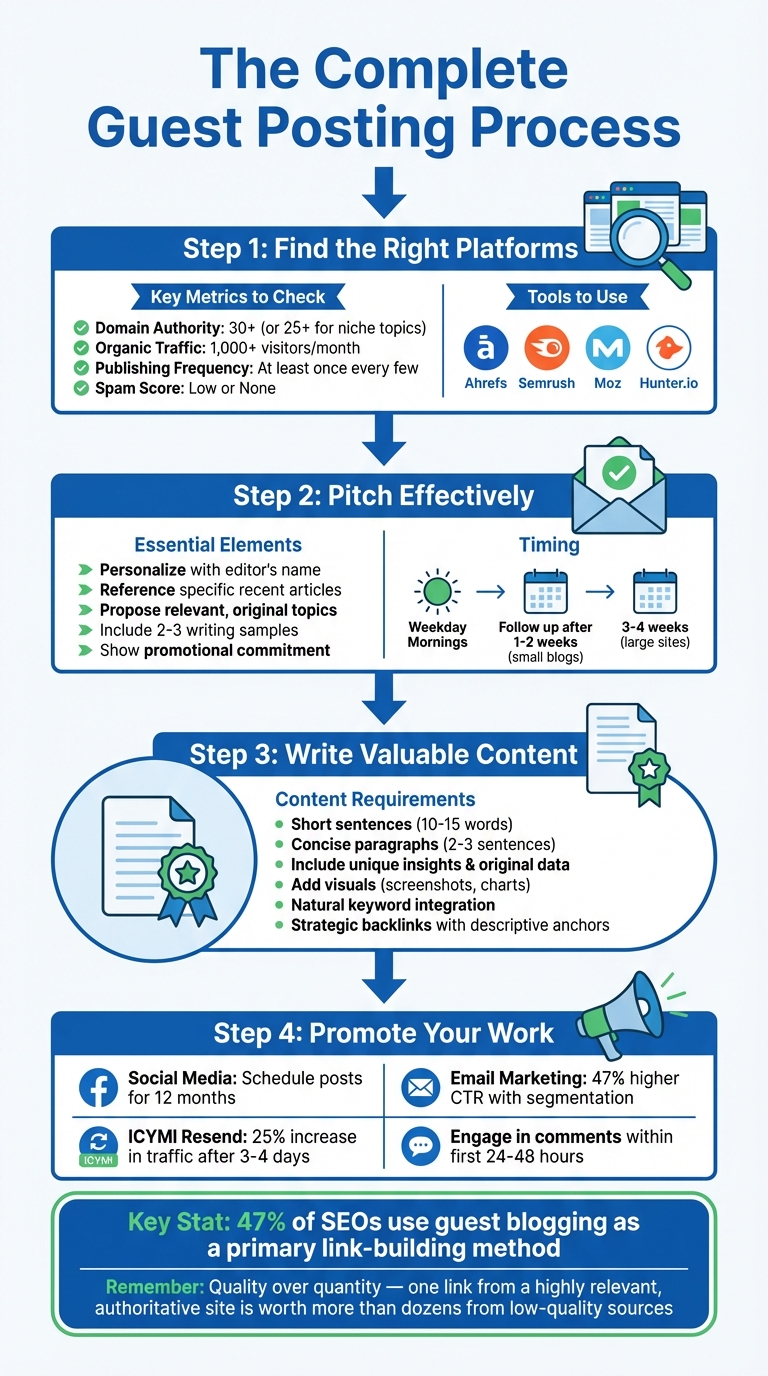
4-Step Guest Posting Strategy: From Finding Platforms to Promotion
Benefits of Guest Posting
Guest posting offers three key perks that make it a valuable strategy: high-quality backlinks, increased traffic, and greater brand authority.
Building High-Quality Backlinks
Backlinks from reputable sites are a core factor in Google’s ranking algorithm, and guest posting is one of the most effective ways to secure them. When your content appears on a trusted site, you’re not just getting a link – you’re gaining link equity. This boosts your Domain Authority and improves the ranking potential of your entire website.
For maximum impact, aim for backlinks from sites that haven’t linked to you before. OptinMonster provides a great example of this strategy in action. Their guest post on the WPForms blog delivered an 18–25% conversion rate on linked lead magnets and kept referral visitors engaged for an average of 3.7 minutes per session.
To get the best results, focus on websites with an Authority Score above 30 and steady organic traffic, ideally exceeding 5,000 monthly visits. Avoid sites that openly sell guest post opportunities or show up on public "write for us" lists – these can trigger penalties from search engines.
But guest posting isn’t just about SEO; it also helps you reach new audiences.
Increasing Organic Traffic and Audience Reach
Guest posts do more than improve rankings – they introduce your brand to fresh audiences who already trust the host site. 83% of marketers agree that backlinks are crucial for organic search rankings, and the benefits extend beyond SEO. Publishing on established platforms increases brand mentions, which can enhance visibility in tools like ChatGPT, Perplexity, and Claude.
Traffic gains depend on where your guest posts appear. A study of 239 guest posts found they generated an average of 50 referral visits per post. However, placements on high-authority sites can yield even better results. For example, OptinMonster saw a 12% increase in targeted traffic during active guest posting campaigns. To make the most of this traffic, direct readers to specific landing pages with tailored lead magnets rather than sending them to a generic homepage.
"I care less about someone’s paper credentials and more about whether they are a genuine partner in promotion. I once rejected a brilliant article from a Ph.D. because he had zero online presence and no plan to share the work." – Leury Pichardo, Senior Director of Digital Marketing and PR, Digital Ceuticals
This expanded reach not only drives traffic but also builds your credibility as a trusted voice in your field.
Establishing Brand Authority
Guest posting on respected websites enhances your credibility by association. When readers see your name on a site they already trust, they’re more likely to view you as an expert. Over time, this credibility can lead to speaking opportunities, media mentions, and increased branded search traffic.
As the demand for expert-driven content grows, this strategy becomes even more valuable. By 2026, publishers are expected to prioritize unique, expert-led insights over generic SEO articles. Sharing original data, personal experiences, and distinctive insights sets you apart in a way that AI-generated content cannot.
Take the example of Vince Nero, who wrote a guest post for Ahrefs in 2021 while working at Siege Media. Instead of submitting a generic article, he shared a detailed case study. This earned him a high-authority backlink and cemented his reputation as a thought leader – proof that quality and expertise outweigh quantity.
sbb-itb-7a53647
Finding the Right Platforms for Guest Posting
Where you publish your guest posts plays a huge role in their success. A mix of research, careful evaluation, and strategy ensures your efforts yield the best results.
Researching Relevant Blogs and Websites
Start by identifying platforms where your target audience is already active. The niche doesn’t have to align perfectly; look for blogs or websites with overlapping audiences. For instance, if you sell project management software, contributing to a productivity-focused blog might be just as effective as writing for a tech site.
"The more closely related a guest blogging opportunity is to your niche, the better the backlink it will be for your SEO efforts." – Maddy Osman, SEO Content Strategist, The Blogsmith
Google search operators can be your best friend here. Use queries like [your niche] + "guest post guidelines", [your topic] + "become a contributor", or inurl:write-for-us to find opportunities. Another tactic is searching for "Top 10 [Niche] Blogs" to identify key players in your industry. Once you’ve found those, dig deeper to locate smaller sites they link to or feature. Tools like Ahrefs and Semrush are also great for analyzing where your competitors have guest posted, helping you pinpoint proven opportunities.
A great example of this in action comes from Pratik Dholakiya, founder of Growfusely. Back in January 2013, his team landed guest spots on high-profile sites like ProBlogger and Search Engine Journal. For the latter, they created a post titled "Link Earning Strategies", inspired by a Quora discussion. The result? Hundreds of social shares and a surge in business leads.
Once you’ve compiled a list of potential blogs, the next step is ensuring they’re worth your time.
Evaluating Platform Quality
Not every guest posting opportunity is created equal. Many sites – about 85% of them – are considered low quality, often with a Domain Rating (DR) below 40 and fewer than 10,000 monthly organic visitors. To make your efforts count, focus on platforms that meet these benchmarks:
- Domain Authority (DA): Aim for 30+ (or 25+ for very niche topics).
- Organic Traffic: Look for sites with at least 1,000 monthly visitors.
- Publishing Frequency: Choose platforms that post original content regularly, at least once every few weeks.
- Spam Score: Avoid sites with high spam scores to protect your reputation.
| Metric | Minimum Acceptable Level | Purpose |
|---|---|---|
| Domain Authority (DA) | 30+ (or 25+ for niche topics) | Indicates ranking potential |
| Organic Traffic | 1,000+ visitors/month | Ensures real audience reach |
| Publishing Frequency | At least once every few weeks | Signals an active, engaged platform |
| Spam Score | Low or None | Avoids harmful associations |
Look for engagement signals like active comments, social media shares, and a strong subscriber base. Verify the site publishes its own content regularly, not just guest posts, and check that its pages are indexed by Google using the site:domain.com operator.
"If it looks ‘easy’ to get a post up on their blog, don’t bother." – Pratik Dholakiya, Founder, Growfusely
Red flags include excessive ads, instant posting (no moderation), or blogs where every post is packed with external links. Lastly, confirm the site ranks for its own brand name to ensure it hasn’t been penalized by search engines.
Using Tools for Platform Discovery
Once you’ve nailed down your quality criteria, SEO tools can simplify the search process. Platforms like Ahrefs, Semrush, and Moz let you analyze metrics like Domain Rating, organic traffic trends, and backlink profiles to weed out low-quality sites. Ahrefs’ Content Explorer is especially helpful for finding high-traffic pages in your niche, while Hunter.io can help you track down editor email addresses for outreach.
If you’re short on time, Organic Media Group‘s guest posting services offer a hands-off solution. They handle everything – from research and outreach to content creation and placement – ensuring you’re featured on reputable platforms that align with your goals. With over 650 successful SEO campaigns, they’ve honed the art of finding opportunities that deliver measurable results.
For a more hands-on approach, tools like Ahrefs’ Site Explorer can uncover pages with declining traffic on target blogs. Pitching an update or "refresh" for these pages can boost your chances of acceptance. You can also explore niche-specific opportunities through communities like Reddit (r/SEO, r/Blogging), Slack groups, or Discord channels.
Writing an Effective Pitch for Guest Posts
After identifying quality platforms, the next step is crafting a pitch that grabs attention. Editors receive hundreds of guest post pitches every week, so yours needs to stand out. A strong pitch isn’t about luck – it’s about showing you’ve done your homework and understand what the blog values.
Personalizing Your Approach
Avoid generic greetings at all costs. Starting with "Dear Webmaster" or "Dear Sir/Madam" screams laziness. Instead, take a moment to find the editor’s name. Check LinkedIn, the site’s "About" page, or use tools like Hunter.io. Then, reference something specific they’ve written recently. A thoughtful compliment on a recent article shows you’re not just copying and pasting the same email to multiple blogs.
"Nothing turns me off more than an email starting with ‘Dear Sir or Madam,’ ‘Dear Webmaster,’ ‘To the owner of Neilpatel.com,’ or simply ‘Hi.’"
– Neil Patel, Co-Founder of NP Digital
Before pitching, spend a week or two engaging with the blog. Comment on and share their posts, tagging the editor when appropriate. This builds familiarity. Also, study the blog’s tone and style to align your pitch with their content.
Another tip: use the search operator site:website.com [your topic] to ensure your idea hasn’t already been covered. If it has, suggest a fresh angle. And always send your pitch to a direct contact rather than generic email addresses like "info@" or "support@".
Once your introduction is tailored, focus on proposing a topic that’s both unique and relevant.
Proposing Relevant and Original Topics
Your topic needs to align with the blog’s audience while offering something fresh. Editors aren’t looking for recycled ideas – they want content that fills gaps in their coverage and provides value to readers. Start by reviewing the blog’s "Most Popular" or "Featured Posts" sections to spot recurring themes. Then, use keyword gap tools to identify topics competitors rank for but the target blog doesn’t.
Be specific. Instead of pitching a broad topic like "Social Media Marketing", go for a niche angle such as "Social Media Marketing for Time-Strapped Restaurant Owners". Specific, actionable topics perform better than general overviews. Better yet, propose a complete system or strategy instead of a random list of tips – systems are perceived as more useful.
In 2014, Brian Dean published a guest post on Buffer titled "How We Increased Our Blog’s Conversion Rate by 134%." It wasn’t just a theory – it was a detailed case study with a clear system. This approach drove significant referral traffic and boosted his authority.
Timing matters too. Use tools like Google Trends or Exploding Topics to identify emerging subjects that editors are eager to cover for immediate traffic.
Once your topic is solid, it’s time to prove you’re the right person to write it.
Showcasing Your Expertise
Your pitch should demonstrate why you’re qualified. Include 2–3 links to high-quality, relevant articles you’ve written. Even your subject line should convey authority. For example:
"[Topic] article idea for [Site] from [Your Title or Notable Achievement]".
But expertise alone isn’t enough – you also need to show how you’ll deliver value. Offer to promote the published post to your email list, build backlinks, or even run social media ads to drive traffic.
"Your pitch is simply an exchange of value. If you can help them in some way, they’ll accept your pitch. If not, they won’t."
– Hunter Branch, Founder of Rank Tree
One marketing agency founder sent a single personalized cold email in 2017 that generated over $50,000 in revenue. That’s the power of a well-crafted pitch.
Timing your pitch is also crucial. Send it on a weekday morning when editors are actively checking their inboxes. Avoid weekends or late nights. If you don’t get a response, wait 1–2 weeks for smaller blogs or 3–4 weeks for larger outlets before following up politely.
| Pitch Element | Purpose | Best Practice |
|---|---|---|
| Subject Line | Get the email opened | Include a catchy headline and your authority/title. |
| Intro Hook | Capture interest | Pose a question or describe a problem the post will solve. |
| Body Paragraph | Prove value | Reference relevant research and explain the audience’s benefit. |
| Work Samples | Establish credibility | Include 2–3 links to high-quality, previously published work. |
| Call to Action | Elicit a response | Ask a specific question or highlight the topic’s urgency. |
Creating and Optimizing Your Guest Post Content
Once you’ve successfully pitched your guest post, the next step is to deliver on your promise with high-quality, optimized content. Your post should provide genuine value to readers while supporting your SEO goals, all without sounding overly promotional. The challenge lies in striking the right balance between actionable advice and strategic optimization.
Writing Engaging and Informative Content
Good structure is the backbone of engaging content. Stick to short sentences (10–15 words) and keep paragraphs concise (2–3 sentences). Use sub-headers, bullet points, and blockquotes to make your content easy to scan and digest.
To stand out, incorporate unique insights such as personal experiences, proprietary data, or original research. As Ana Camarena, Organic Content Lead at Semrush, puts it:
"Describe your successes, failures, and lessons learned – your real-world wins and stumbles are what AI can’t replicate."
Rather than listing random tips, focus on creating a complete, step-by-step system that readers can use to achieve a specific goal. For instance, Kristaps Brencans wrote a guest post for Backlinko featuring a "Tier-1" strategy, complete with original screenshots and actionable steps, which elevated his content to an authoritative level. Tailor your content to your audience – offer advanced strategies for experienced readers and detailed guides for beginners.
Adding visuals is another way to enhance your post. Use screenshots, charts, or custom images to break up text and make your points clearer. Additionally, link to related content on the host website to support their SEO efforts while enriching your post.
Incorporating Keywords and Backlinks Naturally
Keywords and backlinks are essential, but they should feel natural. Use descriptive anchor text to integrate backlinks seamlessly, and avoid overloading your content with keywords. Tools like Ahrefs can help you identify relevant subtopics and structure your post around what your audience is actively searching for.
When inserting backlinks, focus on adding value. Instead of generic phrases like "click here", use descriptive anchors like "our guide to email list-building strategies." For example, OptinMonster’s guest post on WPForms about list-building tactics kept readers engaged for an average of 3.7 minutes and drove traffic to templates with an 18–25% conversion rate. Dmitry Dragilev, Founder of JustReachOut, advises:
"Any backlinks you get through guest posts should be a by-product of your content, not its sole reason."
Link to specific resources, such as a landing page or lead magnet, rather than your homepage. You can also use tools to create personalized campaigns for visitors coming from your guest post URL, which can further boost conversions.
Optimizing Your Author Bio
Your author bio is another opportunity to make an impact. Use it to humanize yourself and establish credibility. Clearly explain who you work with and how you help them, immediately showcasing your professional relevance.
Focus on mentioning your brand name rather than stuffing the bio with keywords. Since many sites limit bio length and promotional language, make every word count. Instead of linking to your homepage, direct readers to a specific resource – like a free guide or tool – and include a clear call to action.
Keep the tone professional but approachable, and write in the second or third person to align with the host blog’s style. A well-crafted bio not only boosts your authority but also encourages readers to connect with you and explore your resources.
Promoting Your Published Guest Post
Promotion kicks off the moment your guest post goes live. A well-executed promotional plan boosts your SEO, attracts targeted readers, and enhances your online credibility – key elements of any guest posting strategy. As Andy Crestodina, Co-founder of Orbit Media, wisely said:
"The best content doesn’t win. The best promoted content wins."
Your efforts shouldn’t stop at publication. Promotion should be ongoing, with the goal of driving traffic, sparking conversations, and building connections that open doors for future collaborations.
Sharing on Social Media and Email Lists
Start by sharing your post across your social media channels. Tools like Buffer or Hootsuite can help you schedule posts not just for today but for the next 12 months. Tailor your messaging for each platform:
- Use Twitter for quick tips or striking visuals.
- Share professional insights on LinkedIn.
- Opt for emotional or shareable captions on Facebook.
- Highlight graphics or infographics on Instagram and Pinterest.
Tagging the host blog and any influencers or brands mentioned in your post can encourage engagement. Also, join relevant groups or discussions to provide value while subtly promoting your post. Use analytics tools to identify when your audience is most active, and attach UTM parameters to track your shares’ effectiveness.
Email marketing is another powerhouse for promotion. Include your guest post in your next newsletter or, if the content is particularly strong, send a dedicated email. Segment your email list based on interests or past interactions – this approach can drive a 47% higher click-through rate compared to generic emails. Boost visibility further by resending the email with a fresh subject line 3–4 days later, which can increase traffic by 25%. For continuous promotion, add a link to your guest post in your email signature.
| Strategy | Implementation Method | Expected Benefit |
|---|---|---|
| ICYMI Resend | Resend to non-openers after 3–4 days | ~25% increase in total traffic |
| Segmentation | Filter by interest (e.g., SEO vs. CRO) | 47% higher CTR |
| Welcome Series | Add to an automated drip sequence | Long-term evergreen traffic |
| Email Signature | Update signature with the latest post link | Consistent 1-on-1 visibility |
Social shares and email blasts are just the beginning. Engaging directly with readers and the host blog can amplify your post’s impact.
Engaging with Readers and the Host Blog
Once your post is live, active engagement is key. Start by promptly replying to comments on the host blog. This not only establishes your authority but also builds trust with the audience and strengthens your relationship with the blog owner. The first 24–48 hours after publication are typically when traffic and engagement peak, so be especially active during this window.
Encourage interaction by ending your guest post with a clear call to action or a thought-provoking question. When responding to readers, go beyond surface-level replies – share extra insights or data points to deepen the conversation. Use tools like Google Alerts or social listening platforms to monitor mentions of your post on social media, so you can join the broader dialogue.
Finally, don’t overlook the value of a simple thank-you note to the blog owner or editor. Expressing gratitude not only shows professionalism but also keeps the door open for future collaborations. As Zach Ball from Moz aptly said:
"Websites don’t give out links. People do."
Building genuine relationships with publishers can often lead to more opportunities than the backlink itself, especially as search engines increasingly reward expertise, authority, and trustworthiness.
Conclusion
Guest posting is an effective way to build quality backlinks, establish your brand’s authority, and attract targeted traffic to your site. With nearly half of SEOs (47%) using guest blogging as a key link-building method, it’s clear this tactic works – when done right. Beyond SEO, guest posts can position you as a trusted voice in your field, boost your visibility in tools like ChatGPT and Perplexity, and open doors to meaningful professional connections.
The secret to success? Treat guest posting as a collaboration, not just a transaction. Focus on contributing to high-authority platforms where your expertise truly resonates. Personalized outreach pitches and content that surpasses editorial expectations are essential. Remember, a single link from a highly relevant, authoritative site holds far more value than dozens from low-quality sources.
Once your post is published, your job isn’t done. Active promotion – via social media, email, and engaging in the comments – shows your dedication to the host blog’s audience. This effort can turn a one-time post into an ongoing relationship, paving the way for future guest slots, industry partnerships, and expanded networking opportunities.
"If you want to crush it with guest blogging today, you’ve got to be an expert first, link builder second".
FAQs
How many guest posts do I need to see SEO results?
The number of guest posts required to achieve SEO results varies based on factors such as the quality of the content and the authority of the websites you’re publishing on. To make a real impact, it’s typically a good idea to focus on consistently publishing well-crafted guest posts over a period of several months. This steady approach helps build your site’s authority and can lead to noticeable improvements in your SEO performance.
What should I do if a site asks me to pay for a guest post?
If a website asks for payment to publish a guest post, take a moment to weigh the opportunity carefully. Paid guest posting can sometimes be linked to scams or result in poor-quality backlinks. To avoid these pitfalls, thoroughly research the site in question. Does it have a solid reputation? Does its audience align with your target market? And most importantly, does the cost make sense for your SEO strategy and branding objectives? Be cautious and make sure the platform genuinely contributes to your marketing goals before committing.
Should my guest post link to my homepage or a landing page?
When adding links to a guest post, it’s usually more effective to direct readers to a relevant landing page rather than your homepage. A landing page that aligns with the topic or purpose of the guest post can help drive better engagement and even boost conversions. Just make sure the link fits naturally within the content and genuinely adds value for the reader.