Finding the right SEO agency can make or break your small business’s online success. A good agency drives real sales by targeting high-intent keywords and ensures long-term growth. On the other hand, a bad choice could lead to Google penalties or a loss of trust in your domain, which may take years to recover from. Here’s a quick guide to help you make the right decision:
- Set Clear Goals: Focus on measurable outcomes like leads, conversions, and revenue – not just traffic or rankings.
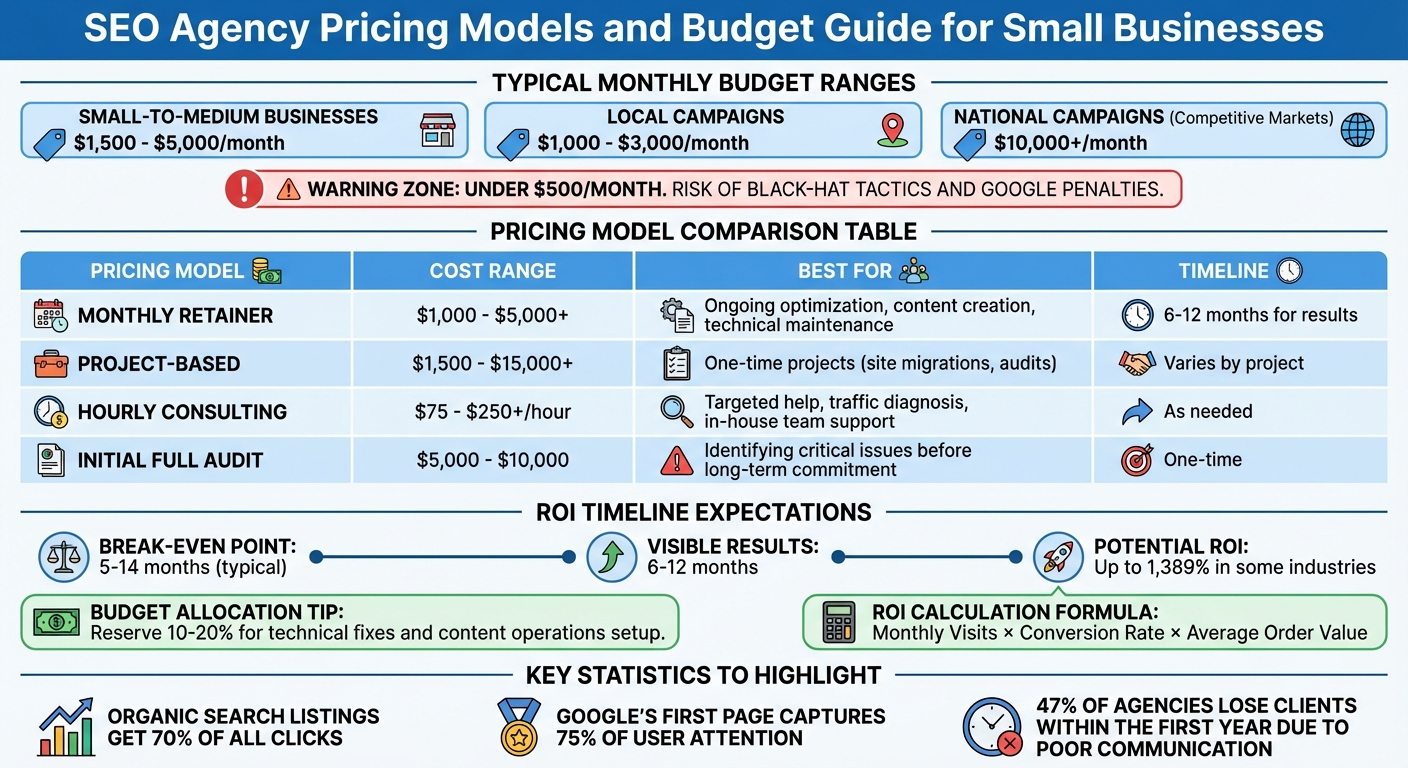
- Establish a Budget: Small businesses typically spend $1,500–$5,000 monthly on SEO. Avoid agencies charging under $500/month as they may use harmful tactics.
- Research Agencies: Look for proven results, client reviews, and case studies. Verify their claims using tools like Ahrefs or Semrush.
- Evaluate Communication: Choose an agency that explains strategies in simple terms and provides regular, transparent reporting.
- Understand Pricing Models: Monthly retainers and hourly rates are common for ongoing work, while project-based pricing suits one-time needs like audits. (Follow an SEO audit checklist to ensure no stone is left unturned.)
SEO is a long-term investment, often taking 6–12 months to show results. The right agency will align with your goals, avoid risky shortcuts, and focus on driving revenue for your business.
Set Your SEO Goals and Budget
SEO Agency Pricing Models and Budget Guide for Small Businesses
Identify Your SEO Priorities
Your SEO priorities should align with your business model. For example, local service providers, like a plumbing company in Dallas, should focus on optimizing their Google Business Profile and appearing in the map pack. On the other hand, B2B companies might aim for long-tail keywords and refining their sales funnel to attract national or niche audiences.
It’s critical to shift away from vanity metrics – like keyword rankings – and focus on results that directly impact your revenue, such as lead quality, conversion rates, and customer lifetime value. Consider this: organic search listings get 70% of all clicks, and Google’s first page captures 75% of user attention. However, those clicks only matter if they’re driving meaningful results for your business.
"The goal is not just to rank higher; it is to own your market. A strategic SEO partner builds a competitive moat around your business." – Design Me Marketing
Once you’ve identified your priorities, translate them into specific, measurable goals that align with your business objectives.
Set Clear and Measurable Goals
Avoid vague goals like "get more traffic." Instead, aim for concrete, measurable targets with a clear timeline. For example, you might aim to boost non-branded organic traffic by 20–30% within six months or secure top 3 rankings for 3–5 high-intent keywords that consistently drive sales.
SEO is a long-term investment, with businesses typically breaking even between 5 and 14 months. In some cases, industries have seen ROI as high as 1,389%, but achieving that requires clear tracking and patience from the outset.
| Goal Type | Recommended KPI | Target Timeline |
|---|---|---|
| Brand Visibility | Increase in non-branded organic impressions | 3–6 Months |
| Lead Generation | 20–30% increase in organic form fills/calls | 6–12 Months |
| Market Expansion | Top 3 ranking for 3–5 high-intent keywords | 6–9 Months |
| Sales Growth | 1–3% conversion rate from organic sessions | 6–12 Months |
Before setting these goals, conduct a technical SEO audit to ensure your targets are realistic.
Determine Your SEO Budget
Once your priorities and goals are clear, it’s time to establish a budget that you can maintain over at least 6 to 12 months. For small-to-medium businesses, this often ranges from $1,500 to $5,000 per month. Local campaigns may start at $1,000 to $3,000 monthly, while national efforts in competitive markets can exceed $10,000.
Several factors influence your budget: the technical state of your site, the number of pages, competition within your industry, and whether you’re targeting local or national search. Higher budgets allow for more content, link-building, and faster results, while lower budgets may require more time to see significant progress.
"Work backwards from how much revenue you’d like to generate from SEO and figure out how many more leads and traffic you need. That can help give you a frame of reference." – Trevin Shirey, VP of WebFX Marketing
When calculating your return on investment, think beyond a single transaction. For example, if your average customer generates $5,000 in lifetime profit and you aim to acquire 10 new customers per month, you can justify an SEO budget that supports that outcome. Additionally, allocate 10–20% of your initial budget for technical fixes and setting up content operations.
Be cautious of services priced under $500 per month. These often rely on automated tools or black-hat tactics, which can lead to Google penalties and long-term damage to your site’s reputation.
sbb-itb-7a53647
Research and Shortlist Agencies with Proven Results
Once you’ve set clear goals and established a budget, the next step is finding agencies that can deliver measurable outcomes.
Review Client Feedback and Testimonials
Start by exploring independent review platforms like Clutch, G2, and Google Reviews. These platforms often provide detailed client feedback, giving you a clearer picture of an agency’s strengths and potential weaknesses. Pay close attention to testimonials that highlight specific achievements. For example, a testimonial mentioning a "50% increase in organic leads within six months" is far more informative than vague praise like "great service."
You can also take an extra step by using tools like Ahrefs or Semrush to verify the search performance of the agency’s publicly listed clients. This ensures the agency truly delivers on its promises.
"Past and proven performance is the most important factor, in my mind, when somebody is looking to find an SEO partner." – Trevin S., Vice President of Business Operations, WebFX
Long-term client relationships are another indicator of consistent value. Agencies with clients who stick around for more than two years often demonstrate reliability and results. Additionally, consider auditing client websites using tools like Screaming Frog to spot technical issues such as broken links or poorly optimized metadata. If an agency’s clients have these problems, it may signal they aren’t practicing what they preach.
Lastly, examine how leading agencies, such as Organic Media Group, showcase their results.
Spotlight on Organic Media Group
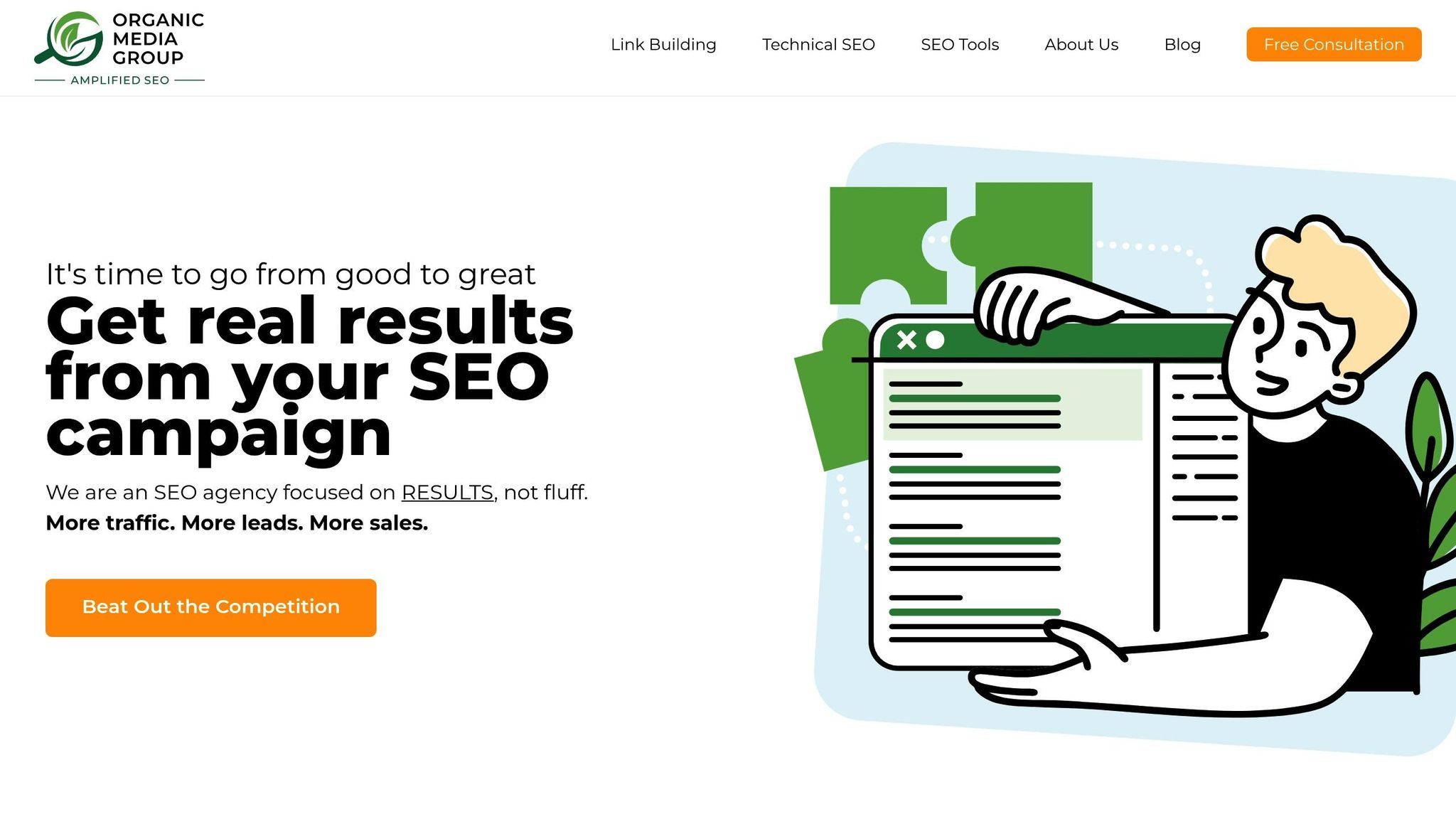
Organic Media Group stands out for its proven ability to deliver measurable outcomes. With over 650 successful SEO campaigns under their belt, they use a well-rounded approach that combines link building, on-page SEO, and content marketing. Their strategies are tailored to businesses of all sizes, from small local companies to large national brands.
One client shared their experience:
"Organic Media Group was very professional and helped us grow faster than any other strategy we tried. In less than 3 months we started showing up on the first page of the most competitive searches".
The agency consistently earns 5-star ratings, with clients praising their professionalism and commitment to delivering results.
Request References and Case Studies
After narrowing down your options, request three to five client references and detailed case studies from each agency. Focus on case studies that come from businesses similar to yours in size and industry. Reputable agencies are transparent and happy to share detailed examples of their work.
Effective case studies should outline the client’s initial challenges, the strategies implemented, and the measurable results achieved. For instance, a strong case study might detail how a local plumbing company increased service calls by 40% in nine months through targeted local SEO and an optimized Google Business Profile.
Don’t stop at reviewing case studies – call the references directly. Ask specific questions like, "How long did it take to see a positive return on investment?" and "What’s one thing you wish the agency could improve?" These conversations can help you verify the agency’s claims and ensure their approach aligns with your business needs.
Evaluate Communication, Transparency, and Reporting
Strong communication is what sets true partners apart from basic service providers. Just like having clear SEO goals and a realistic budget helps avoid risks, open communication and straightforward reporting prevent potential missteps. Before committing to an agency, take time to evaluate how they handle communication, transparency, and reporting.
Check Their Communication Style
Find out if you’ll have a dedicated account manager or if you’ll be shuffled between team members. Ask about their preferred communication methods – do they rely on email, phone calls, or video meetings? Also, clarify how often you can expect updates. Some agencies might touch base weekly, while others stick to monthly or quarterly check-ins.
Pay attention to how they explain their strategies. A good agency will break down complicated SEO concepts into simple, digestible explanations instead of burying you in confusing jargon. They should also take the time to ask smart, tailored questions about your business, such as your target audience, average order value, and main revenue streams – not just zeroing in on keyword rankings.
"The best agencies act more like partners than vendors. They start by understanding your goals: Do you want leads, appointments, online sales?" – Allison Dunn, CEO, Deliberate Directions
Consider scheduling a video or phone consultation to test how well their communication style aligns with your needs. If the initial discussions feel unclear or frustrating, it could signal ongoing communication issues after signing a contract.
Once you’re comfortable with their communication approach, take a closer look at how they execute their SEO strategies. This includes evaluating their technical SEO services to ensure your site’s foundation is sound.
Verify Their SEO Methods
Clear communication is the backbone of effective SEO strategies. Understanding how an agency approaches SEO is just as critical as knowing their promises. Specifically, ask about their link-building practices. Be cautious of any agency relying on automated link schemes, forum backlinks, or blog comment backlinks – these outdated tactics can lead to serious Google penalties over time.
Ask about their content creation process as well. Ensure that their content is created by human writers with proper editorial oversight. Agencies that rely heavily on AI-generated content without human review should raise a red flag. Additionally, confirm that they stay aligned with Google’s guidelines and algorithm updates. Beware of agencies offering "secret strategies" or guarantees of quick success.
"Legitimate SEOs will never guarantee a client a top ranking position because they know there are no guarantees with SEO." – Adam Heitzman, Managing Partner, HigherVisibility
Review Their Reporting Practices
A reliable agency should provide full access to raw data, such as Google Analytics 4, Google Search Console, and Google Business Profile, instead of just sending you static screenshots. Before signing on, request a sample anonymized report to see if their reporting provides actionable insights instead of overwhelming you with data dumps.
The best reports connect SEO activities directly to your business outcomes, like generating leads or increasing revenue, rather than focusing on vanity metrics like keyword rankings or impressions. Reports should also include context, explaining why certain metrics have shifted and outlining clear next steps.
"The fundamental difference between professional agencies and data providers lies in insight development. Clients pay for strategic insight, not just raw data." – Reportr
Choose an agency that schedules regular meetings to go over reports and adjust strategies, rather than just emailing links to reports. It’s also crucial to ensure you have ownership of your data and dashboards – not the agency. Remember, poor communication is a frequent reason for client dissatisfaction, with nearly 47% of agencies losing clients within the first year.
Consider Customization and Pricing Models
Once you’ve nailed down communication and transparency, the next step is understanding how an agency tailors its strategies and pricing to suit your specific needs. A one-size-fits-all approach won’t cut it. Avoid generic campaigns that focus on high-volume, low-intent keywords. Instead, look for strategies that prioritize buyer intent, technical site health, and clear conversion goals.
Look for Tailored SEO Strategies
An effective SEO strategy should be built around your industry and business model. For example, a local service business will have vastly different needs compared to an eCommerce store or a B2B manufacturer. Ask potential agencies if they have experience working in your specific market. This ensures they understand the unique challenges your business faces.
Be cautious of agencies that serve your direct competitors. Ethical agencies typically avoid working with competing clients to maintain exclusivity and avoid conflicts of interest. Additionally, pay close attention to how they measure success. The best partners focus on leads and revenue, not just keyword rankings.
"SEO isn’t one-size-fits-all. Agencies focus on different aspects, like technical SEO or content. Your goals matter most. Choose an agency that aligns with your priorities." – Sarah Berry, Lead SEO Consultant, WebFX
To avoid being stuck with a generic package, request a detailed list of deliverables in your contract. A truly customized strategy should not only address your SEO goals but also integrate seamlessly with your broader marketing efforts, like email campaigns, social media, and paid ads.
Once you’ve assessed their approach, dive into the pricing models to see what aligns with your budget and growth goals.
Compare Pricing Models
Understanding how pricing works is key to finding a model that fits your budget and timeline. The most common options include monthly retainers, project-based pricing, and hourly consulting.
- Monthly retainers are ideal for ongoing tasks like optimization, content creation, and technical maintenance.
- Project-based pricing works well for one-time jobs, such as technical audits or site migrations.
- Hourly consulting is a great choice for focused needs like diagnosing traffic drops or supporting in-house teams.
For businesses new to SEO, starting with a full audit ($5,000 to $10,000) can help identify critical issues before committing to a long-term plan.
| Pricing Model | Typical Cost Range | Best For |
|---|---|---|
| Monthly Retainer | $1,000 – $5,000+ | Ongoing optimization and maintenance |
| Project-Based | $1,500 – $15,000+ | One-time projects like migrations |
| Hourly Consulting | $75 – $250+ | Targeted help or audits |
Before signing any contract, use a simple ROI formula to ensure the numbers work for your business: Monthly Visits × Conversion Rate × Average Order Value. This helps you determine if the proposed retainer is financially sound. Also, confirm the agency avoids black-hat tactics like Private Blog Networks (PBNs).
"SEO becomes an investment – not a sunk cost – when you translate rankings into pipeline and cash flow." – Frontend Horizon
Keep in mind that SEO often takes 6 to 12 months to deliver measurable results, so choose a pricing model that supports long-term growth.
Conclusion
Picking the right SEO agency isn’t just about improving rankings – it’s about forming a partnership that drives your business’s revenue. Start by setting clear goals and a realistic budget, then dig into agencies with a track record of delivering results in your industry. Client feedback and case studies can give you valuable insights into their performance.
Transparency is non-negotiable. As 12AM Agency explains:
"A trustworthy SEO company will be an open book about their process, strategies, and results. If their methods are a ‘secret sauce,’ run".
A reliable agency will conduct a detailed audit before quoting a price and will focus on metrics that matter – like leads, conversions, and revenue – not just keyword rankings. Pairing honesty with a realistic timeline ensures a foundation for long-term growth.
Keep in mind, results don’t happen overnight. It often takes 6 to 12 months to see meaningful progress. Stay away from agencies using shady, black-hat tactics. Instead, look for teams offering tailored strategies that align with your business needs, whether you’re running a local service, an eCommerce store, or a B2B operation.
When reviewing potential agencies, prioritize those with proven expertise and transparent practices. For example, Organic Media Group has completed over 650 successful campaigns by focusing on link building, on-page optimization, and content marketing. Their approach emphasizes ethical practices and measurable ROI, helping businesses of all sizes achieve sustainable growth.
Ultimately, your choice of agency will shape your long-term online success. Focus on expertise, alignment with your goals, and a strong track record rather than just chasing the lowest price. As Ryan Sylvestre from NoGood puts it:
"SEO is like tattoos, you get what you pay for. You wouldn’t go to the cheapest artist and expect the best artwork".
FAQs
What should I ask an SEO agency before signing a contract?
Before partnering with an SEO agency, it’s essential to dig into their process, expertise, and level of transparency. Asking the right questions can reveal whether they’re the right fit for your business. Here are a few examples:
- What specific SEO areas will you focus on optimizing?
- Do you have experience working with businesses in my industry?
- How do you measure success in an SEO campaign?
- Can you provide case studies or examples of past results?
- What is your strategy for link building and creating content?
These questions help ensure their approach aligns with your goals and gives you a better understanding of what to expect from the partnership.
How can I tell if an SEO agency is using risky tactics?
Watch out for warning signs like promises of guaranteed #1 rankings or reliance on outdated tactics, such as focusing solely on metadata. Steer clear of agencies using unethical "black hat" methods like keyword stuffing, cloaking, or link schemes. Be wary of unrealistic guarantees or agencies that fail to ask about your business goals. Always review their strategies carefully to ensure they follow ethical and effective SEO practices.
What metrics should I track to prove SEO is paying off?
To gauge how well your SEO efforts are working, focus on tracking key performance indicators (KPIs) such as:
- Organic traffic: This measures how many visitors land on your site through unpaid search results.
- Leads: Keep an eye on metrics like Marketing Qualified Leads (MQLs) and Sales Qualified Leads (SQLs) to understand how SEO drives potential customers into your sales funnel.
- Customer acquisition costs (CAC): Analyze how much you’re spending to convert customers through SEO.
- Revenue influenced by SEO: This helps tie your SEO efforts directly to your business’s bottom line.
You should also monitor keyword rankings, website conversion rates, and your site’s overall search engine visibility. Watching these metrics over time provides a clear picture of how SEO is contributing to your business’s growth and success.