
Measuring B2B SEO ROI is all about connecting your SEO efforts to real revenue. It answers the critical question: "Is SEO making money for your business?" Here’s the process in a nutshell:
- Why It Matters: SEO can generate leads at 61% less cost than paid ads and attract customers with 23%-30% higher lifetime value. Tracking ROI helps you prove SEO’s impact on revenue and justify budgets.
- Challenges: B2B sales cycles are long and complex, often involving multiple touchpoints. Using multi-touch attribution models ensures SEO gets proper credit throughout the buyer’s journey.
- Key Metrics: Focus on non-branded organic traffic, Marketing Qualified Leads (MQLs), Sales Qualified Leads (SQLs), organic Customer Acquisition Cost (CAC), and revenue influenced by SEO.
- Formula: ROI = ((Revenue from SEO – Total SEO Costs) / Total SEO Costs) x 100. Include all SEO expenses (tools, labor, content, etc.) for accurate calculations.
- Steps: Track traffic, set up conversion tracking, assign dollar values to leads, document all costs, and calculate ROI over a 6-12 month period.
SEO is a long-term investment, often taking 4-12 months to see results, but its compounding benefits make it one of the most cost-effective growth channels for B2B businesses. Start tracking the right metrics today to turn SEO into a measurable revenue driver.
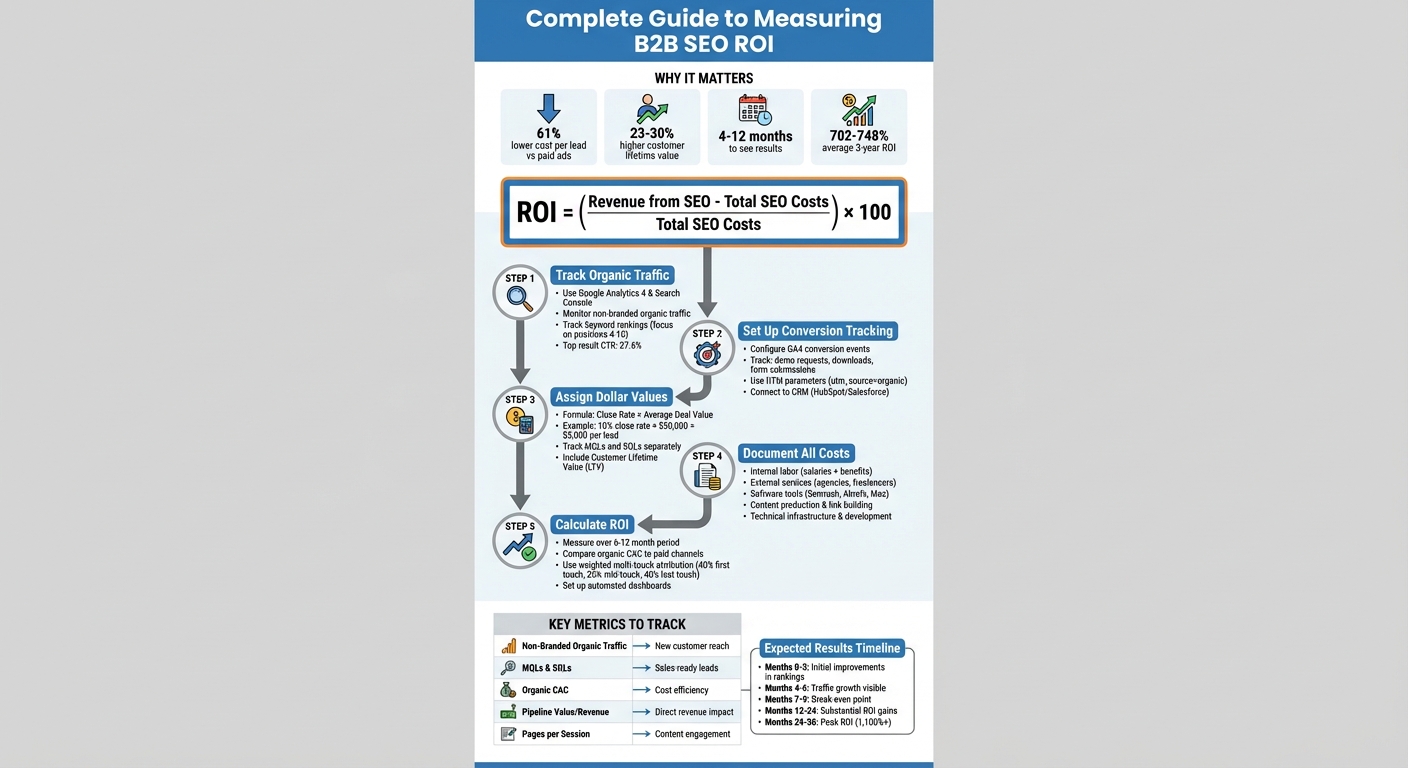
5-Step Process to Measure B2B SEO ROI with Key Metrics and Formula
Why You Need to Measure B2B SEO ROI
Measuring SEO ROI turns abstract metrics into tangible business outcomes. Instead of just reporting on keyword rankings or impressions, you can showcase results like revenue, pipeline growth, and profit – metrics that resonate with CEOs and CFOs. When you can demonstrate how organic search directly drives deals, SEO shifts from being seen as an expense to being recognized as a revenue generator.
ROI data does more than justify budgets – it shows how every dollar spent on SEO contributes to measurable returns. It also helps you allocate resources more effectively by identifying high-performing keywords and content. This kind of insight ensures your efforts focus on strategies that consistently deliver results.
Tracking ROI also supports long-term planning. It provides a foundation for accurate forecasting and realistic goal-setting, which is especially important in B2B. Unlike paid advertising, where results often stop when the budget runs out, SEO has a compounding effect. Content created today can keep driving conversions for years. Understanding this dynamic is key to appreciating how SEO fuels sustainable B2B growth.
How SEO Drives B2B Growth
SEO contributes to B2B growth in three main areas: generating leads, building brand awareness, and increasing revenue. Organic search is a cost-effective channel, producing leads at 61% less cost compared to other methods while delivering higher-quality prospects. Additionally, B2B customers acquired through organic search often have a 23% to 30% higher lifetime value than those gained through paid channels.
The long-term impact of SEO is powerful. Real-world examples illustrate its ability to drive revenue and improve budget efficiency. Take Buzzacott, an accounting firm that revamped its website and tracking systems in 2025. By fixing broken attribution models, they discovered that organic search was generating $17,100 more in value than previously estimated. Similarly, Payara, a software company, shifted its focus from "traffic growth" to "qualified pipeline from search." This pivot allowed them to pinpoint which keywords and content directly influenced sales, leading to smarter budget decisions. Another example is Checkwriters, a payroll and HR software provider, which implemented an automated executive dashboard in 2025. This tool tracked three critical metrics – monthly SEO-driven revenue, active pipeline influenced by organic search, and lifetime value trends – enabling their CEO to assess SEO performance in under 30 seconds.
Common Challenges in Measuring B2B SEO ROI
Despite its benefits, measuring SEO ROI in B2B isn’t without its hurdles. B2B sales cycles are often lengthy and complex, involving multiple decision-makers and touchpoints. For instance, a prospect might find your content in January, download a whitepaper in March, request a demo in May, and close the deal in July. Assigning the sale to just one touchpoint oversimplifies this journey.
To address this, weighted multi-touch attribution models (e.g., 40% credit to the first touch, 20% to mid-touch, and 40% to the final touch) ensure SEO gets proper recognition. Without this approach, up to 60% of conversions might go uncredited.
Another challenge is balancing lead quality with lead volume. As visibility grows, you may attract more unqualified leads. Measuring ROI by focusing on Sales-Qualified Leads (SQLs) helps ensure only leads with real conversion potential are counted. For example, one company saw its lead qualification rate drop from 45% to 15% as its visibility scaled.
The extended nature of B2B sales cycles adds another layer of complexity. As Maile Ohye from Google explains:
In most cases, SEOs need four months to a year to help your business first implement improvements and then see potential benefit.
This means leadership must set realistic expectations. While immediate results might not be feasible, showing steady progress and incremental wins helps keep stakeholders aligned as the strategy evolves.
Metrics and Formula for B2B SEO ROI
Core Metrics to Track
When measuring the ROI of B2B SEO, focus on metrics that tie directly to revenue rather than vanity stats like traffic or rankings. The key categories to monitor include traffic quality, lead generation, efficiency, and profitability.
Start by tracking non-branded organic traffic, which reflects how effectively your content attracts new prospects through generic searches. This metric shows your reach into untapped markets. Additionally, monitor Marketing Qualified Leads (MQLs) and Sales Qualified Leads (SQLs) generated from organic search. These leads represent potential customers who align with your ideal profile and are ready to engage with your sales team.
Efficiency is another critical area. Calculate your Organic Customer Acquisition Cost (CAC) by dividing total SEO expenses by the number of customers acquired through organic efforts. Compare this figure to your paid channel CAC to determine which channel offers better cost-effectiveness. Also, consider Customer Lifetime Value (CLV), as SEO-acquired customers often have a 20% to 30% higher lifetime value compared to those acquired through paid channels. This happens because customers who discover you organically tend to be a better match for your offerings.
Don’t overlook assisted conversions, which highlight SEO’s role in the early stages of the buyer journey. For instance, a potential customer might read several blog posts over a couple of months before eventually converting through a direct visit. Tools like Google Analytics 4 can help you track these interactions and showcase the indirect impact of your content.
| Metric Category | Specific B2B SEO Metric | Purpose |
|---|---|---|
| Traffic Quality | Non-Branded Organic Traffic | Measures reach to new potential customers. |
| Lead Generation | Organic MQLs & SQLs | Tracks the volume of sales-ready leads. |
| Efficiency | Organic CAC | Compares SEO acquisition cost to paid ads. |
| Profitability | Pipeline Value / Revenue | Links SEO efforts directly to revenue. |
| Engagement | Pages per Organic Session | Shows how well your content engages users. |
These metrics provide a solid foundation for evaluating your B2B SEO strategy. Now, let’s dive into how to calculate your overall ROI.
The B2B SEO ROI Formula
The formula for calculating B2B SEO ROI is simple:
ROI = ((Revenue from SEO – Total SEO Costs) / Total SEO Costs) x 100.
This gives you the percentage return on every dollar invested in SEO.
Revenue from SEO requires a thoughtful breakdown. Multiply the number of organic leads by your lead-to-customer conversion rate, then multiply the result by your Average Customer Lifetime Value (CLV). For example, if you generated 50 organic leads in the last quarter, converted 10% (5 customers), and your average CLV is $50,000, your revenue from SEO would be $250,000. For businesses that rely on offline sales, you can assign a "Goal Value" to leads using this formula: Average CLV × Lead-to-Customer Close Rate.
When calculating SEO costs, include everything: in-house salaries (adjusted for time spent on SEO), agency or freelancer fees, software subscriptions (like Semrush or Ahrefs), content production, link-building, and technical development. Many businesses underestimate their investment by leaving out developer hours or CMS maintenance, which can lead to inflated ROI figures.
Here’s a real-world example: Between May 2023 and May 2024, Stratabeat launched a blog for a robotics company that boosted their organic traffic value to $87,867 per month by targeting high-intent B2B content. If their monthly SEO costs totaled $15,000 (including content creation, technical improvements, and tools), their ROI calculation would look like this:
(($87,867 – $15,000) / $15,000) x 100 = 486% ROI.
Lastly, when attributing revenue to SEO, avoid relying solely on "last-click" models. Instead, use a weighted multi-touch attribution approach. For example, assign 40% credit to the first touch, 20% to mid-funnel interactions, and 40% to the last touch. This method ensures SEO receives proper recognition for its role across the entire buyer journey. By adopting this approach, you can better understand the true impact of your SEO efforts.
How to Measure B2B SEO ROI: Step-by-Step
Step 1: Track Organic Traffic and Keyword Rankings
Start by using Google Analytics 4 to monitor your organic search performance. In the "Traffic Acquisition" report, filter by "Organic Search" to view metrics like new users, engaged sessions, and engagement rates. Then, turn to Google Search Console (GSC) to track keyword rankings. GSC provides critical data such as average position, impressions, clicks, and click-through rates. Pay close attention to keywords ranking in positions 4–10 – these are often easier to optimize for better results.
Click-through rates are a great metric to monitor. For example, the top-ranking result in Google typically garners a 27.6% click-through rate, while the second and third spots average 15.8% and 11%, respectively. To dig deeper, use tools like Semrush or Ahrefs for additional insights. These platforms also calculate a "Traffic Value" metric, which estimates how much it would cost to generate the same traffic through paid ads. For instance, Canva’s estimated 19.8 million monthly organic visitors in the U.S. equate to a Traffic Value of $26.4 million. Make sure to segment your data between branded and non-branded traffic to clearly distinguish SEO-driven growth from overall brand awareness.
Once you’ve gathered your organic traffic and keyword data, the next step is to analyze how visitors interact with your website.
Step 2: Set Up Conversion Tracking
To measure meaningful actions from organic visitors, set up conversion events in Google Analytics 4. For B2B companies, these actions might include demo requests, whitepaper downloads, contact form submissions, or newsletter signups. Use standardized UTM parameters (e.g., utm_source=organic and utm_medium=search) to keep tracking consistent across all SEO campaigns.
To take this a step further, connect GA4 to your CRM system, such as HubSpot or Salesforce, to track how organic leads progress to closed-won deals. Multi-touch attribution is essential for B2B, where it often takes 2 to 5 touchpoints to generate a qualified lead. A weighted attribution model – assigning, for example, 40% credit to the first touch, 20% to mid-funnel interactions, and 40% to the last touch – can provide a clearer picture of SEO’s role throughout the buyer’s journey.
Once conversions are being tracked, the next step is to assign a monetary value to these leads.
Step 3: Assign Dollar Values to Leads
To calculate the value of each lead, use this formula:
Average Revenue per Conversion = Close Rate × Average Deal Value.
For example, if demo requests convert at 10% and the average deal value is $50,000, each demo request is worth approximately $5,000. Work with your sales team to pull historical conversion data from your CRM. Keep in mind that Sales Qualified Leads (SQLs) usually carry more value than Marketing Qualified Leads (MQLs).
For a broader perspective, consider incorporating Customer Lifetime Value (LTV) into your calculations. Multiply LTV by your lead-to-customer conversion rate for a long-term view. Interestingly, customers acquired through organic search often have a 20–30% higher LTV compared to those from paid channels. Adjust lead values based on search intent. For instance, transactional queries like "buy commercial software" are likely to convert at higher rates than informational queries like "what is B2B SEO".
This process establishes the revenue component needed for your ROI calculation.
Step 4: Document All SEO Costs
To get an accurate ROI, you’ll need to track every dollar spent on SEO. Break down expenses into five categories: internal labor, external services, software and tools, content and distribution, and technical infrastructure. For in-house efforts, calculate costs by multiplying the hours spent on SEO tasks by the fully loaded hourly rate, which includes salary, benefits, and overhead. If a team member works on SEO part-time, prorate their costs accordingly.
Don’t forget to include agency retainers, freelancer fees, and subscriptions for tools like Semrush, Ahrefs, or Moz. Also, track costs for content production, link building, guest posting, and promotional outreach. Many companies underestimate their investment by overlooking expenses like developer hours or CMS maintenance, which can lead to an inflated ROI.
To stay organized, maintain a monthly tracking spreadsheet. This ensures you capture all costs in real time and avoid missing any expenses when calculating ROI.
Step 5: Calculate and Analyze Your ROI
With all the data in place – traffic metrics, conversion tracking, lead valuation, and cost documentation – you’re ready to calculate ROI. Apply the ROI formula over a 6–12 month period to account for the compounding effects of organic growth and the longer B2B sales cycle. Keep in mind that it typically takes 4 to 12 months to see meaningful financial results from SEO improvements.
SEO’s Customer Acquisition Cost (CAC) is generally 40–60% lower than paid channels when properly attributed. To streamline reporting, consider setting up automated dashboards that pull real-time data on organic revenue and pipeline contributions. By regularly comparing organic CAC to other channels, you can spot trends early and adjust your strategy as needed, ensuring SEO remains a key driver of your overall growth.
Tools for Measuring B2B SEO ROI
The right tools can transform guesswork into actionable insights, helping you track everything from website traffic to revenue. Here’s how to make the most of them.
Google Analytics 4
Google Analytics 4 (GA4) is essential for tracking conversions and revenue from organic search. It uses a data-driven attribution model that highlights how organic search contributes throughout the B2B customer journey. To focus on SEO performance, customize your Traffic Acquisition reports by filtering the "Session default channel group" to "Organic Search".
To assign a dollar value to each conversion, multiply your lifetime value (LTV) by your lead-to-close rate. For example, if your LTV is $20,000 and your close rate is 15%, each lead is worth approximately $3,000. Additionally, pay attention to GA4’s "Engaged Sessions" metric, which captures sessions lasting over 10 seconds, those with conversions, or sessions with multiple page views. This metric offers a clearer view of traffic quality compared to traditional bounce rates. After analyzing this data, you can enhance your insights with competitive data from specialized SEO tools.
SEO Platforms: Semrush and Ahrefs

Platforms like Semrush and Ahrefs work alongside GA4 by offering keyword rankings, backlink data, and competitive insights that your analytics tool may not provide. These tools even estimate the paid acquisition cost for organic traffic. For instance, in May 2024, Semrush found that Canva attracted nearly 19.8 million monthly organic visitors from the U.S., with an estimated paid advertising cost of $26.4 million per month.
Ahrefs’ Keywords Explorer provides a "Traffic Potential" metric, showing the total traffic a top-ranking page receives from all its keywords. Meanwhile, Semrush’s Position Tracking tool lets you monitor keyword rankings and compare organic growth with up to four competitors. Both platforms also offer backlink analysis to identify which links drive the most referral traffic and boost your site’s authority. If you’re exploring options, Semrush even offers a free account that lets you track up to 10 keywords.
Google Sheets for Budget and ROI Tracking
Once you’ve gathered data from GA4 and SEO platforms, use Google Sheets to consolidate and analyze your SEO ROI. Combine revenue data from GA4, traffic value insights from Semrush or Ahrefs, and your SEO costs to calculate ROI using this formula: (SEO Revenue – SEO Costs) / SEO Costs.
Track all expenses, including internal resources, external services, software, content creation, and technical updates, as outlined earlier. Log costs monthly for detailed quarterly ROI reviews. To streamline tracking, use standard UTM parameters and consider creating separate tabs for branded and non-branded traffic. This distinction helps you see which efforts are driving new market demand versus capturing existing interest. Since SEO often takes 4–12 months to show results, reviewing ROI quarterly offers a more accurate picture of long-term performance.
sbb-itb-7a53647
Common B2B SEO ROI Mistakes to Avoid
After learning how to measure B2B SEO ROI, it’s just as important to recognize common mistakes that can distort your results. Let’s break down the most frequent errors and how to steer clear of them.
Ignoring the Long-Term Value of SEO
SEO is not a quick fix – it’s a long-term strategy that builds momentum over time. One of the biggest mistakes teams make is expecting immediate results. As Google’s Maile Ohye explains:
In most cases, SEOs need four months to a year to help your business first implement improvements and then see potential benefit
.
Some teams panic when results don’t show up within the first 60 days, but the real payoff often comes later. By Year 3, SEO ROI can outperform Year 1 results by as much as 12x. Unlike paid ads, which stop delivering the moment your budget runs out, content created today can continue to drive leads and conversions for months or even years. To fully capture these long-term benefits, it’s essential to focus on tracking metrics that reflect sustained growth.
Tracking the Wrong Metrics
A 200% increase in traffic might sound impressive, but if revenue remains flat, it’s a sign you’re focusing on vanity metrics. The problem isn’t that SEO doesn’t work for B2B – it’s that many teams prioritize the wrong data, like keyword rankings and traffic, over metrics like conversion rates.
For example, in 2025, Buzzacott, a B2B accounting firm, discovered they had overlooked $17,100 in organic search value due to flawed attribution tracking. By implementing full-funnel attribution across forms and calls-to-action, they uncovered SEO’s real impact. Similarly, Payara, a software company, shifted from tracking "organic traffic growth" to measuring "qualified pipeline from search." This change helped them identify which keywords were driving meaningful results and which high-traffic terms weren’t converting.
Another common misstep is relying exclusively on last-click attribution, which can undervalue SEO’s role by up to 340%. A weighted multi-touch attribution model offers a clearer picture of how SEO contributes throughout the buyer journey. It’s also vital to separate branded and non-branded traffic in your reporting. Branded searches (like someone typing your company name) often reflect existing awareness, not new demand. Segmenting these metrics ensures you’re measuring genuine organic growth.
Finally, don’t overlook the broader, less direct benefits that contribute to SEO’s overall ROI.
Overlooking Indirect ROI Contributions
Some of SEO’s most valuable contributions are indirect and take time to materialize. Educational content, for example, may not generate immediate sales but builds trust and authority, laying the groundwork for future conversions. As James from SEO Sherpa puts it:
SEO ROI includes ‘hard’ ROI, like sales revenue and lead conversions. But it also includes ‘soft’ ROI, such as increased brand visibility, improved trust, and audience growth that may not show up as revenue right away
.
To measure these indirect benefits, calculate your "paid replacement value." This involves multiplying your organic clicks by the average cost-per-click (CPC) for those keywords, showing how much you’re saving compared to running paid ads. Additionally, consider presenting two ROI perspectives to stakeholders: a "First-Purchase ROI" for a conservative estimate and a "Lifetime ROI" to reflect the compounding effects of your SEO efforts.
Timelines and Benchmarks for B2B SEO ROI
Short-Term vs. Long-Term Expectations
Understanding when to expect results is crucial for setting realistic goals. For most B2B SEO campaigns, the break-even point typically falls between months 7 and 9, following an initial investment period.
During the first 3 to 6 months, mid-market companies often notice early improvements in keyword rankings and organic traffic. These are promising signs that the strategy is on the right track, even if revenue growth hasn’t materialized yet. By 12 to 24 months, businesses can anticipate more substantial gains in market share and the benefits of compounding returns. The most significant ROI generally occurs between 24 and 36 months, with some campaigns achieving returns upwards of 1,100% by the three-year mark.
The timeline for seeing results can differ depending on company size:
- Small businesses (under $10 million in revenue): Initial results in 6 to 12 months, with meaningful growth by 18 to 24 months.
- Mid-market companies: Early wins in 3 to 6 months, with noticeable revenue impact between 12 and 18 months.
- Enterprise organizations: Initial results often take 6 to 12 months, while achieving dominance in competitive markets may require 18 to 36 months.
These timelines provide a framework for assessing progress and aligning expectations with benchmark metrics.
B2B SEO Benchmark Metrics
To gauge whether your SEO efforts are on track, it’s helpful to know what successful outcomes look like. On average, B2B SEO delivers an ROI of 702% to 748% over three years, outperforming most other marketing channels. Additionally, organic search generates leads at 61% lower costs than paid advertising, and customers acquired through SEO often have 20% to 30% higher lifetime values compared to those from paid channels.
Here are some key benchmarks to monitor:
| Metric | B2B Benchmark |
|---|---|
| Website Conversion Rate (Visitor to Lead) | 2% – 5% |
| Average Cost Per Lead (CPL) | ~$200 |
| Cost Per Demo Request | $600 – $800 |
| MQL to SQL Conversion Rate | 10% – 30% |
| SEO ROI (3-Year Average) | ~700% |
Timelines and ROI can also vary by industry. For example:
- B2B SaaS companies: Break even in 7 months, with a 3-year ROI of 702%.
- Financial services firms: Break even in 9 months, achieving a 1,031% ROI over three years.
- Manufacturing companies: Break even in 9 months, with an 813% return.
- Real estate firms: While they take 10 months to break even, their 3-year ROI can reach an impressive 1,389%.
These metrics and timelines underscore the long-term value of investing in SEO for B2B companies.
Conclusion
Measuring B2B SEO ROI isn’t just a nice-to-have – it’s what separates real growth from blind guesswork. Dan Burt from Breaking B2B sums it up perfectly:
If you’re not measuring ROI, you’re not managing growth. You’re guessing.
The approach laid out here moves the focus away from vanity metrics like keyword rankings and zeros in on what actually drives business outcomes: revenue, pipeline influence, and customer lifetime value. These are the metrics that fuel sustainable, revenue-focused SEO strategies.
Consistency is the secret ingredient. Track your metrics monthly and adjust budgets quarterly to account for search engine updates and seasonal trends. Automating your reporting with dashboards that pull live data from analytics and CRM systems ensures you catch issues early – like a 20% dip in organic revenue – before they spiral into bigger problems. And don’t overlook this: organic search drives 53% of all trackable website traffic, and SEO-acquired customers often deliver 20-30% higher lifetime value compared to paid channels.
Think of SEO as a long-term investment. It usually takes 4 to 12 months to see meaningful results, but the content you create today can keep generating leads for years without additional spending.
If you’re struggling with tracking gaps, attribution challenges, or getting buy-in from leadership, teaming up with experts can fast-track your progress. Specialists like Organic Media Group can help you implement multi-touch attribution, focus on high-intent keywords, and design dashboards that connect SEO efforts directly to business outcomes. With experience across 650+ campaigns, they’re equipped to deliver strategies that prioritize pipeline growth over surface-level metrics.
The businesses that succeed with SEO are the ones that measure everything and adapt strategically. Start tracking the metrics that matter today, and you’ll be well-positioned to reap the long-term rewards that make SEO one of the most effective growth channels for B2B companies.
FAQs
What are multi-touch attribution models, and how do they help measure SEO ROI?
Multi-touch attribution models allocate credit across all critical interactions a buyer experiences throughout their journey – like the initial visit, mid-funnel activity, and the final conversion. This method ensures that SEO’s contribution to building early awareness and assisting conversions is properly recognized, rather than placing all the emphasis on the last-click interaction.
By highlighting SEO’s influence at every stage, businesses can better understand its overall impact on ROI. This insight enables them to make smarter decisions, refine their strategies, and achieve stronger outcomes.
What are the key metrics to measure B2B SEO success?
To gauge the effectiveness of your B2B SEO strategy, keep an eye on key metrics like organic traffic growth, keyword rankings, and click-through rates for high-intent keywords. These indicators reveal how well your content is performing in search results and attracting the right audience.
Beyond traffic, it’s crucial to track qualified leads, conversion rates, and the revenue generated from SEO efforts. These metrics highlight how SEO contributes to your bottom line and aligns with broader business goals.
For a deeper understanding of ROI, include metrics such as customer acquisition cost (CAC) and pipeline revenue tied to SEO. These figures provide a clearer picture of how your SEO efforts translate into tangible business outcomes.
Why is SEO a long-term strategy for B2B companies?
SEO works as a long-term approach for B2B companies because it focuses on creating steady growth by improving organic visibility. Unlike paid ads, which offer quick but short-lived results, SEO builds momentum over time, leading to consistent traffic, leads, and revenue.
When businesses invest in well-crafted content, technical SEO improvements, and link-building strategies, they can position themselves as industry leaders. This not only boosts their rankings but also delivers results that can last for months or even years. While the payoff isn’t instant, the lasting benefits make SEO a smart and cost-efficient choice for driving B2B growth.