
When deciding how to pay for SEO services, you typically choose between project-based pricing or a monthly retainer. Each model has its strengths based on your goals, budget, and timeline:
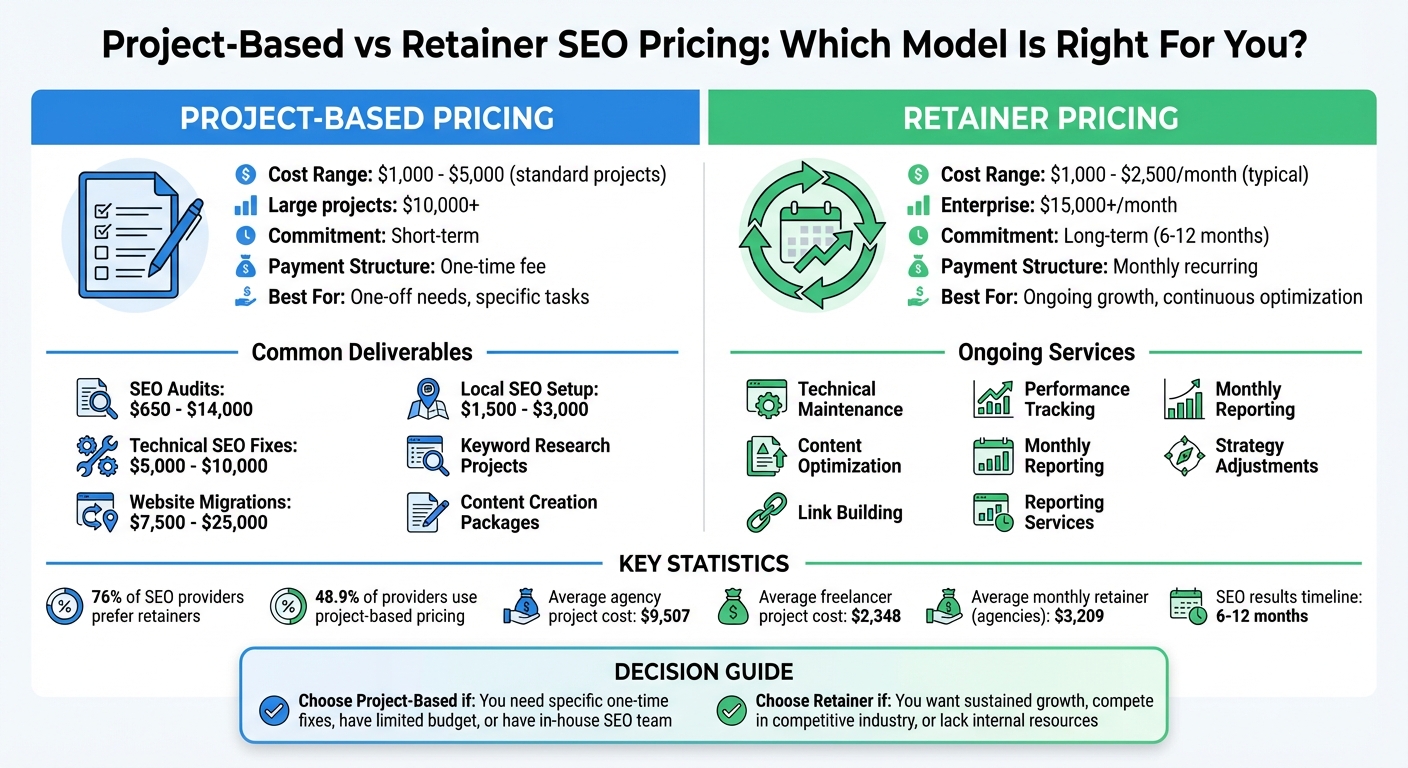
- Project-Based Pricing: Pay a one-time fee for specific tasks with clear deliverables (e.g., audits, migrations). Costs range from $1,000 to $5,000 for standard projects, but larger tasks can exceed $10,000.
- Retainer Pricing: Pay a recurring monthly fee (usually $1,000 to $2,500) for ongoing services like content creation, link building, and optimization. Long-term commitment (6–12 months) is common, and results take time.
Quick Tip: Use project-based pricing for one-off needs or short-term tasks. Opt for a retainer if you want consistent growth and long-term SEO improvements.
Quick Comparison
| Factor | Project-Based Pricing | Retainer-Based Pricing |
|---|---|---|
| Cost | Fixed per project ($1,000–$5,000) | Monthly ($1,000–$2,500) |
| Scope | Defined tasks | Continuous improvements |
| Commitment | Short-term | Long-term (6–12 months) |
| Best For | One-time needs | Ongoing SEO growth |
Both models have pros and cons. The right choice depends on whether you need short-term fixes or a long-term SEO strategy.
Project-Based vs Retainer SEO Pricing Comparison Guide
What Is Project-Based SEO Pricing?
Project-based SEO pricing involves a one-time fee for completing a specific SEO task with clearly outlined deliverables and a set timeline. Instead of committing to ongoing monthly payments, you’re essentially hiring an agency or freelancer to tackle a defined project.
This pricing model works well for tasks that have a clear beginning and end. Think of it like hiring a contractor to remodel your kitchen: you agree on the scope, price, and deadline ahead of time. Typical examples include conducting a technical site audit, resolving critical errors before a website launch, or running a one-time link-building campaign.
How much does it cost? That depends on the complexity of the project. Simpler tasks, like basic keyword research or quick site health checks, often cost less than $1,000. Mid-range projects – such as audits or bundled content services – usually fall between $1,000 and $5,000, which accounts for 52% of SEO projects in the US, UK, and Australia. More advanced projects, like a full technical overhaul, may cost between $5,000 and $10,000. For enterprise-level websites or highly competitive industries, costs can climb to $10,000 to $30,000 or more.
On average, SEO agencies charge $9,507 per project – over four times what freelancers charge, which averages $2,348. Experience also plays a big role: SEO professionals with 5–10 years of experience typically charge $9,087 per project, while those with less than two years average $1,881. Interestingly, nearly half (48.9%) of SEO service providers use this pricing model for at least part of their work. Let’s take a closer look at the typical deliverables that fall under this approach.
Common Deliverables in Project-Based Pricing
Here are some of the most common deliverables you’ll find in project-based SEO pricing:
- SEO audits: These are often the most sought-after projects, with costs ranging from $650 to $14,000, depending on the size and complexity of your site. Audits involve crawling your website to uncover technical issues and providing a prioritized roadmap for fixes.
- Keyword research projects: These identify the search terms your target audience uses. They’re often bundled with competitive analysis and search intent mapping for a comprehensive approach.
- Technical SEO fixes: These projects address specific problems like site speed, mobile responsiveness, broken redirects, or schema markup errors. Larger-scale fixes can cost between $5,000 and $10,000.
- Website migrations: Whether you’re changing domains, switching CMS platforms, or restructuring your site, migrations are critical to preserving your rankings. Costs for these projects typically range from $7,500 to $25,000 or more, depending on the site’s size.
- Content creation packages: These deliver a set number of optimized blog posts, landing pages, or product descriptions tailored to your SEO goals.
- Link-building campaigns: These projects focus on securing a specific number of high-quality backlinks within a set timeframe.
- Local SEO setup projects: Priced between $1,500 and $3,000, these projects include optimizing your Google Business Profile and building local citations.
- Google penalty cleanup projects: These involve identifying and removing harmful links or content to restore your site’s standing with Google.
The success of project-based pricing hinges on clearly defining the scope of work upfront.
As Scott Wilson, Founder of Digital Influence, puts it: "If we are working with a client on a project that is expected to last for a short period of time, then a short-term contract can be beneficial. This is because it allows us to be flexible and adjust the contract if the project evolves or changes in any way."
What Is Retainer SEO Pricing?
Retainer SEO pricing is all about building an ongoing partnership with SEO specialists. Instead of tackling SEO as a one-off project, this model operates on a fixed monthly fee to ensure continuous optimization. It’s designed to adapt to ever-changing market conditions and search engine algorithms. As Irina Shvaya, Founder of eSEOspace, puts it: "It’s a continuous, strategic partnership. This model acknowledges that SEO is not a one-time event but a sustained process of strategy, implementation, analysis, and adaptation". The goal? To keep your site optimized as algorithms evolve and competitors shift their strategies.
Monthly retainer costs vary widely depending on the scope of work. For example:
- Local SEO services typically start at $1,500 per month.
- Small businesses may spend between $2,500 and $5,000 monthly.
- Mid-market companies often pay $4,000 to $8,000.
- Enterprise-level SEO can exceed $15,000 per month.
Interestingly, most SEO agencies (64%) charge less than $1,000 per month for retainers, while only 13% fall into the $2,000 to $5,000 range. On average, agencies charge about $3,209 per month, consultants average $3,250, and freelancers charge significantly less at $1,348.
Agencies typically structure retainer agreements around dedicated hours or resources each month. Early on, the focus is on technical fixes and on-page optimization. Over time, priorities shift toward creating new content and building the website’s authority. SEO results don’t happen overnight – most agencies recommend a minimum commitment of 3 to 6 months, with meaningful outcomes often taking 6 to 12 months.
For instance, Hunter Talent, an Australian talent agency, partnered with StudioHawk on a $1,500 monthly retainer from October 2020 to February 2025. Over those 60 months, they saw a staggering 2,610% increase in organic traffic and generated roughly $3.8 million in additional revenue.
Now, let’s dive into what’s typically included in these retainer packages.
Services Included in Retainer Pricing
Retainer packages bundle together a variety of essential SEO tasks to keep your website performing its best. Here’s what you can usually expect:
- Technical Maintenance: Monthly site audits, monitoring Core Web Vitals, and resolving indexing issues to ensure your site runs smoothly.
- Content Optimization: Updating keyword strategies, refreshing older content, and creating new blog posts or landing pages to target emerging search terms.
- Link Building: Securing high-quality backlinks through outreach, managing guest blogging opportunities, and building local citations to boost authority.
- Performance Tracking and Reporting: Regular updates on keyword rankings, traffic trends, and strategy adjustments, often paired with monthly calls to discuss progress.
These services work together to ensure your SEO strategy stays aligned with algorithm updates and shifts in the competitive landscape.
Pros and Cons of Project-Based vs Retainer Pricing
Choosing between project-based and retainer pricing depends on the priorities and needs of both agencies and their clients. Each model has its own set of advantages and challenges, shaping how work is structured and billed.
Retainer pricing offers agencies a steady, predictable revenue stream. In fact, 76% of SEO providers prefer retainers because they help avoid the "feast or famine" cycle that often comes with project-based work. For clients, retainers provide consistent monthly fees, which can simplify budgeting, but they often come with long-term commitments.
As Luke Dane, Founder & Director of Sprocket Digital, puts it: "I think long-term contracts mostly serve the agency as they can lock down recurring revenue for a set period, but the client is stuck regardless of the outcome".
On the other hand, project-based pricing gives businesses transparency and control over costs. For instance, a technical audit might cost $1,000, while a comprehensive content package could be $5,000. This approach works well for companies with one-off needs or those hesitant to commit long-term. However, for agencies, the downside is a lack of revenue stability, as they must constantly secure new projects to maintain cash flow.
While project-based pricing allows for greater flexibility and quicker adjustments, it can become complicated when project scopes change, requiring renegotiation. Retainers, especially those using a "bucket of hours" system, handle workload fluctuations better on a month-to-month basis. However, adjusting the terms of a retainer mid-contract can be challenging for both parties.
From a long-term perspective, retainers often yield better results. SEO efforts typically take 6–12 months to show measurable impact, and value-based retainers have been shown to improve client retention rates by 35%.
Rocky Pedden, President of RevenueZen, highlights this point: "Being able to have the time to show the impact of SEO is really important. Depending on the client that can take anywhere from 6-12 months, so having the time to build that allows the agency to show ROI".
The table below breaks down the key differences between the two pricing models:
Comparison Table
| Factor | Project-Based Pricing | Retainer-Based Pricing |
|---|---|---|
| Revenue Stability | Low: Income varies with project availability | High: Provides a consistent monthly stream |
| Cost Predictability | High for specific tasks: Fixed per project | High overall: Fixed monthly costs |
| Scope Flexibility | High: Easy to adjust between projects | Moderate: Adjusts within monthly workloads |
| Client Commitment | Short-term: Typically weeks to months | Long-term: Minimum of 6–12 months |
| Scalability | Low: New contracts needed for additional work | High: Allows for strategy-based growth |
| Outcome Predictability | High: Focused on specific deliverables | Moderate: Focused on long-term ROI |
sbb-itb-7a53647
When to Choose Each SEO Pricing Model
Picking the right SEO pricing model depends on your business’s goals, budget, and timeline. Each approach caters to different needs, and knowing when to use each can help you avoid unnecessary expenses and delays.
Best Scenarios for Project-Based Pricing
Project-based pricing is ideal for tasks with a clear start and finish. Think of technical SEO audits, website redesigns, or CMS migrations – these are specific projects that don’t require ongoing work. If you’re launching a product or need to tackle a particular issue quickly, this model lets you get the job done efficiently.
For startups or small businesses with tighter budgets, this approach can be especially appealing. Instead of committing to a $1,500–$3,000 monthly retainer, they can allocate $3,000–$7,500 for foundational tasks like keyword research, setting up local SEO, or conducting a detailed audit. Companies with in-house SEO teams also use project-based pricing when they need outside expertise for specialized tasks – such as schema markup updates, content sprints, or focused link-building campaigns.
Scott Wilson, Founder of Digital Influence, notes: "If we are working with a client on a project that is expected to last for a short period of time, then a short-term contract can be beneficial. This is because it allows us to be flexible and adjust the contract if the project evolves or changes in any way".
However, if your goal is ongoing growth and sustained performance, a retainer model might be a better fit.
Best Scenarios for Retainer Pricing
Retainer pricing is designed for businesses aiming for long-term growth. SEO is a marathon, not a sprint – it often takes six to twelve months to see measurable results. A retainer model ensures consistent efforts to build domain authority and stay ahead in competitive spaces.
This model is especially useful for continuous optimization. With frequent algorithm updates, ongoing monitoring is crucial. Retainers cover tasks like content marketing, link building, and Core Web Vitals improvements – areas that demand steady attention rather than one-time fixes.
Industries like finance, legal, and healthcare particularly benefit from retainer pricing. These competitive sectors require constant adjustments to maintain strong rankings. A retainer ensures your agency can proactively refine strategies instead of just reacting to issues.
Joe Gilbert, Managing Director of Red Giraffe, explains: "It takes time to build domain authority and gain improved rankings. A long-term contract can help them get to where they want to be in that time, as opposed to having clients drop out if they don’t see immediate results".
Up next, let’s look at hybrid SEO pricing models and how they combine the advantages of both approaches.
Hybrid SEO Pricing Models
A hybrid model blends the consistency of a monthly retainer with the flexibility of project-based fees for specific tasks. This structure ensures steady progress in SEO while allowing for special projects without renegotiating long-term agreements. It’s an approach many SEO professionals are adopting – 74.7% already charge monthly retainers, with many adding project-based work to address evolving client needs.
Here’s how it typically works: You pay a monthly fee for ongoing services like technical audits, keyword tracking, and performance reporting. On top of that, you’re charged separately for one-off projects, such as site migrations, seasonal campaigns, or product launches. This setup makes it clear which services are included and which fall outside the scope of the retainer.
Amanda Walls, Founder of Cedarwood Digital, highlights this challenge: "Managing expectations outside of scope – although we have retainer-based services we have often had clients request elements… as an extra that’s outside of scope, not included within the monthly hours".
This model is especially useful for businesses with fluctuating or seasonal demands. For example, you can maintain baseline SEO through the retainer and ramp up project-based efforts during peak sales periods. Some agencies even take a phased approach: starting with full-service execution on a retainer and later transitioning to a "co-delivery" model. In this setup, the client handles daily tasks while the agency provides tools and strategic guidance, often charging a SaaS fee plus a reduced management fee.
Jay, Founder of Linkilo, explains: "Combining a retainer for ongoing maintenance with project-based pricing for specific campaigns can be highly effective".
The success of hybrid pricing lies in setting clear boundaries. Be explicit about what’s included in the monthly retainer and what triggers a separate project fee. This clarity helps avoid misunderstandings and ensures both parties are aligned. By combining the strengths of both pricing models, hybrid pricing supports long-term SEO goals while remaining adaptable to immediate needs. For businesses on the rise, it offers predictable costs with the flexibility to seize new opportunities as they come.
Conclusion: Choosing the Right Model for Your Business
After reviewing project-based, retainer, and hybrid pricing models, the best choice ultimately depends on your business’s specific needs. The right SEO pricing model should align with your goals, budget, and timeline. Retainers are ideal for ongoing optimization and long-term strategies that build domain authority over time. On the other hand, project-based pricing works well for one-off tasks with clearly defined deliverables. Retainers provide predictable monthly costs, simplifying budgeting, while project fees can fluctuate based on immediate needs. If you’re unsure about committing to a long-term partnership, starting with a short-term pilot retainer can help you test the waters without a significant commitment.
"Being able to have the time to show the impact of SEO is really important. Depending on the client that can take anywhere from 6-12 months, so having the time to build that allows the agency to show ROI."
– Rocky Pedden, President, RevenueZen
Consider your internal resources as well. If your team lacks the capacity to implement technical recommendations or produce content, a retainer that includes both strategy and execution can help you achieve results more quickly. For businesses with seasonal demands or specific high-impact initiatives, a hybrid model might be the perfect middle ground. This approach combines the strengths of both retainers and project-based pricing, ensuring your investment supports both immediate needs and long-term SEO objectives.
Ultimately, the key is to match the pricing model to your specific service requirements. Use project-based pricing for focused tasks like audits or technical fixes, and opt for retainers if you’re aiming for consistent growth in competitive industries. As Zac Harris from Orbit Media wisely notes:
"SEO is a process, not a project."
This insight serves as a reminder that a sustained, strategic approach is essential for long-term success.
FAQs
What are the benefits of choosing a retainer-based SEO pricing model instead of project-based pricing?
A retainer-based SEO pricing model provides steady, ongoing support designed to align with your business’s changing needs. This model ensures regular optimization, consistent maintenance, and a long-term strategy aimed at delivering lasting growth.
Unlike project-based pricing, which is centered on one-time tasks, a retainer establishes a continuous partnership. It allows for recurring efforts to adjust to shifts in search engine algorithms, industry trends, and your business objectives. This setup works well for businesses looking for predictable expenses and consistent, measurable progress.
Should my business choose project-based SEO or a monthly retainer?
Deciding between project-based SEO and a monthly retainer boils down to your business goals, timeline, and budget.
For short-term goals – like conducting a technical SEO audit, running a link-building campaign, or optimizing specific landing pages – a project-based approach works best. It comes with a defined scope, clear costs, and a set timeline. But if your aim is long-term growth, such as improving domain authority or steadily increasing organic traffic, a monthly retainer is the way to go. It ensures consistent, ongoing support to adapt and refine strategies over time.
Budget plays a key role too. A project-based fee is a one-time payment, while a retainer spreads costs out monthly, offering more predictable cash flow. If your team doesn’t have the bandwidth to handle regular SEO tasks, a retainer guarantees continuous expert management. For businesses needing both occasional deep-dive projects and ongoing optimization, agencies like Organic Media Group often offer flexible plans. You can start with a project and transition into a retainer as your needs evolve.
Is a hybrid SEO pricing model the right choice for my business?
A hybrid SEO pricing model blends the consistency of a monthly retainer with the adaptability of project-based fees, making it a practical choice for many businesses. The monthly retainer covers ongoing essentials like technical upkeep, content production, and performance monitoring, ensuring steady progress and predictable costs. On the other hand, project-based fees let you allocate funds for specific, time-sensitive efforts such as site audits, link-building campaigns, or product launches.
This model provides a balanced solution: dependable monthly services to keep your SEO efforts on track, paired with the flexibility to tackle high-impact, short-term projects as they arise. For instance, you might spend $2,500–$5,000 monthly on core services and add project fees for targeted initiatives. This setup allows your SEO strategy to stay aligned with your business objectives and market shifts, ensuring you’re investing in what matters most, exactly when it’s needed.