Want to boost your brand’s authority and search rankings? Online PR (or Digital PR) is one of the most effective ways to achieve both. By earning media coverage on trusted platforms, you can secure high-quality backlinks, improve SEO, and position your brand as an industry leader.
Key Takeaways:
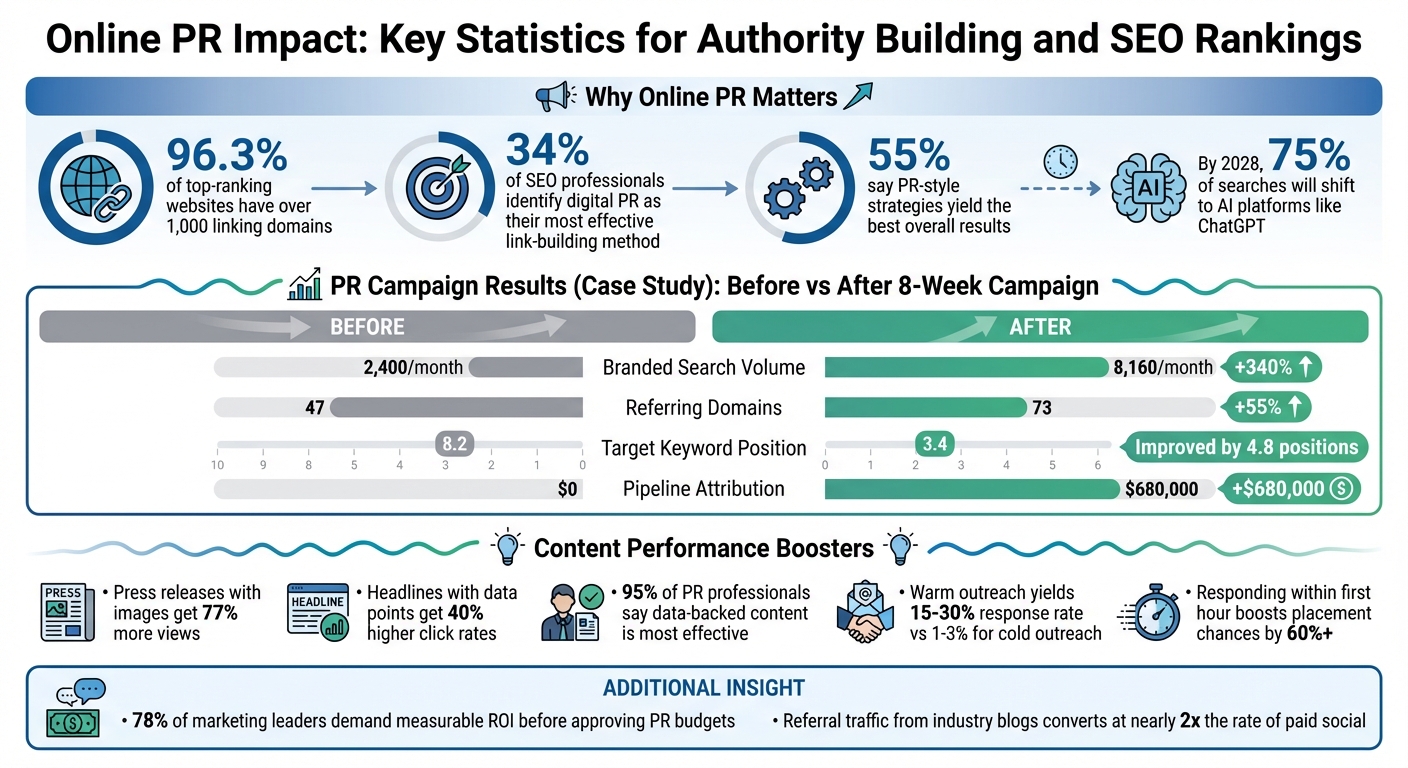
- Why it matters: 96.3% of top-ranking websites have over 1,000 linking domains. Online PR helps you earn these valuable backlinks.
- How it works: Secure mentions in high-authority publications, which build trust with both readers and search engines.
- AI relevance: By 2028, 75% of searches will shift to AI platforms like ChatGPT. Brands cited in trusted media will dominate these results.
- Proven results: Case studies show PR campaigns can lead to 340% branded search growth, 55% more referring domains, and significant revenue gains.
This guide breaks down actionable strategies like press releases, media outreach, and influencer partnerships to help you strengthen your brand’s credibility and achieve measurable growth.
Online PR Impact: Key Statistics for Authority Building and SEO Rankings
How Online PR Builds Trust and Improves SEO Rankings
Online PR plays a dual role: it builds trust among people and signals authority to search engines. When a well-known publication highlights your brand, it boosts your credibility with readers while also acting as a third-party endorsement that search engines value. According to a 2026 survey, 34% of SEO professionals identified digital PR as their most effective link-building method, and 55% said PR-style strategies yielded the best overall results.
Mentions from high-authority sites significantly enhance your brand’s credibility. For instance, a single feature on a website with a Domain Rating (DR) of 80+ can carry the same weight as 20 to 40 mid-tier guest posts. Beyond traditional SEO, these endorsements are gaining importance with AI platforms, which increasingly prioritize such mentions. As tools like ChatGPT and Google AI Overviews become central to answering user queries, PR teams are now tracking how often AI platforms cite their brand as a key performance indicator (KPI). This not only impacts search rankings but also strengthens your brand’s reputation, as explained further below.
How Online PR Strengthens Brand Credibility
Credibility isn’t something you can claim – it’s something you earn. When a journalist writes about your brand, it validates your business in the eyes of the audience. This effect is amplified by the mere exposure phenomenon, which suggests that repeated appearances in media increase familiarity, leading to greater consumer trust.
Take the example of CBB Design Firm. In October 2025, they were featured in high-profile outlets like Architectural Digest (DA 92) and Martha Stewart (DA 91). These placements not only generated valuable backlinks but also built semantic connections that helped search engines understand the firm’s expertise in luxury design.
This kind of authority-building operates on two levels. For human audiences, consistent media coverage establishes thought leadership. For search engines, it supports "entity lifting", a process where your brand is recognized as a reliable source within a specific niche. Former Google engineer Jun Wu described it best:
"Authority emerges from being recognized as a source within specific informational hubs".
The more often your brand appears in media alongside relevant topics, the stronger the semantic connections become. This helps search engines and AI platforms better identify your expertise. To achieve this, focus on securing coverage in outlets that align with your industry’s core topics, ensuring your brand is consistently associated with key areas of expertise.
SEO Benefits of Online PR Campaigns
Beyond building credibility, online PR delivers tangible SEO benefits. Backlinks from high-authority websites (DR 60–95+) enhance your domain authority. These mentions act as endorsements that reinforce your position as an industry expert.
Online PR also drives referral traffic, which can improve engagement metrics and positively impact organic rankings. Referral traffic from respected industry blogs often converts at nearly double the rate of paid social media campaigns. For example, a targeted press release campaign in the real estate industry led to an 83% increase in traffic and better Local Pack rankings.
| Factor | Earned Editorial | Negotiated Placement |
|---|---|---|
| Link Placement | Journalist’s choice | Paid or negotiated placement |
| Domain Authority | DR 60 to DR 95+ | DR 20 to DR 60 |
| E-E-A-T Signal | Very High (journalistic trust) | Moderate (paid endorsement) |
| AI Citation Potential | Very High | Low to Moderate |
What’s more, online PR helps safeguard your SEO efforts. A diverse presence across respected publications sends strong trust signals, making your rankings more resilient to algorithm updates. With the growing role of AI platforms in search, spreading mentions across high-authority outlets is becoming an essential strategy. To get the most out of this approach, focus on securing features in publications with high domain authority and relevance to your field.
Core Online PR Strategies to Build Authority
Expanding on the earlier focus on SEO benefits and trust-building, these four strategies are designed to secure high-quality backlinks while amplifying your brand’s authority. Each approach has its own strengths, but together they form a well-rounded system that earns credibility from both audiences and search engines.
Start with press releases that meet professional journalistic standards. An effective press release includes a concise, attention-grabbing headline under 100 characters, a lead paragraph answering the five Ws within the first 25–40 words, and at least one expert quote offering meaningful insight. For instance, in 2025, a Nashville-based health tech company adopted a monthly press release strategy using AP style, data-focused headlines, and high-resolution visuals. Over a year, the company saw its Domain Authority jump from 24 to 31, gained 127 DA 80+ backlinks, and experienced a 47% increase in organic traffic. Timing matters, too – distribute releases between Tuesday and Thursday, ideally from 8:00 AM to 10:00 AM ET, to maximize newsroom visibility. After crafting your release, shift your focus to building relationships with key media professionals.
Media outreach is all about connecting with journalists in a meaningful way. Start by identifying reporters who cover your niche and engaging with their work before pitching. Cold outreach typically yields a low 1–3% response rate, but warm outreach – where you’ve already established some rapport – can result in a much higher 15–30% response rate. Spend 2–4 weeks engaging with a journalist’s content on social media or referencing their work in your own before reaching out. When you send your pitch, keep it concise (100–200 words) and lead with your strongest quote, making it easy for journalists to copy and paste. Acting quickly is crucial – responding to a journalist’s query within the first hour can boost your placement chances by over 60%.
Influencer collaborations are another powerful tool, as they provide third-party trust signals that search engines and AI systems recognize. To make these partnerships effective, offer influencers clear story angles, robust data, and prompt communication. Prioritize niche relevance over general authority – a mention in a highly specific industry publication often carries more weight for your SEO strategy than a link from a broader, high-Domain Authority site. This targeted approach aligns seamlessly with a long-term strategy for building credibility.
Finally, digital storytelling focuses on creating data-driven content that journalists are eager to cite. According to 95% of PR professionals, data-backed content is their most effective tool for gaining media coverage. Including at least one high-resolution image in a press release can increase views by 77%, while headlines featuring specific data points can boost click rates by up to 40%. Structure your content clearly so AI-powered search engines can easily identify and attribute key facts – use bullet points, headers, and clear attribution to make your brand stand out. These tactics not only enhance your digital presence but also solidify your brand’s authority in its field, a core principle of Organic Media Group’s strategy.
Online PR Techniques by Organic Media Group
Guest Posting and Link Building for Topical Authority
Organic Media Group uses guest posting as a key strategy to establish authority. Their approach focuses on securing editorial placements in publications that align closely with a client’s niche. By doing this, they ensure that each link not only boosts visibility but also strengthens topical relevance. This method helps build credibility with search engines by connecting editorial mentions to algorithmic trust.
Their process is thorough: it starts with in-depth research, followed by personalized outreach and the creation of content that genuinely resonates with the audience of the host publication. Instead of chasing high Domain Authority scores for the sake of it, the agency emphasizes contextual relevance. For example, a guest post on a niche-specific blog often has a bigger SEO impact than a generic placement on a broader site. Through these targeted placements, Organic Media Group crafts strategies that turn editorial wins into tangible, measurable growth.
Custom PR Strategies for Measurable Results
In addition to guest posting, Organic Media Group develops tailored PR strategies designed to achieve clear, measurable outcomes. By leveraging proprietary data, surveys, and public statistics, they create stories that are credible and appealing to journalists. Once media coverage is secured, the agency boosts its impact by sharing the story across owned platforms like blogs and newsletters, ensuring it reaches a broader audience and stays relevant longer.
"Organic Media Group was very professional and helped us grow faster than any other strategy we tried. Within three months, we achieved first-page rankings in a competitive industry." – Mark, CEO
This layered approach ensures that PR efforts drive meaningful results, like quality leads, rather than just vanity metrics. With a perfect 5-star client rating and over 650 successful SEO campaigns under their belt, Organic Media Group’s methods consistently lead to first-page rankings and long-term growth.
sbb-itb-7a53647
Measuring the Success of Online PR Campaigns
Key Metrics for Authority and SEO Performance
Tracking the right metrics is essential to separate impactful PR campaigns from wasted resources. With 78% of marketing leaders now demanding measurable ROI before approving next year’s PR budgets, it’s clear that proving value is no longer optional. Yet, 75% of marketers admit their current systems fall short when it comes to demonstrating PR’s impact.
To start, focus on authority metrics like Domain Authority, Domain Rating, and the number of unique referring domains. A single backlink from a high-authority publication like The Wall Street Journal or Forbes can outweigh dozens of mentions on lower-authority sites [28,29]. Beyond that, dive into SEO performance indicators such as:
- Growth in organic traffic
- Improved keyword rankings for terms featured in your PR content
- Search impressions tracked through Google Search Console
Fast forward to 2026, and measuring Generative Engine Optimization (GEO) has become just as important. This involves monitoring how often your brand is cited in AI-generated responses on platforms like ChatGPT or Perplexity [27,29]. With zero-click searches on the rise, being recognized as a trusted source by AI systems is now as impactful as earning traditional backlinks.
"If PR professionals want to prove their impact, they need to go beyond tracking SEO to also understand their visibility in GEO as well." – Katie Delahaye Paine, CEO, Paine Publishing
Another key metric? Branded search spikes, which offer a direct view of growing brand awareness. Pair these insights with UTM parameters to link referral traffic to engagement metrics like time on page and bounce rate [26,27]. Some organizations have seen PR ROI climb by 300–500% by tying these activities directly to revenue and customer acquisition.
Now, let’s explore how before-and-after comparisons can bring these metrics to life.
Visualizing Results with Before-and-After Comparisons
Metrics like these allow for clear before-and-after snapshots of PR campaign performance. Take this example from early 2026: A mid-market B2B SaaS company kicked off an eight-week PR campaign, landing features in Forbes, TechCrunch, and VentureBeat. The results were impressive:
- Branded search volume surged by 340%, jumping from 2,400 to 8,160 monthly searches.
- Referring domains increased by 55%, from 47 to 73.
- Their ranking for the target keyword "AI workflow automation" improved from 8.2 to 3.4.
- The campaign generated $680,000 in new pipeline opportunities.
Here’s a closer look at the data:
| Metric | Before Campaign | After 8 Weeks | Change |
|---|---|---|---|
| Branded Search Volume | 2,400/month | 8,160/month | +340% |
| Referring Domains | 47 | 73 | +55% |
| Target Keyword Position | 8.2 | 3.4 | Improved by 4.8 positions |
| Pipeline Attribution | $0 | $680,000 | New revenue stream |
To replicate this success, establish baseline metrics at least 30 days before launching your campaign. Track branded search volume, referring domains, keyword rankings, and organic traffic levels. Tools like Google Analytics 4 can help you measure assisted conversions, which highlight how PR exposure serves as a critical touchpoint in the customer journey. This approach reveals PR’s broader role in driving measurable business outcomes – not just last-click attribution.
Conclusion
Online PR plays a key role in connecting your brand’s story to better search visibility. As John Mueller from Google explains:
"Digital PR is just as critical as technical SEO".
With 96.3% of top-ten search results having over 1,000 linking domains, earning media coverage from trusted sources is what sets high-ranking brands apart. These numbers highlight the potential for measurable success, as seen in recent case studies.
The strategies discussed – from crafting newsworthy press releases to gaining coverage in respected outlets and optimizing for AI platforms – work because they align with what search engines and AI models prioritize: third-party validation. By 2028, it’s expected that 75% of searches will shift to AI-driven platforms. If your brand isn’t cited as a credible source in AI-generated responses, you risk losing visibility where it matters most.
Consider this: a tech startup achieved a 47% increase in referring domains within two weeks by focusing on SEO-optimized press releases distributed through reliable networks. Similarly, a real estate professional saw an 83% jump in organic traffic in January 2026 after a strategically placed announcement. These examples demonstrate the tangible impact of a well-planned, data-driven PR strategy. Setting clear objectives is crucial to achieving such results.
Start by defining SMART goals – such as boosting traffic by 20%, earning 100 new brand mentions, or improving rankings for three target keywords within 90 days. Focus on metrics like referring domains, branded search volume, and AI citations rather than vanity metrics like impressions. Keep in mind that campaigns typically take 60 to 90 days to gain traction, so consistency and patience are essential.
Organic Media Group has successfully executed over 650 SEO campaigns, integrating link building, content marketing, and technical SEO to deliver results. The online PR strategies outlined in this guide – press releases, media outreach, influencer partnerships, and digital storytelling – work together to establish authority and trust. Whether you’re a local business or scaling nationally, applying these tactics with care and persistence can lead to higher search rankings and increased revenue.
FAQs
How do I choose the right publications to pitch?
When selecting publications to pitch to, focus on those that align closely with your industry and target audience. Start by researching their editorial style and the topics they frequently feature. This will help you craft a pitch that resonates with their focus.
Build a targeted media list by identifying journalists who cover your niche. Personalize each pitch to demonstrate that you’ve done your homework and understand their interests. Taking the extra time to tailor your outreach can make all the difference.
Another effective strategy is to respond quickly to journalist queries on sourcing platforms. Being timely and relevant increases your chances of being featured.
In short, successful outreach comes down to three key elements: relevance, personalization, and timing. Nail these, and you’ll significantly improve your odds of getting noticed.
How can I track PR impact on rankings and revenue?
Track how public relations efforts influence your rankings and revenue by keeping an eye on critical metrics like search visibility, backlink quality, and organic traffic. Dive into data from media placements, backlinks, and brand mentions to assess how your SEO performance is shaping up.
Leverage analytics tools to monitor shifts in keyword rankings and traffic patterns. On the revenue side, link growth in organic conversions to specific PR campaigns. Partner closely with your marketing team to tie PR activities directly to measurable business results.
How do I get my brand cited in AI search results?
To make sure your brand appears in AI search results, focus on crafting structured and reliable content. This includes using tools like schema markup and incorporating question-based headers to make your content easier for AI to understand and reference.
Building a strong online presence is also key. Use digital PR strategies such as securing mentions in trusted media outlets, issuing press releases, and earning citations from credible third-party sources. AI systems tend to favor content that demonstrates depth and authority, so publishing consistent, high-quality material alongside proactive media outreach can make a significant difference.