
Digital PR blends traditional media outreach with modern online strategies like SEO, social media, and influencer marketing. The goal? To secure media coverage, build authority, and drive measurable growth for businesses. Unlike traditional PR, which focuses on short-lived mentions in print or TV, digital PR delivers long-term value through backlinks and online visibility, directly improving SEO and organic traffic.
Key takeaways:
- Backlinks are critical for SEO: Editorial links from high-authority websites signal credibility to search engines, boosting rankings and organic traffic.
- Targeted media outreach works best: Focus on journalists covering your niche recently, and pitch stories during optimal times (Mon-Thurs, 8–10 AM).
- Original data drives coverage: Journalists are 3.2x more likely to cite unique research or insights, making data-driven content a powerful tool for earning backlinks.
- Success stories: Brands like BloomsyBox and Qooper achieved traffic growth of over 500% and 2,200%, respectively, through well-executed digital PR campaigns.
Digital PR campaigns require a mix of strategic outreach, data-driven content, and consistent effort over 3–6 months to see meaningful results. When done right, it delivers up to 5x higher ROI compared to traditional PR approaches.
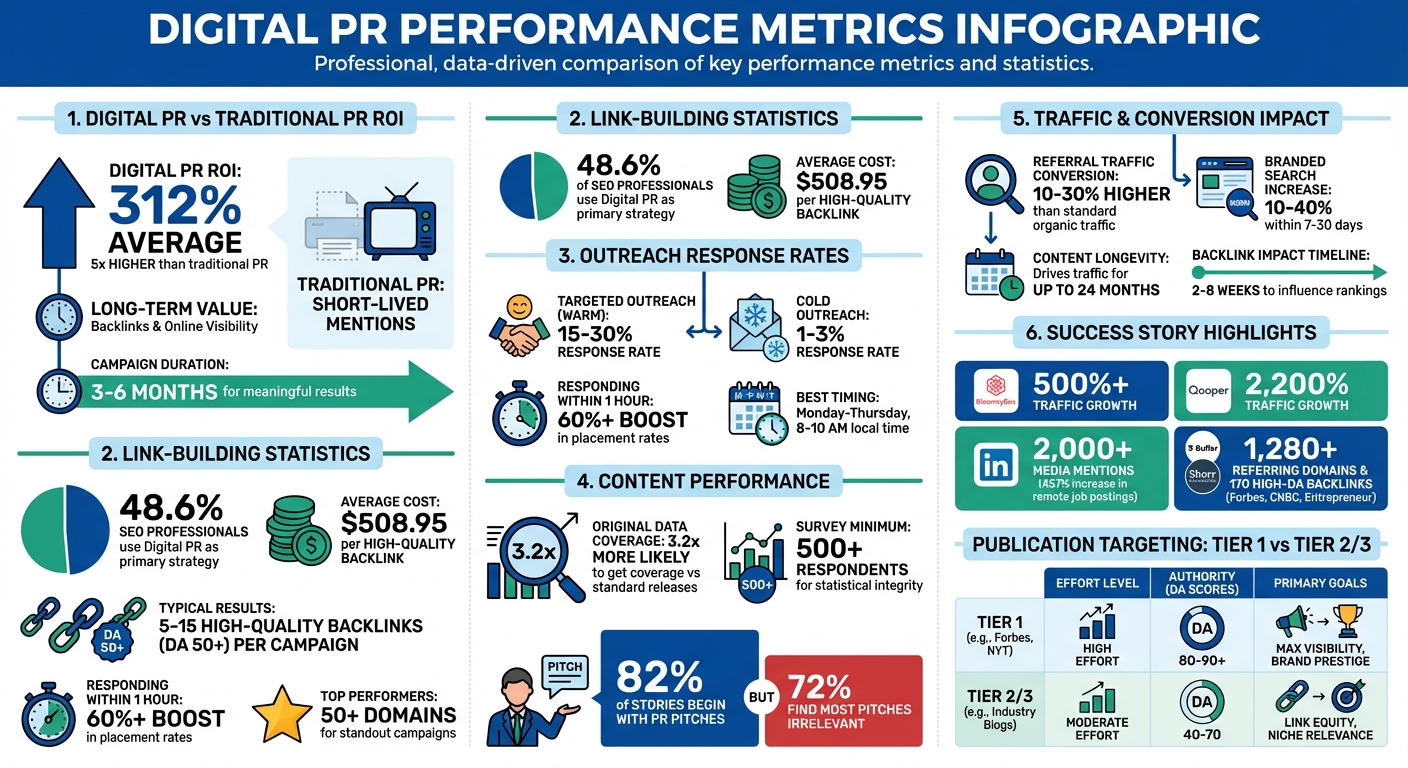
Digital PR vs Traditional PR: ROI, Response Rates, and Link-Building Performance Comparison
Core Strategies for Building Authority and Earning Backlinks
These strategies are designed to elevate your digital PR efforts, enhancing SEO performance, building authority, and driving measurable growth. The key is to create content that journalists feel compelled to cite. In 2026, the focus shifts to becoming a trusted source of original data, expert insights, or shareable assets that align with a journalist’s story. This approach naturally earns editorial backlinks.
Nearly half (48.6%) of SEO professionals now rely on digital PR as their primary link-building strategies. While outdated link schemes risk penalties, genuine editorial coverage from reputable publications signals trustworthiness to search engines and AI platforms like ChatGPT and Perplexity. Let’s explore how targeted media outreach and data-driven content can solidify your authority.
Media Outreach with an SEO Edge
Traditional media outreach often casts too wide a net. Instead, SEO-focused outreach hones in on journalists who have recently covered your specific topic, ensuring your pitch is relevant to their audience. This approach significantly improves response rates – targeted outreach to warm contacts yields 15–30% response rates, compared to just 1–3% for cold outreach.
Relevance trumps vanity metrics. A backlink from a Domain Authority (DA) 60 site that aligns with your industry and drives traffic is far more valuable than a DA 80 link from an unrelated site. To fine-tune your media list, focus on journalists who have written about your topic within the past 60–90 days rather than relying solely on domain authority rankings.
Timing also matters. Pitch stories Monday through Thursday, between 8–10 AM local time, for better response rates. When using platforms like Connectively (formerly HARO), Qwoted, or Featured.com to respond to journalist queries, acting within an hour can boost placement rates by over 60%. These platforms connect you directly with journalists seeking expert commentary, offering a time-efficient way to secure high-quality backlinks.
"Speed can make or break your link-building campaign in reactive PR." – Mike Khorev, SEO Consultant
Technical precision is equally important. Ensure backlinks are placed within the editorial body of articles, not in footers or sidebars, to maximize their SEO value. Use tools like Google Alerts to monitor unlinked brand mentions and request links only when editorially appropriate. This targeted approach sets the stage for creating impactful, data-driven content.
Crafting Data-Driven Content That Gets Noticed
Original research positions your brand as a primary source that journalists naturally cite. Data-driven content stands out because it offers unique insights that are difficult to replicate without proper attribution. When journalists use your statistics, they’re compelled to link back to your content, leading to organic backlink growth.
Journalists are 3.2 times more likely to cover stories featuring original data compared to standard press releases. While companies spend an average of $508.95 per high-quality backlink, the editorial credibility and long-term SEO benefits make this investment worthwhile.
A great example is Asana’s "State of Work Innovation" report, which surveyed 13,000 knowledge workers across six countries in 2024–2025. This effort earned them editorial coverage and backlinks from major outlets like VentureBeat and Forbes. Similarly, LinkedIn’s analysis of platform data revealed a 457% increase in remote job postings over a year, resulting in over 2,000 media mentions and valuable backlinks.
The most effective data formats include:
- Indexes and rankings that are easy to headline and localize
- Benchmarks answering "What is normal?" for an industry
- Myth-busting studies that challenge widely held beliefs
- Interactive tools like calculators that offer immediate value
For survey-based research, aim for at least 500 respondents to ensure statistical integrity.
"Links do not show up because content exists. Links show up when your content becomes a source other writers need." – Bradley Bernake, OutReachFrog
Make your data accessible by creating a "press kit" for every campaign. Include a one-paragraph summary, 3–5 pre-written pull quotes, and a set of charts that editors can easily incorporate into their articles. This minimizes friction for journalists and increases the likelihood of coverage. Keep in mind that 82% of journalists say their stories often begin with PR pitches, but 72% find most pitches irrelevant. Your job is to ensure yours stands out.
Developing High-Impact Content Assets
Creating "authority nodes" – reference-grade assets that become go-to resources in your industry – builds lasting momentum through passive citations. These assets include definitive guides, interactive tools, and annual reports that consistently attract backlinks.
The secret is offering something exclusive to your site that can’t be easily replicated elsewhere. For example, interactive tools like ROI calculators or benchmarking tools draw backlinks because users must visit your site to access them. These assets often attract links from educational institutions, industry associations, and media outlets curating valuable resources for their audiences.
A standout example is Visit Iceland’s "Looks like you need Iceland" campaign. By letting users "scream" into speakers set in Icelandic landscapes, they created an emotional, interactive experience. The campaign generated 2.5 billion impressions in just two weeks, earned multiple industry awards, and gained extensive media coverage.
To make your content "linkable", focus on solving problems, answering questions, or providing data that supports claims other writers need to make. Annual reports and industry benchmarks often become enduring reference points, accumulating backlinks over time. For instance, Buffer’s "State of Social" campaign, based on original industry research, earned over 1,280 referring domains.
Digital PR campaigns typically yield 5–15 high-quality backlinks from sites with a DA of 50+, with standout assets earning coverage from 50+ domains. Shorr Packaging’s original research campaign secured 170 high-DA backlinks from outlets like Forbes, CNBC, and Entrepreneur, while SafeHome.org achieved 100% editorial links (DA 84–92+) from prestigious publications like the Chicago Tribune and SeattlePI.
Investing in asset development pays off far beyond immediate backlinks. These "authority nodes" strengthen E-E-A-T (Experience, Expertise, Authoritativeness, Trustworthiness) by building brand citations and enhancing relevance in Google’s Knowledge Graph. As AI search engines increasingly rely on brand mentions to verify credibility, these editorial placements become essential trust signals for platforms like ChatGPT, Perplexity, and Gemini.
sbb-itb-7a53647
Tools and Resources for Digital PR Campaigns
The right tools can transform digital PR from guesswork into a precise, data-focused strategy. By 2026, an impressive 95.9% of digital PR professionals will rely on data-driven content as their go-to approach. To stay ahead, you need platforms that help you catch trends early, connect with the right journalists, and measure your campaign’s impact on backlinks and traffic.
Content and Topic Research Tools
A strong story angle is the backbone of any successful campaign. Tools like BuzzSumo help you stay on top of trends by analyzing 8 billion articles and maintaining updated profiles for 330,000 journalists each month. Subscriptions range from $199 to $999 per month.
Exploding Topics uses advanced algorithms to identify rising trends well before they hit the mainstream. For example, it flagged "AI image enhancers" when searches were at just 3,000 per month – well before they surged to 98,000 monthly searches. This foresight lets you create content before the competition catches on. Plans start at $39/month (billed annually).
Semrush Topic Research zeroes in on "Trending subtopics" that have gained traction over the past 60 days, along with related questions and top headlines. Starting at $149/month, the Semrush AI PR Toolkit also ensures your brand stands out in AI-generated search results – a growing concern as tools like ChatGPT and Perplexity reshape search habits.
When it comes to monitoring real-time opportunities, Brand24 and Nexis Newsdesk track brand mentions and consumer sentiment across social media and news outlets. Even Google Alerts, a free tool, remains a staple for keeping tabs on mentions across blogs, forums, and news sites. These tools ensure you can jump on breaking news cycles where your expertise fits.
But research alone isn’t enough – you also need tools to connect with the right journalists.
Media Database and Outreach Tools
Finding the right journalist is becoming increasingly difficult. In fact, 60.8% of PR professionals say this task has grown more challenging over the past year. This is why many turn to platforms like Muck Rack (used by 46.6% of professionals) and BuzzStream (used by 44.6%) for building media lists. Interestingly, manual list-building is also on the rise, with 32.4% of professionals opting for this approach in 2026.
PressReacher simplifies this process with its AI-powered journalist database, which spans millions of contacts across 60,000+ publications. It offers human-verified emails, readership insights, and editorial calendars to ensure your pitches land in the right inboxes. Plans start at £134/month, with no long-term commitments.
"PressReacher has completely changed how I find and pitch journalists. The search is genuinely impressive. I find the right contacts in minutes, not hours." – Becca Marsh, PR Executive
For connecting with journalists actively seeking expert commentary, platforms like Connectively (formerly HARO), Qwoted, and Featured.com are invaluable. Connectively sends out three daily digests and remains the largest journalist-sourcing network. Qwoted specializes in finance and B2B sectors, offering expert-verified profiles and direct messaging. Meanwhile, Featured.com is ideal for marketing, tech, and productivity niches.
Precision in outreach is key to improving response rates. Tools like BuzzStream’s ListIQ generate targeted media lists directly from news searches, ensuring your pitches are relevant. Additionally, Semrush’s Backlink Gap tool identifies publications linking to competitors but not your brand, giving you a clear direction for outreach.
Building a Data-Driven Digital PR Strategy
Having the right tools is just the start – what truly makes digital PR effective is a strategy rooted in data. A well-thought-out approach turns tools into precise outreach mechanisms. With over 67% of marketers identifying digital PR as the best way to earn backlinks from high-quality websites, it’s clear this method works. But success isn’t just about sending out pitches. You need to know your audience, prioritize the right publications, and craft pitches that truly connect.
Audience Research and Persona Development
Before you start pitching, you need to understand your audience on a deeper level. Go beyond basic demographics and focus on psychographic segmentation – the values, attitudes, and beliefs that drive decisions. This is what separates campaigns that hit home from those that fall flat.
A great way to start is by talking to your customer-facing teams. Sales reps and call center staff often hear the same questions, concerns, and frustrations repeatedly. Their insights can help you pinpoint what your audience actually cares about. From there, map out your audience’s journey, focusing on their challenges and goals. Remember, your brand isn’t the hero of the story – they are. Your role is to be the guide that helps them achieve success.
"You have to know who you are talking to before you start doing the talking." – Holland Gormley, Outreach and Education Specialist, U.S. Copyright Office
Consider Patagonia as an example. By creating "The Activist" persona – centered around anti-consumerism and climate concerns – they launched their 2011 "Don’t Buy This Jacket" campaign. Despite urging customers not to buy, their deep understanding of audience values led to a 30% increase in sales. Similarly, Xero, an accounting software company, segmented its audience into small business owners and accountants. When the UK introduced "Making Tax Digital", Xero developed a resource hub with tailored FAQs. This targeted strategy performed so well that it temporarily outranked official UK government pages in search results.
Once you’ve defined your personas, use them to identify the media outlets your audience actually follows. Companies that implement buyer personas see 24% more leads and experience 36% shorter sales cycles. These insights can help you ensure your pitches land where they’ll make the most impact.
Tiered Publication Targeting and Outreach
Using audience insights, you can prioritize your media targets strategically. A tiered targeting approach ensures your efforts are focused where they’ll deliver the biggest returns. This means reserving high-effort campaigns for top-tier outlets while scaling outreach for more niche publications.
- Tier 1: These are national and global outlets like Forbes, CNBC, or The Wall Street Journal, with Domain Authority (DA) scores of 70 or higher. These placements offer unparalleled visibility and link equity. A single link from a DA 80+ publication can outweigh hundreds from lower-authority sites. However, these outlets demand original data, exclusive insights, or breaking news.
- Tier 2: This includes trade press and industry-specific outlets with DA scores between 40 and 70. While their reach is smaller, they often provide better engagement and a more targeted audience.
- Tier 3: These are niche blogs and local news sites. While easier to secure, they should still meet quality benchmarks like organic traffic above 1,000 visits per month and a consistent publishing schedule.
| Aspect | Tier 1 (Premium Media) | Tier 2/3 (Niche/Blogger) |
|---|---|---|
| Primary Goal | Brand Authority & Massive Reach | SEO Link Velocity & Targeted Traffic |
| Target | Journalists & Editors | Webmasters & Industry Bloggers |
| Authority | Very High (DA 70-90+) | Moderate (DA 30-60) |
| Effort | High (Requires original data/news) | Moderate (Scalable outreach) |
Start with a link gap analysis to identify publications that link to your competitors but not to you. These outlets are already interested in your industry, making them prime targets. Prioritize based on how well their audience aligns with yours, not just their DA. Sometimes, a slightly lower DA outlet with a perfect audience match delivers better results than a high-DA site with minimal relevance.
Another effective tactic is offering exclusives to Tier 1 outlets. Giving a major publication first access to your insights significantly improves your chances of coverage. Once the story runs, you can pitch a broader angle to Tier 2 and Tier 3 outlets.
Customizing and Personalizing Media Pitches
Generic outreach doesn’t work. Journalists receive hundreds of emails weekly, so personalization is key to standing out.
Start by addressing journalists by name and referencing their recent work. Show that you’ve read their articles and understand their focus. Keep pitches short – under 200 words – to ensure they’re easy to read on smartphones. Lead with your most compelling data point or quote to make it easy for them to incorporate into their story.
Timing is also crucial. Responding to journalist queries within the first hour boosts placement rates by over 60%. Platforms like Connectively, Qwoted, and Featured.com can help by connecting you with reporters actively seeking expert commentary.
Before pitching, build relationships with journalists. Engage with them on social media, cite their work in your content, or leave thoughtful comments on their articles. These small actions can increase your response rate by up to 10 times.
Finally, include a "chart pack" with your pitch – simple, well-labeled visuals that journalists can easily embed in their articles. If you’re working with a large dataset, break it into smaller, targeted segments. This approach increases the number of outlets that can cover your story.
Measuring ROI and Performance of Digital PR Campaigns
Once you’ve set your digital PR strategies in motion, the next step is to measure their success. Without solid metrics, you’re left guessing about the impact of your efforts. In fact, over 70% of PR professionals say the digital landscape has become more complicated in the past year, making it harder to prove PR’s value. Gini Dietrich, Founder of Spin Sucks, sums it up perfectly:
"I always say it’s the bane of our existence. You know if you have great PR, and you know if you have bad PR. But you don’t know how to measure it".
The solution? Focus on tracking metrics that connect directly to your business goals. This approach ties digital PR efforts to measurable growth.
Key Metrics to Track for Digital PR Success
When it comes to backlinks, quality beats quantity every time. A single authoritative link from a trusted site can do more for your SEO than dozens of links from less relevant sources. Metrics like Domain Authority (DA), Page Authority (PA), and topical relevance should guide your evaluation. Tools such as Google Search Console and Ahrefs are great for identifying which placements are boosting your keyword rankings.
UTM parameters can help you track referral traffic, while monitoring sentiment across platforms offers insights into both short-term and long-term brand perception. Even unlinked mentions can be valuable, as they contribute to your share-of-voice and may highlight potential reputation concerns. Additionally, track lead-generating actions like webinar sign-ups, whitepaper downloads, or demo requests that stem from traffic driven by PR efforts.
With AI-powered search becoming more common, it’s also important to track how often your brand appears in tools like Google AI Overviews, ChatGPT, Claude, or Perplexity. Tools like Peekaboo can help you monitor your visibility in zero-click search environments, where users get answers without clicking through to your site.
| Metric Category | Key Metrics | Business Objective Alignment |
|---|---|---|
| SEO / Authority | Backlinks, DA/PA, Keyword Rankings | Improves search visibility and reduces paid media costs. |
| Brand Awareness | Media Mentions, Social Engagement, Share of Voice | Builds brand reputation and expands reach. |
| Engagement | Referral Traffic, Time on Page, CTR | Tracks audience interest and content effectiveness. |
| Conversion | Lead Gen, Downloads, Sales | Ties PR efforts directly to revenue and growth. |
| Reputation | Sentiment Analysis, Unlinked Mentions | Monitors brand health and addresses potential risks. |
By gathering data in these areas, you can translate insights into actionable business results.
Presenting Results to Stakeholders
Once you’ve gathered your data, the next step is presenting it in a way that resonates with stakeholders. Executives care about how PR affects revenue – not vanity metrics. Use tools like Looker Studio or Power BI to create dashboards that link PR activities to key business outcomes. For example, show how a surge in media mentions led to higher organic traffic, which then generated qualified leads and sales.
Go beyond last-click attribution to show the full journey – from media coverage to backlinks, ranking improvements, and eventual conversions. Since backlinks can take two to eight weeks to influence rankings, use correlation windows to track search performance improvements after a PR push. Efficiency metrics, like "Links per 1,000 mentions", can also help benchmark outreach efforts.
Combine numbers with narratives. Pair quantitative data with qualitative insights, such as notable headlines or mentions of your CEO in high-profile outlets. Visualize how sentiment has shifted over time and connect positive coverage to an increase in search volume for your brand. When stakeholders see that digital PR can lower paid media costs, drive qualified traffic, and directly contribute to conversions, it creates a strong case for continued investment.
Conclusion: Growing Your Business Through Digital PR
By leveraging proven methods to earn backlinks and improve SEO, digital PR can turn your brand’s visibility into measurable growth. With an average ROI of 312%, digital PR outpaces traditional PR efforts by 3–5 times. Its content remains online indefinitely, continuing to drive traffic and generate leads for up to 24 months. Companies running consistent campaigns see 3 to 5 times more high-authority backlinks than those relying solely on outreach, while earned media can increase branded search demand by 10–40% within just 7–30 days.
However, success in digital PR takes time. Most campaigns require 3 to 6 months of steady effort before you’ll notice meaningful gains in domain authority and organic traffic. On top of that, referral traffic from earned links tends to convert at a rate 10% to 30% higher than standard organic traffic.
To get the most out of digital PR, it’s essential to align it with your broader SEO and content marketing strategies rather than treating it as a standalone effort. Building strong relationships with journalists early on, producing original research that offers genuine value, and focusing on key metrics like backlinks, referral traffic, and conversions (instead of just media mentions) are all crucial steps.
"Trust tends to rise more from credible third-party mentions than from paid ads." – Steve Morris, CEO and Founder of NEWMEDIA.COM
Earning trust through authoritative placements establishes a lasting brand presence that supports long-term growth. By integrating these digital PR strategies into your overall marketing plan, you can set your business on a path toward sustained success and industry leadership.
FAQs
How do I know which publications are worth targeting?
To make the most impact, focus on publications that align closely with your industry and cater to your target audience. Look for outlets with strong authority – think domain authority of 80 or higher – and a reputation for publishing trustworthy, data-backed content. Prioritize platforms that actively cover topics relevant to your brand and are eager for expert input or fresh data. Tools like Qwoted or similar services can connect you with these opportunities. Respond quickly to inquiries to boost your chances of gaining media coverage and earning valuable backlinks.
What type of original data is easiest to pitch and earn links from?
The best types of original data that attract links include original research, data visualizations, interactive tools, and industry benchmarks. These formats provide useful insights and resources that resonate with publishers and journalists, making them highly shareable and great for earning backlinks.
How can I tie digital PR links to leads and revenue?
To tie digital PR efforts directly to leads and revenue, the key lies in creating high-impact, shareable content. Think along the lines of original research, detailed reports, or eye-catching data visualizations. These types of assets naturally attract authoritative backlinks, which not only boost your search rankings but also drive highly targeted traffic to your site.
Another crucial element? Building strong relationships with journalists and media outlets. Personalized outreach is essential here. By tailoring your communication to each journalist or outlet, you increase the likelihood of your content being featured in reputable publications. The result? Greater brand visibility, enhanced credibility, and a higher chance of attracting qualified leads that convert into sales.