The way we build links for SEO has changed. Bulk link-building tactics like directory submissions and guest posts are now outdated and risky due to Google’s AI-powered updates. Instead, Digital PR link building focuses on earning high-quality links through trust, relationships, and newsworthy content.
Here’s why Digital PR is taking over:
- Quality over quantity: A single link from a high-authority site (DA 80+) is more valuable than hundreds of low-quality links.
- Relationship-driven: Building connections with journalists leads to editorial mentions that Google rewards.
- SEO benefits: Digital PR strengthens your brand’s authority, boosts rankings, and increases referral traffic.
To succeed, focus on creating unique, data-backed content, building genuine relationships with journalists, and using tools like HARO to secure placements. Track your success by monitoring organic traffic, branded searches, and referral traffic. Digital PR isn’t just a link-building strategy – it’s a way to build lasting authority online.
Why Digital PR Link Building Beats Traditional Backlinks
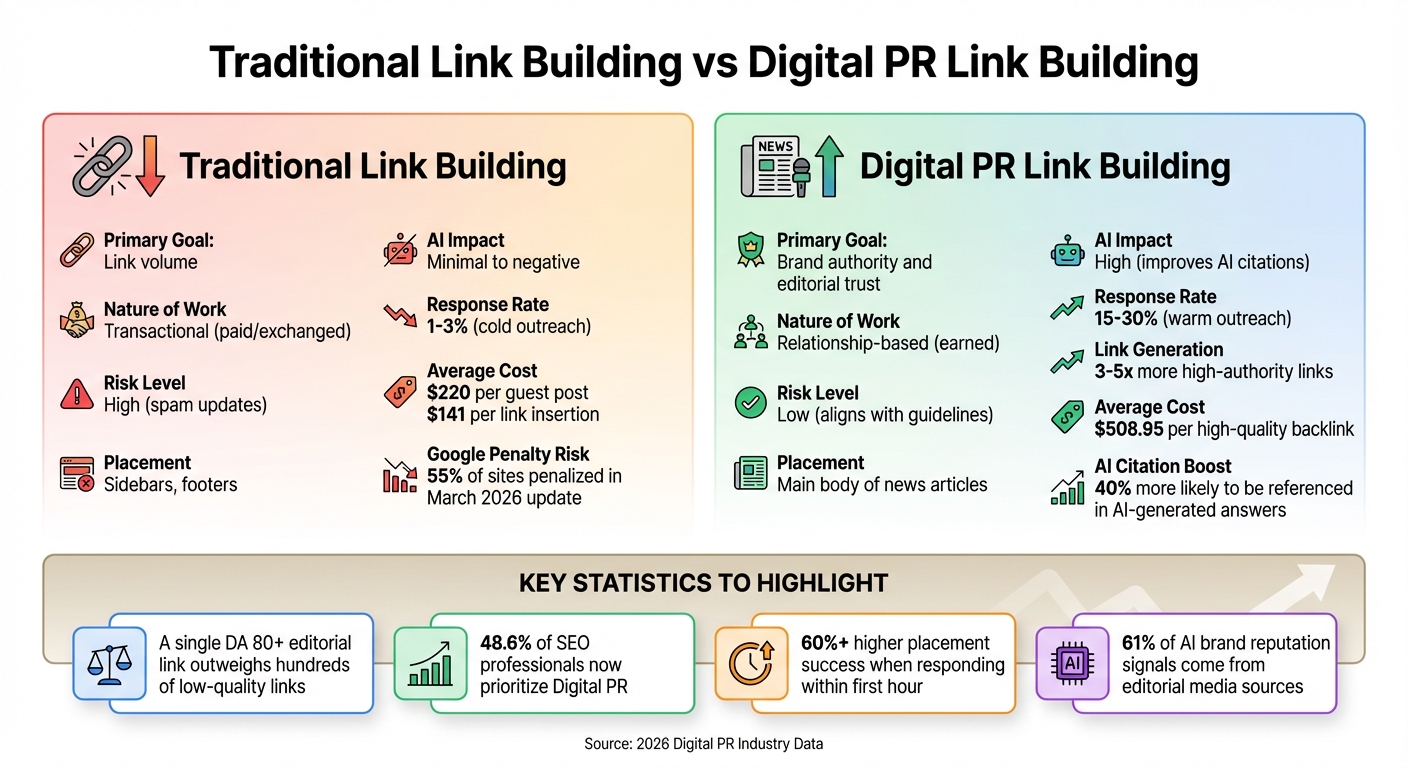
Traditional Link Building vs Digital PR Link Building Comparison
From Volume to Value
In the past, traditional link building was all about quantity – gathering as many links as possible through bulk strategies. But Google’s algorithms have grown far more sophisticated, shifting the focus from sheer numbers to quality.
Fast forward to 2026, and a single editorial link from a DA 80+ news outlet can outweigh hundreds of links from low-quality directories or link farms. Google’s March 2026 update cracked down on "scaled content abuse", penalizing 55% of affected sites in just two weeks. This update specifically devalued sponsored guest posts on generalist sites. In contrast, companies running consistent Digital PR campaigns are now earning 3 to 5 times more high-authority links compared to those sticking with traditional outreach methods.
The difference lies in placement and relevance. Digital PR links are naturally embedded within the main content of articles, while traditional backlinks often end up in less impactful spots like footers, sidebars, or author bios. Google’s current algorithm also prioritizes topical relevance over raw Domain Authority. For example, a DA 60 niche trade publication that’s closely aligned with your industry can provide more SEO value than a DA 80 general interest site covering unrelated topics.
This evolution highlights the growing importance of relationship-driven outreach over transactional tactics.
Relationships vs. Transactions
Traditional link building often depends on one-off paid arrangements, like guest posts (which average $220) or link insertions (around $141 each). On the other hand, Digital PR focuses on building long-term relationships with journalists and industry insiders who can repeatedly reference your work.
The numbers speak for themselves: warm outreach to established contacts results in a 15–30% response rate, compared to a mere 1–3% for cold outreach. Timing is also key. Responding to a journalist’s query within the first hour on platforms like Connectively or Qwoted can boost your chances of securing a placement by over 60%. As Jolissa Skow, a Content Strategist, aptly put it:
"Relationships compound, transactions don’t."
Google’s AI-powered SpamBrain now flags and devalues links from guest post marketplaces and paid link networks. This makes transactional link building not just ineffective but risky, as it can lead to spam penalties.
SEO Impact of Digital PR Links
Digital PR links go beyond just improving link quality – they significantly enhance your SEO by strengthening E-E-A-T signals (Experience, Expertise, Authoritativeness, and Trust), driving relevant referral traffic, and boosting visibility in AI-driven search results.
By associating your brand with respected publications and recognized experts, Digital PR links elevate your E-E-A-T profile. They also attract engaged audiences who are genuinely interested in your industry, bringing in meaningful referral traffic. Moreover, these links can improve how often AI search engines like ChatGPT and Perplexity cite your brand. These AI tools prioritize credible sources and repeated mentions from authoritative news outlets. A study of 1,000 domains revealed a strong correlation between high-quality backlinks (measured by Authority Score) and mentions in AI-generated answers.
As John Mueller, Google’s Search Advocate, explained:
"I would tend not to focus on the total number of links to your site… there could be one really good link from a really good website out there that is for us a really important sign."
| Feature | Traditional Link Building | Digital PR Link Building |
|---|---|---|
| Primary Goal | Link volume | Brand authority and editorial trust |
| Nature of Work | Transactional (paid/exchanged) | Relationship-based (earned) |
| Risk Level | High (spam updates) | Low (aligns with guidelines) |
| Placement | Sidebars, footers | Main body of news articles |
| AI Impact | Minimal to negative | High (improves AI citations) |
sbb-itb-7a53647
Benefits of Digital PR Link Building
Digital PR link building goes beyond boosting SEO – it strengthens brand credibility, increases traffic, and expands audience reach.
Better Credibility and Authority
When a well-known news outlet mentions your brand, it sends a strong signal of trust to both search engines and potential customers. These mentions help search engines connect your brand to specific topics and areas of expertise within their Knowledge Graph.
Here’s some evidence: Brands with 20% more media mentions experienced a 15% boost in organic search traffic, even when their backlink profiles didn’t change. Trusted editorial citations outperform self-placed links by significantly elevating your E-E-A-T signals (Experience, Expertise, Authoritativeness, and Trustworthiness). In fact, 65% of top-ranking pages for competitive keywords in 2025 were backed by numerous unlinked brand mentions in high-authority media outlets.
AI-driven search results also favor brands with consistent media coverage. For instance, in 2024, AI-generated answers were 40% more likely to reference brands that had been mentioned in recent news stories. This means Digital PR not only strengthens your traditional SEO but also positions your brand as a trusted source for AI-driven tools like ChatGPT and Gemini. The result? Higher search rankings and better visitor engagement.
More Organic Traffic and Higher Rankings
Digital PR links work seamlessly with modern search algorithms to deliver results. Unlike paid placements, which Google’s SpamBrain often flags or devalues, editorial links from trusted sources remain highly effective. Backlinks continue to be the second most influential ranking factor, right after content relevance. Consistent efforts in Digital PR help create a strong, high-authority link profile.
But it’s not just about rankings. These links also drive qualified referral traffic. Readers coming from editorial mentions tend to be highly engaged, with low bounce rates and longer time spent on your site. These behaviors further reinforce your organic search performance.
Wider Audience Reach
Digital PR doesn’t just improve rankings – it opens the door to new audiences. When journalists feature your research or quote your experts, your brand gets introduced to potentially massive readerships.
This exposure can snowball. For example, a single data study can lead to coverage across multiple publications, reaching countless new readers. By 2026, 34% of SEO professionals identified Digital PR as their most effective link-building strategy – nearly double the rate of scaling guest posting campaigns.
Additionally, as AI tools increasingly rely on credible news sources, brands with a strong Digital PR presence are more likely to be cited. This creates a virtuous cycle: media coverage leads to AI citations, which drive brand searches and reinforce your authority in Google’s eyes. Digital PR is clearly the next step in link building, aligning high-quality brand mentions with the demands of modern SEO.
How to Win with Digital PR Link Building
Digital PR can work for businesses of all sizes. Whether you’re running a small operation or a medium-sized company, you can compete effectively by focusing on creating standout content, building meaningful connections, and using the right tools. The trick? Work smarter, not harder. Here are three practical strategies to step up your Digital PR link-building game.
Create Newsworthy Content
Journalists don’t link to just any content – they link to content that serves as a valuable resource. If your content can make a journalist’s job easier, you’re far more likely to earn a link. As Bradley Bernake from OutReachFrog explains:
"Links do not show up because content exists. Links show up when your content becomes a source other writers need."
The goal is to create what’s known as "Authority Nodes." These are high-quality, reference-worthy assets that others in your industry will naturally want to link to. Examples include original surveys with 500+ participants, industry reports, cost calculators, or myth-busting studies. Take Kwikset’s campaign in 2024–2025 as an example – they conducted a nationwide study on holiday security habits and paired it with an interactive burglary statistics tool. The result? 143 backlinks with an average Domain Authority of 58 and a 27% boost in branded search volume.
To make your content even more appealing, reduce editorial friction. Provide journalists with ready-to-use assets like a concise summary, headline stats with context, expert quotes, and visually appealing charts. You can also localize national data by breaking it down into regional insights to make your pitches more tailored.
Remember, relevance often outweighs domain metrics. A link from a niche publication relevant to your industry can be more valuable than one from a high-domain site that’s unrelated. This aligns with Google’s 2026 updates, which emphasize topical relevance over sheer Domain Authority. Plus, original data studies tend to offer the "information gain" that AI tools like ChatGPT and Google AI Overviews prioritize for citations.
Build Relationships with Journalists
Building genuine relationships with journalists is crucial for long-term success. Cold outreach often has a low response rate (1–3%), but warm outreach to established contacts can boost that to 15–30%. Start by identifying journalists who cover your niche and review their recent work from the past 60–90 days to ensure your story aligns with their focus. Tools like Roxhill and Hunter can help you find detailed contact information and track their articles.
Engage with journalists authentically before pitching. Share their work on social media, reference them in your content, or leave thoughtful comments on their posts. When you’re ready to pitch, lead with the most compelling finding or quote rather than a lengthy introduction. Keep your pitch concise (under 200 words) and use bullet points for clarity. Avoid overly promotional language – journalists receive up to 100 email pitches per week, so standing out means being clear and relevant.
Also, watch for unlinked mentions of your brand. If a publication mentions you but doesn’t include a link, reach out with a polite and well-reasoned request. This approach often delivers strong results.
Use Tools like HARO and BuzzSumo
Modern journalist sourcing goes beyond HARO. Platforms like Connectively and Qwoted are becoming essential for staying ahead.
Connectively remains a top choice, offering three digest emails daily (at 6:00 AM, 12:00 PM, and 6:00 PM ET) with journalist requests across various industries. Qwoted provides real-time alerts and direct messaging, making it especially useful for B2B and professional services. Featured.com, on the other hand, pairs expert profiles with specific queries, helping you secure mentions in blogs and newsletters.
For competitive research, tools like Ahrefs and Semrush are indispensable. Use them to conduct link gap analyses, identifying websites that link to your competitors but not to you – these are prime targets. According to recent data, 84% of digital PR professionals rely on Ahrefs for SEO insights, while 56% use BuzzStream for managing outreach and tracking relationships.
Timing is everything. Set up real-time notifications on platforms like Qwoted to respond promptly – the first hour often makes all the difference. Monitoring social media for journalist queries can also help you stay on top of opportunities. When replying to queries, lead with your strongest quote, include a specific stat, and keep your response brief (under 200 words).
While 82% of journalists say PR pitches often spark their stories, 72% complain that most pitches are irrelevant. By running consistent, well-targeted digital PR campaigns, you can earn significantly more high-quality links than through link building strategies alone. The tools and strategies are there – how you use them is up to you.
Measuring Digital PR Campaign Success
Running a Digital PR campaign without tracking results is like driving without a map – you won’t know if you’re heading in the right direction. Metrics are your guide, showing you what’s working, what’s not, and where to focus your efforts. In fact, 82% of PR professionals now measure their campaigns, and 86% agree that measurement is key to proving PR’s value. This shift from guesswork to data-driven decisions has reshaped how businesses approach link building. As Digital PR becomes a core part of SEO strategies, tracking performance is no longer optional – it’s essential.
Key Metrics to Track
Start by monitoring organic traffic growth through tools like Google Analytics. Combine this with keyword ranking data for your target terms. If your campaign is boosting rankings for the phrases that matter most to you, it’s a clear sign your efforts are paying off.
Next, keep an eye on referring domains and link quality. It’s not just about the number of links but their relevance. A link from a niche site in your industry often outweighs one from a general high-authority domain. Tools like Ahrefs can help you assess the Domain Authority of linking sites and identify which pages are attracting the most links. On average, Digital PR campaigns generate 3–5 times more referring domains than traditional link-building strategies for the same investment.
Branded search volume is another important indicator. If more people are searching for your company by name after a campaign, it shows increased interest. Use Google Search Console or Google Trends to track these spikes. For instance, Kwikset’s Digital PR efforts led to a 27% increase in branded search volume.
Referral traffic is another metric that often gets overlooked. By using UTM parameters, you can track how many visitors, leads, and conversions come directly from your PR efforts. As BuzzStream highlights:
"Referral traffic is an under-appreciated success metric from digital PR. It is one of the most direct ways to see the impact of your PR efforts."
With the rise of AI-driven tools and zero-click searches, it’s also crucial to monitor AI visibility. Check if your content appears as a citation in tools like AI Overviews, ChatGPT, or Claude. Research and data studies are particularly effective at earning these citations, which can boost brand awareness even without direct clicks.
Finally, don’t overlook brand sentiment. Track whether mentions of your brand are positive, neutral, or negative. The tone of coverage matters – positive mentions build trust, while even one negative article can harm your reputation.
| Metric Category | What to Track |
|---|---|
| SEO Impact | Organic traffic growth, keyword rankings, Domain Authority of referring sites |
| Brand Awareness | Branded search volume, media mentions, share of voice |
| Engagement | Referral traffic, social shares, time on site from PR-driven visitors |
| ROI | Lead quality, conversion rate, cost per acquisition |
Optimizing and Scaling Campaigns
Use performance data to identify what’s working and double down on successful strategies. For example, data studies often perform well – invest more in creating similar content. Strengthen relationships with journalists and publications that bring in high-quality referrals.
Run a backlink audit every 90 days to spot devalued links, especially from general high-authority sites or thin-content domains. If necessary, disavow these links. Focus on earning links from sources that are relevant to your niche, and don’t forget about unlinked brand mentions – turning these into active links has a success rate of over 30%.
To scale your efforts, systematize your outreach. Respond to journalist queries on platforms like HARO and Qwoted regularly. Follow-up emails can boost your success rate by 65%. Before launching a full campaign, test your ideas with a small group of journalists – this can increase your chances of success by up to 40%.
Lastly, optimize your landing pages for traffic generated by PR campaigns. Use A/B testing to refine calls-to-action and conversion pathways specifically for visitors coming from earned media. Track which placements generate the most valuable leads and use those insights to shape future campaigns. These steps ensure that your Digital PR efforts align with SEO best practices and deliver measurable results.
Conclusion
As SEO continues to evolve, Digital PR has firmly established itself as the go-to strategy, pushing outdated backlink methods into the background. With nearly half (48.6%) of SEO professionals now prioritizing Digital PR for link-building, the trend is undeniable: quality far outweighs quantity. Google’s SpamBrain AI actively penalizes manipulative tactics like guest posts and link exchanges, while rewarding editorial coverage that showcases expertise and trustworthiness.
Securing editorial placements in respected outlets like TechCrunch or niche industry journals creates long-term "Authority Nodes." These nodes act as passive citation generators, signaling to both Google and AI-driven tools like ChatGPT that your brand is a credible and reliable source. Interestingly, 61% of the signals shaping AI’s perception of brand reputation stem from editorial media sources.
At an average cost of $508.95 per high-quality backlink, Digital PR offers more than just SEO perks. It drives referral traffic, boosts branded search volume, and positions your brand as a thought leader. As Nate Nead of PR.Digital aptly puts it:
"Digital PR is link building for adults".
This approach isn’t about quick wins or risky shortcuts – it’s about building credibility that compounds over time.
To succeed with Digital PR, focus on creating newsworthy content backed by original data, cultivate genuine relationships with journalists, and leverage tools like HARO to provide expert insights on trending topics. The benefits go beyond rankings: track your success through organic traffic growth, the quality of referring domains, and branded search volume. Don’t overlook unlinked brand mentions – turning them into active links is another way to amplify results.
The businesses thriving in 2026 aren’t chasing link counts; they’re earning editorial trust. By adopting Digital PR strategies that align with how search engines and AI assess authority, you’re not just climbing the rankings – you’re building a lasting competitive edge with every placement.
FAQs
How do I know if a link is truly “editorial” and safe?
To ensure a link is genuinely editorial and safe, it should come from media coverage that highlights noteworthy, relevant content. These links are earned naturally when credible journalists or editors from respected publications include them because your content adds value or is newsworthy. Steer clear of links from paid placements, sponsored articles, or manipulative schemes to maintain authenticity and adhere to best practices.
What kind of data or assets encourage journalists to link to me?
Journalists tend to link to resources that are trustworthy, relevant, and packed with meaningful insights. Think along the lines of original research, exclusive data, expert analysis, or timely industry updates. Materials that tie into current events or present fresh angles often perform best. The key is to craft well-researched, relevant content that both journalists and their readers will find genuinely helpful.
How long does Digital PR take to improve rankings and traffic?
Digital PR usually begins to impact rankings and traffic within around 90 days. Over time, the effects become more apparent as backlinks and authority signals accumulate, contributing to sustained SEO growth.